
Fair fighting rules are a short set of agreements a couple makes about how they will argue: start gently, stick to one issue, criticise the behaviour rather than the person, never use contempt, take a break when it gets too heated, and repair afterwards. They do not stop disagreements. They stop disagreements from doing damage.
Every couple argues. The Gottman Institute’s research suggests that how a couple argues matters far more than how often, and most of its conflict advice comes down to a handful of habits that keep a disagreement fair. Below are ten fair fighting rules built on that research, with what each one sounds like in practice, and how to turn them into an agreement the two of you actually use.
The 10 rules for fair fighting
1. Choose the time
A fair fight starts before anyone speaks. Raising something important as your partner walks in the door, at midnight, or in front of the children sets the conversation up to fail. Ask first: “Can we talk about the holiday plans tonight after dinner?” If now is not a good time, agree when it will be.
2. Start soft
The Gottman Institute’s guide to softening your start-up makes the case that how a conversation starts predicts how it will end. A harsh opening leaves you with at least as much tension as you began with. A soft one describes the situation, says how you feel and asks for what you need, without blame.
- Harsh: “You never do anything around here.”
- Soft: “I’m feeling swamped with the house this week. Could you take over the washing until Friday?”
Our guide to I-statements versus you-statements covers this shift in more detail.
3. One issue at a time
Bringing every past grievance into one argument, sometimes called kitchen-sinking, makes it impossible to resolve anything. If you are talking about money, talk about money. If another issue matters, note it and agree to come back to it another time.
4. Criticise the behaviour, not the person
There is a big difference between a complaint and a criticism. “You left the dishes again” is about a behaviour you can change. “You’re so lazy” is a verdict on someone’s character, and it invites a defence rather than a change. Criticism is the first of the patterns the Gottman Institute calls the Four Horsemen, all of which fair fighting rules are designed to keep out.
5. No contempt, ever
Contempt is sarcasm, mockery, name-calling, eye-rolling and anything else that communicates “I am better than you”. Of the Four Horsemen, it is the one Gottman’s research links most strongly to relationships breaking down. You can be angry, frustrated and blunt without being contemptuous.
6. Listen to understand, then say it back
Most people spend the other person’s turn preparing their reply. Try something different: before you respond, sum up what you heard. “So you’re saying you feel like the weekends always revolve around my family?” If you got it wrong, they will correct you, and the conversation has moved forward rather than in circles.
7. Own your part
Defensiveness, meeting every complaint with an excuse or a counterattack, keeps an argument going indefinitely. Owning even a small part of the problem changes the temperature. “You’re right, I did forget to call. I’m sorry” is not losing. It is often what lets your partner own their part too.
8. Take a break before it boils over
When an argument gets heated, the body shifts into a stress response, and listening and careful thinking both get much harder. Either of you can call a break, and the break should be long enough to settle, at least twenty minutes, with a time to come back. “I’m too wound up to listen properly. Can we pick this up at eight?” is fair. Walking out without a word is not. Our guide to de-escalation techniques covers how to bring the heat down before you need a break at all.
9. Make repair attempts, and accept them
A repair attempt is anything that stops an argument spiralling: a joke, a touch, an apology, or something as simple as “Let me try that again”. The Gottman Institute lists the six skills of constructive conflict management as softening your start-up, accepting influence, making effective repairs, de-escalating, soothing yourself and your partner, and compromise. Repairs only work if they are received, so when your partner reaches out mid-argument, take it.
10. Finish with a next step, not a winner
A fair fight ends with something you will both do differently, not with one person conceding. That might be a small trial (“Let’s try alternating weekends for a month”), a compromise, or simply agreeing that you now understand each other better and will come back to it. Many disagreements between couples are about lasting differences that are managed rather than solved, so understanding each other is a real result.
What is off-limits in a fair fight
Some moves are unfair whatever the issue. Agree that these are off the table:
- threats to leave or end the relationship, used to win a point
- name-calling, swearing at each other, or put-downs
- bringing up a partner’s insecurities or things told in confidence
- arguing in front of children, friends or family
- the silent treatment as a punishment, rather than an agreed break
How to write your own fair fighting agreement
Rules work best when you choose them together, at a calm moment, rather than one person announcing them mid-argument.
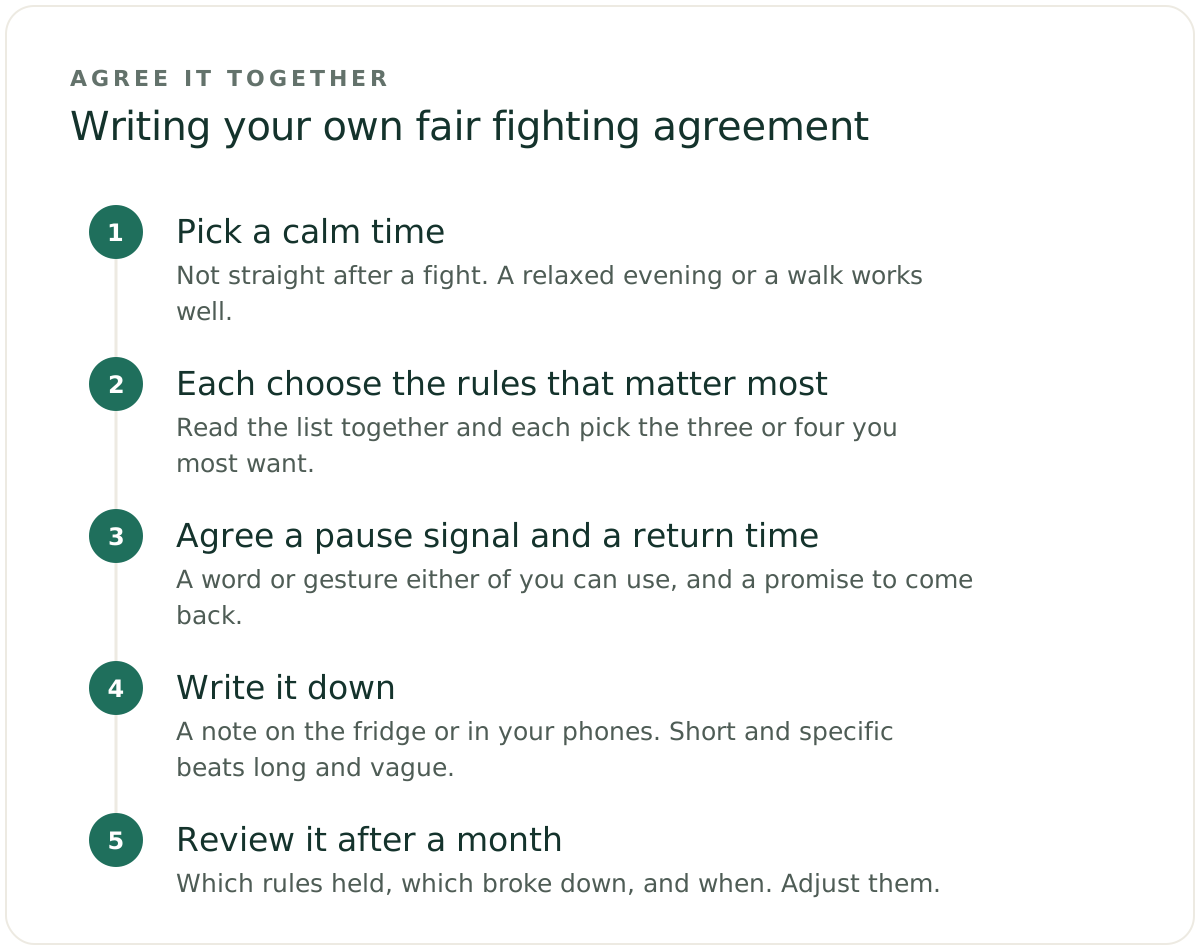
- Pick a calm time. Not straight after a fight. A relaxed evening or a walk works well.
- Each choose the rules that matter most. Read the list above together and each pick the three or four you most want. You will often find your partner’s list says a lot about how arguments feel from their side.
- Agree a pause signal and a return time. A word or gesture either of you can use, and a promise to come back within a set time.
- Write it down. A note on the fridge or in your phones. Short and specific beats long and vague.
- Review it after a month. Which rules held? Which ones broke down, and when? Adjust them.
Expect to break the rules sometimes. The point is not a perfect record. It is having something to come back to: “We said one issue at a time. Can we park the money stuff?”
When fair fighting rules are not enough
Fair fighting rules assume two people who both feel safe and both want to sort things out. They are not a fix for a relationship where one person frightens, threatens, controls or hurts the other, and asking someone to argue fairly with a partner like that puts the burden in the wrong place. If that sounds familiar, contact 1800RESPECT on 1800 737 732 for confidential support, or 000 in an emergency.
If you keep to the rules and the same argument still goes nowhere for months, that is a sign it may be time for a couples counsellor.
Where FairTalk fits in
Fair fighting rules are easy to agree on and hard to keep when you are upset. FairTalk gives the conversation a fair structure from the outset. You talk the issue through together while FairTalk listens without taking sides, and either of you can pause if it gets heated. Afterwards, you both get a fair picture of each other’s perspective and a way forward you have shaped together, along with guidance on the communication skills each of you could build.
If your partner is not ready to talk, the solo session feature lets you work through your own side first. FairTalk is not therapy, and it is not suitable where there is abuse, coercion or a power imbalance.
Frequently asked questions
What are the rules of fair fighting?
The core rules of fair fighting are to choose a good time, start gently, stick to one issue, criticise the behaviour rather than the person, never use contempt, listen and say back what you heard, own your part, take a break when it gets too heated, make and accept repair attempts, and finish with a next step. The details vary from couple to couple, so the best rules are the ones you agree together.
What does Gottman say about fighting fair?
The Gottman Institute’s research suggests that how couples argue matters more than how often. Its advice centres on softening how you start a difficult conversation, avoiding criticism, contempt, defensiveness and stonewalling, making and accepting repair attempts, and taking a break when either person is overwhelmed. It describes six skills of constructive conflict: soft start-up, accepting influence, repair, de-escalation, soothing and compromise.
What is a soft start-up?
A soft start-up is a gentle way to raise a problem: you describe the situation, say how you feel, and ask for what you need, without blaming your partner. For example, “I’m feeling stretched this week. Could you take over dinners until Friday?” instead of “You never help.” The Gottman Institute’s research suggests that how an argument starts strongly predicts how it ends.
How long should a break be during an argument?
At least twenty minutes, which gives a stressed body time to settle. Agree a time to come back to the conversation before you step away, so the break does not feel like being walked out on. Use the time to calm down rather than to rehearse your next argument.
What should never be said in an argument?
Avoid threats to leave, name-calling, put-downs, mockery and anything that uses a partner’s insecurities or confidences against them. Contempt in particular, such as sarcasm, eye-rolling or treating your partner as beneath you, does lasting harm. If an argument ever involves fear or threats, that is a safety issue rather than a communication problem.