
The most common relationship problems are everyday ones: money, sharing the housework, not enough time together, expectations that do not match, family and in-laws, and stress from outside the relationship. Most can be worked through by raising them early, calmly and specifically, as a problem you share rather than a fault in your partner.
This guide covers each of those problems, what tends to sit underneath them, and what to actually say. It is written for everyday problems between two adults who both feel safe with each other. If your relationship involves fear, threats, control or violence, that is not a communication problem. Contact 1800RESPECT on 1800 737 732, or 000 in an emergency.
What are the most common relationship problems?
Relationships Australia asks Australians what puts pressure on their most important relationship. In its national survey, the most common pressures were study or work commitments (25.8%), mental health (22.1%) and money problems (20%). Among people visiting its website for help, unfulfilled expectations (43%), division of household tasks (32%) and money problems (31%) also ranked high.
The Gottman Institute adds a useful distinction. Some problems are solvable, and it lists housecleaning, disciplining children, sex and in-laws as common examples. Others are perpetual: lasting differences in personality or preference that a couple manages rather than settles. Its research puts perpetual problems at sixty-nine percent of relationship conflict. That is not a reason for despair. It means the goal is often a better conversation, not a final answer.
1. Money
Money arguments are rarely only about the number. They tend to be about security, freedom, fairness and trust.
What it often sounds like: “You spent how much?” or “Why do I have to justify every coffee?”
What can sit underneath: worry about the future, a different family history with money, or feeling that the spending decisions are not shared.
How to talk about it:
- Talk about money when nothing has just gone wrong, not straight after a big bill.
- Start with what money means to each of you: “Growing up, money was always tight, so a low balance makes me anxious.”
- Agree on a few shared rules, such as a spending amount either of you can use without checking in.
The government’s Moneysmart site makes the point that a few simple conversations early on help couples understand each other and manage money together. One boundary matters here: if one partner controls all the money, restricts access to it or demands accounts of every dollar, that can be financial abuse, and 1800RESPECT can help.
2. Housework and the mental load
Who does what at home is one of the most persistent sources of friction. The Australian Bureau of Statistics found in its 2024 time use survey that women spent an average of 4 hours 53 minutes a day on unpaid work, compared with 3 hours 52 minutes for men. Unpaid work includes housework and care, and the gap shows up in plenty of homes.
What it often sounds like: “Why am I the only one who notices the bins?” or “Just tell me what you want me to do.”
What can sit underneath: feeling taken for granted, and the invisible work of noticing, planning and remembering, often called the mental load.
How to talk about it:
- Write down everything the household needs, including the planning: booking appointments, buying birthday presents, knowing when the bin goes out.
- Divide jobs by ownership, not by “helping”. Owning a job means noticing it needs doing as well as doing it.
3. Not enough time together
Work, children, commutes and phones all compete for the same evening, and a couple can end up running a household together without really spending time together.
What it often sounds like: “You’re always on your phone” or “We never do anything anymore.”
What can sit underneath: loneliness, or a fear that you have stopped mattering to each other.
How to talk about it: describe what you miss rather than what your partner is doing wrong. “I miss our Saturday mornings” opens a conversation. “You care more about work than me” starts a defence. Then agree something small and specific, such as one evening a week with phones in another room.
The opposite problem is just as common: one person needs more time alone or with friends than the other. That is usually a perpetual difference in temperament, so aim for a rhythm you can both live with rather than a winner.
4. Expectations that do not match
Among people seeking help from Relationships Australia, unfulfilled expectations were the most common pressure after mental health. Many expectations are never said out loud. They come from the family each person grew up in: who cooks, how birthdays are marked, how often you see your parents, how loudly you argue.
What it often sounds like: “I shouldn’t have to ask” or “How was I supposed to know?”
How to talk about it: turn the unspoken into the spoken. “In my family, birthdays were a big deal, so when the day passes quietly I feel forgotten” gives your partner something they can actually work with. Ask about their version too. Often neither expectation is wrong. They are just different, and you get to decide together what your household does.
5. Family and in-laws
Conflict with a partner’s family puts them in an awkward spot, caught between loyalty to you and loyalty to the people who raised them.
What it often sounds like: “Your mother always does this” or “Why do you never back me up?”
How to talk about it:
- Talk about the impact on you, not the character of their relative.
- As a general rule, each person handles conversations with their own family.
- Agree a shared position first, then present it together. A couple who agree in private are far harder to divide in public.
Our guide to negotiation and compromise covers how to reach a middle ground when you want genuinely different things, such as where to spend the holidays.
6. Stress from outside the relationship
Work pressure, health problems, caring for others and the cost of living all spill into a relationship. An argument about the dishes is sometimes carrying the weight of a whole week.
How to talk about it: name the outside stress directly. “I’ve had a brutal week and I’m short with everyone, not just you” can lower the temperature immediately. Then ask for what would actually help.
How to talk about any relationship problem
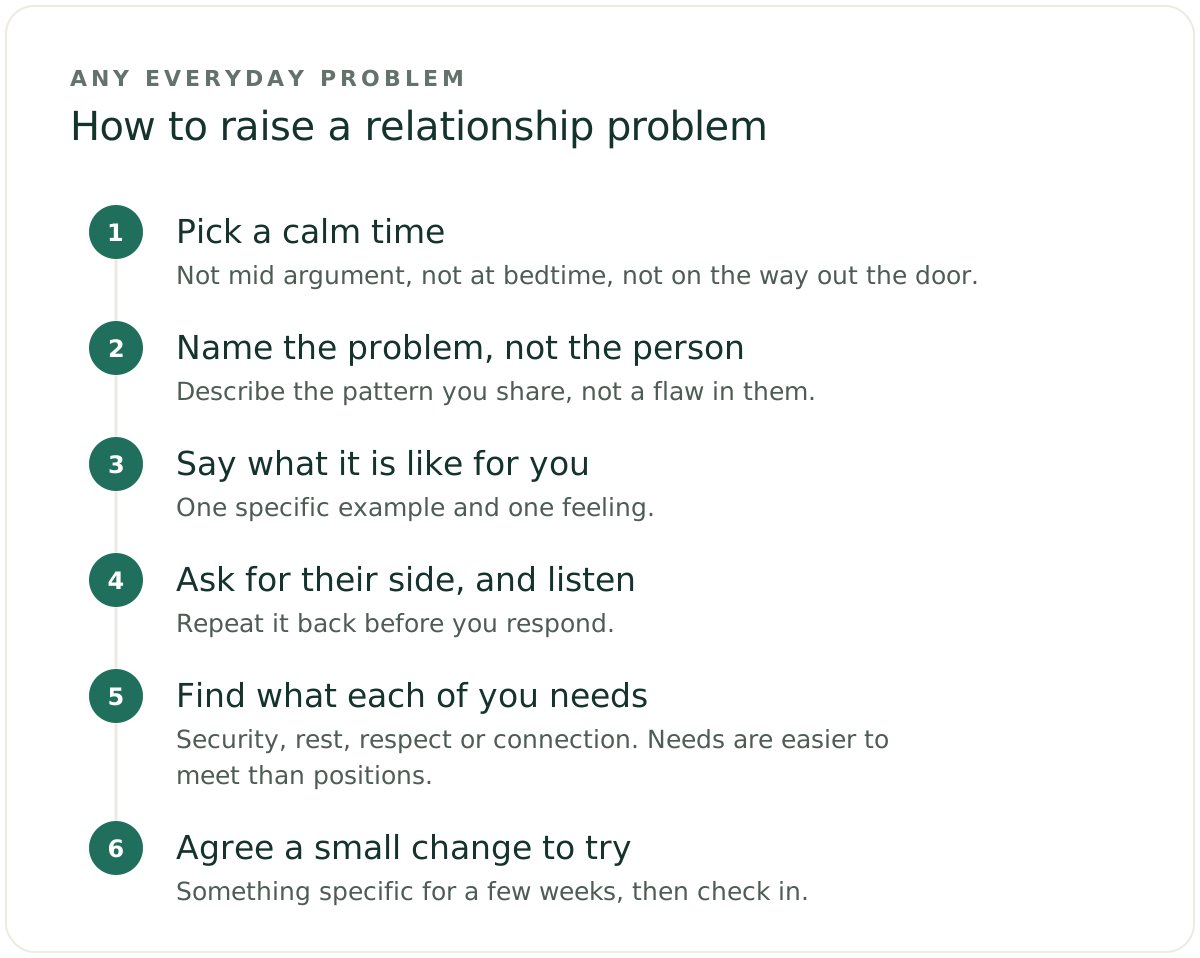
- Pick a calm time. Not during the argument, not at bedtime, and not when one of you is walking out the door. “Can we talk about the money stuff tomorrow night?” is a good start.
- Name the problem, not the person. “We keep arguing about the weekends” invites teamwork. “You’re so selfish with your time” invites a defence.
- Say what it is like for you. One specific example and one feeling: “Last Saturday, when plans changed at the last minute, I felt pushed aside.”
- Ask for their side, and listen. Their experience of the same problem may be completely different. Try to repeat it back before you respond.
- Find what each of you needs. Underneath most positions is a need for security, rest, respect or connection. Needs are easier to meet than positions.
- Agree a small change to try. Something specific for a few weeks, then check in. Small, real changes beat big promises.
How you talk matters as much as what you talk about. Criticism, contempt, defensiveness and stonewalling are the patterns the Gottman Institute calls the Four Horsemen, and they can turn a solvable problem into a recurring fight. If your conversations keep escalating, our guide on how to stop fighting with your partner has practical techniques for breaking the cycle.
When to look for relationship help
Most everyday problems can be worked through by two people who both want to. Some situations do call for outside help, though:
- the same argument has gone round for months with no movement
- contempt, coldness or long silences have become normal
- there has been a serious breach of trust, such as an affair
- one or both of you is struggling with your mental health
- you are unsure whether you want to stay together
In those cases a couples counsellor can help, and our guide to what couples therapy is explains what to expect. And if one partner is controlling, frightening or hurting the other, the right help is 1800RESPECT on 1800 737 732, not a communication tool or joint sessions.
Where FairTalk fits in
FairTalk is designed for exactly the everyday problems in this guide: money, chores, time, family and expectations. You talk the issue through together while FairTalk listens without taking sides, and either of you can pause if it gets heated. Afterwards, you both get a fair picture of each other’s perspective and a way forward you have shaped together, along with guidance on the communication skills each of you could build.
If your partner is not ready to talk yet, the solo session feature lets you work through your own side first, so you are clearer about what you need before you raise it. FairTalk is not therapy, and it is not suitable where there is abuse, coercion or a power imbalance.
Frequently asked questions
What are the most common relationship problems?
The most common relationship problems are money, the division of housework, not enough time together, unmet expectations, family and in-laws, and stress from work, health or the cost of living. In Relationships Australia’s national survey, work or study commitments, mental health and money problems were the most common pressures. Most of these are everyday problems that couples can work through by talking about them early and specifically.
How do I talk to my partner about relationship problems without fighting?
Pick a calm time, describe the problem rather than criticising your partner, and say what it is like for you using one specific example. Then ask for their side and listen before you respond. Finish by agreeing one small change to try, rather than trying to solve everything in one conversation.
Can relationship problems be fixed without counselling?
Many everyday relationship problems can. Disagreements about money, chores, time and family often improve when both people talk about them calmly and agree small, specific changes. Counselling is worth considering when the same argument has gone round for months, trust has been seriously broken, or mental health is involved.
When should we get marriage help?
Consider marriage help when the same conflict keeps returning with no progress, when contempt or long silences have become normal, after a serious breach of trust, or when either of you is unsure about staying together. A couples counsellor or your GP is a good place to start. If there is fear, control or violence, contact 1800RESPECT on 1800 737 732.
Is it normal to have the same relationship problems over and over?
Yes. The Gottman Institute’s research found that most relationship conflict is about perpetual problems, lasting differences that couples manage rather than solve. What matters is whether you can keep talking about them calmly, rather than whether they ever disappear completely.