Most people believe the key to a lasting relationship is finding the right person: someone compatible, someone you are drawn to, someone who shares your values. Compatibility and attraction matter, but they are not what carries a relationship through the years. What does is something quieter and far more learnable: the ability to understand and manage emotions, your own and your partner’s, especially when things get difficult.
That ability has a name. Psychologists call it emotional intelligence, and a large body of research suggests it predicts whether a relationship thrives more reliably than how well-matched two people looked at the start. The good news, and the point of this guide, is that unlike compatibility, emotional intelligence can be deliberately built.
What Emotional Intelligence Actually Means
The concept was popularised by psychologist Daniel Goleman, whose work drew a distinction between raw intellect and the set of skills that govern how we handle ourselves and our relationships. Emotional intelligence is not about being nice, being calm all the time, or suppressing what you feel. It is about being aware of emotions and using that awareness well.
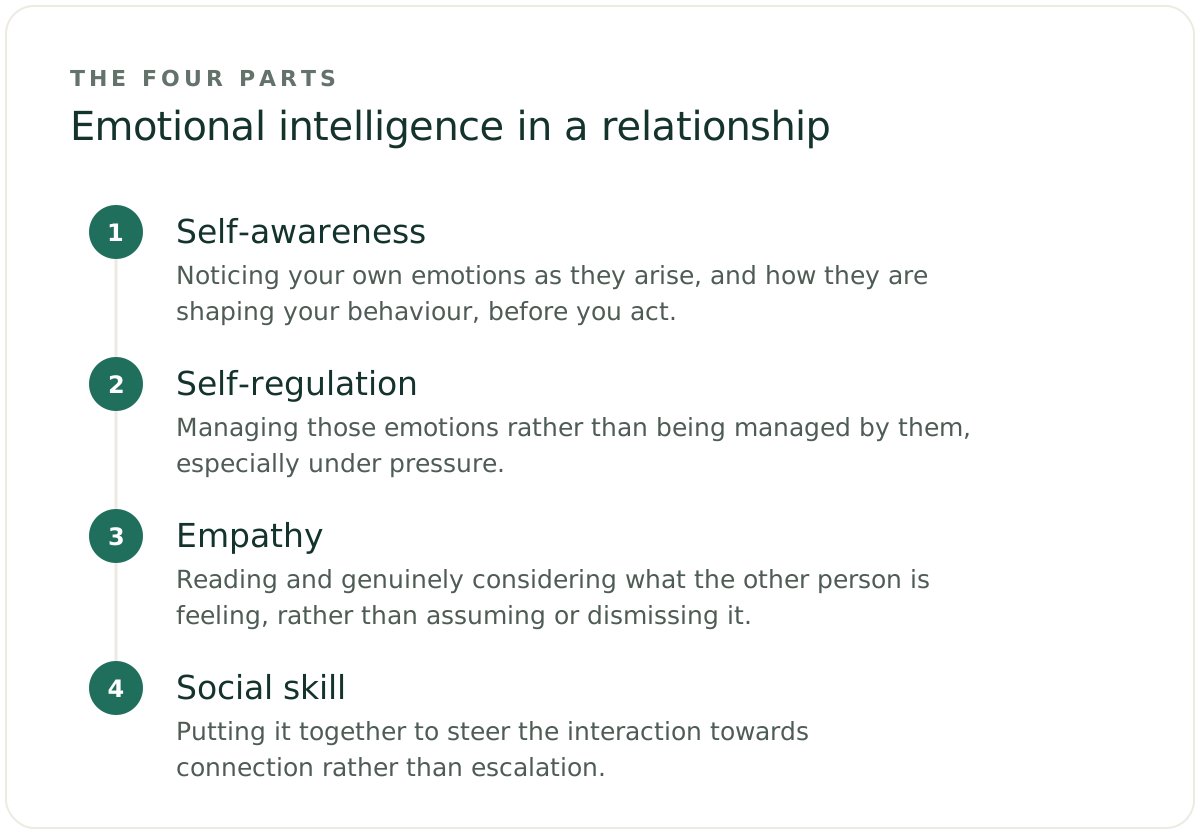
In the context of a relationship, it breaks down into four practical capacities:
Self-awareness. Noticing your own emotions as they arise, and recognising how they are shaping your behaviour, before you act on them.
Self-regulation. Managing those emotions rather than being managed by them, particularly under the pressure of a disagreement.
Empathy. Reading and genuinely considering what the other person is feeling, rather than assuming or dismissing it.
Social skill. Putting all of that together to steer an interaction towards connection rather than escalation.
None of these is a fixed trait you either have or lack. Each is a skill that strengthens with attention and practice.
What High and Low Emotional Intelligence Look Like
Emotional intelligence is easiest to understand by watching how it plays out in ordinary moments. The same situation produces very different responses depending on how developed these skills are.
When a partner raises a complaint. Low emotional intelligence hears an accusation and reacts to protect itself, with defensiveness, denial, or a counter-complaint. High emotional intelligence hears the feeling underneath the complaint and gets curious about it, even when the delivery was clumsy.
Under stress. Someone with low emotional awareness lets a hard day leak into the relationship without noticing, then is genuinely puzzled by the tension that follows. Someone with more awareness can say, “I’m short-tempered tonight and it isn’t about you,” which defuses the situation before it starts. This matters most when stress becomes chronic, because burnout quietly drains the emotional bandwidth that emotional intelligence runs on.
In the middle of an argument. Low emotional intelligence escalates: the volume rises, old grievances get dragged in, and the goal quietly shifts from resolving the issue to winning. High emotional intelligence notices the escalation, names it, and is willing to pause rather than push through to a damaging conclusion.
After a mistake. Low emotional intelligence defends, minimises, or waits for the other person to move first. High emotional intelligence repairs quickly and specifically, because it understands that a genuine, timely apology costs little and protects a great deal.
Day to day. Low emotional intelligence treats emotional connection as background noise and only attends to the relationship when something is wrong. High emotional intelligence notices the small bids for attention and affection and responds to them, which is what keeps the reservoir of goodwill full for when it is needed.
The encouraging part is that nobody sits permanently at one end of this spectrum. Most of us manage more emotional intelligence on a good day than a bad one, and the point of building the skill is to raise the floor, so that even your harder moments are handled a little better than they used to be.
Why It Matters More Than Compatibility
The instinct to explain relationship success through compatibility is understandable, but the research points elsewhere. Decades of study by the Gottman Institute found that what distinguishes relationships that last from those that fail is not the absence of differences or conflict. Every couple has perpetual disagreements they never fully resolve. What separates the stable couples is how they handle those differences: whether they can stay emotionally attuned to each other even in the middle of a fight.
That attunement is emotional intelligence in action. Two highly compatible people with low emotional intelligence will still struggle, because every difference becomes a threat neither of them can manage well. Two less obviously matched people with high emotional intelligence can navigate real differences without the relationship eroding, because they can regulate themselves, understand each other, and repair after a rupture.
Compatibility describes how similar two people are. Emotional intelligence describes how well they handle the ways they are not.
This is why emotional intelligence outperforms compatibility as a predictor. Compatibility is largely fixed once you have chosen each other. Emotional intelligence is the variable you can keep improving for as long as the relationship lasts.
How Emotional Intelligence Changes Conflict
Conflict is where emotional intelligence earns its keep, because it is precisely when the skills are hardest to use and matter most.
A person with low emotional awareness in an argument is essentially reacting on autopilot: a comment lands, a threat response fires, and the counter-attack is out before any conscious choice is made. Someone with more developed self-awareness has a small but decisive gap between the feeling and the response, and that gap is where every constructive choice lives.
Self-regulation keeps that gap open. Research summarised by the American Psychological Association shows that simply naming an emotion reduces its intensity, a process called affect labelling. A partner who can notice “I’m getting defensive here” has already changed the trajectory of the conversation, because a named feeling is far easier to manage than an unnamed one.
Empathy does the other half of the work. When you can genuinely register that your partner is not attacking you but is themselves hurt or frightened, the whole nature of the disagreement shifts from a contest into a shared problem. That reframe is the difference between the arguments that damage a relationship and the ones that deepen it.
How to Build Emotional Intelligence
Because these are skills rather than traits, they respond to deliberate practice. A few habits build them faster than any amount of reading about them.
Name what you feel, specifically. Get into the habit of identifying your emotion precisely, “I feel dismissed” rather than “I feel bad.” Precision is what makes a feeling manageable, and it is the foundation the other skills are built on.
Pause before you react. When you notice your emotional temperature rising, treat that as a signal to slow down rather than speed up. Even a few seconds is enough to move from reaction to choice. If you need longer, a short, agreed break is a sign of skill, not avoidance.
Get curious about your partner’s experience. Before defending your position, ask yourself what they might be feeling and why. Asking directly, “what’s going on for you underneath this?”, is often more revealing than anything you could have assumed.
Repair after ruptures. No one regulates perfectly. Emotional intelligence shows up as much in how you reconnect after a bad moment as in how you avoid one, so a genuine “I’m sorry, I got sharp there” is one of the most valuable skills in the set.
For the wider communication toolkit these habits sit within, our guide to improving communication skills covers the practical structure in more depth.
Where FairTalk Fits In
Emotional intelligence is built through practice, and the hardest place to practise it is in the middle of a real disagreement, when self-awareness is lowest and reactions are fastest. FairTalk creates the conditions those skills need. Both people talk the issue through in one conversation while the AI listens impartially, and because the analysis comes afterwards rather than in the heat of the moment, each person gets to see the other’s perspective laid out calmly: what each of you felt and what you needed.
Seeing your own words and your partner’s reflected back without the charge of the argument is often where the self-awareness and empathy that emotional intelligence depends on begin to click. It does not replace the daily practice, but it gives you a structured space to apply it. For the specific patterns that emotional intelligence helps couples avoid, see our guide to Gottman’s Four Horsemen, the four patterns that most reliably predict relationship breakdown.
Frequently Asked Questions
Can you actually improve emotional intelligence, or is it fixed?
You can improve it. Unlike personality traits, which are relatively stable, the components of emotional intelligence are skills that strengthen with deliberate practice. Naming your emotions accurately, pausing before reacting, and consciously considering your partner’s experience all build the underlying capacity over time. Most people who work at it notice a difference within weeks, and it continues to develop for as long as they keep practising.
Is emotional intelligence really more important than compatibility?
For long-term success, the evidence suggests it is. Compatibility helps a relationship begin, but every couple eventually encounters real differences and recurring disagreements. What determines whether those differences erode the relationship or are absorbed by it is how well both people understand and manage emotion, their own and each other’s. That capacity keeps mattering long after the initial sense of being well-matched has been tested.
What if my partner has low emotional intelligence?
You cannot install emotional intelligence in someone else, but you have more influence than it might seem. Because these interactions are dynamic, one partner regulating themselves, listening genuinely, and repairing after conflict often changes how the other responds, even without a deliberate decision on their part. Modelling the skills tends to be more effective than lecturing about them. If the deeper issue is an unwillingness to engage at all, that is worth addressing directly, and sometimes with professional support.
How is emotional intelligence different from just being nice?
They are not the same thing. Being nice is often about smoothing things over and avoiding discomfort, which can actually mean suppressing feelings and leaving problems unaddressed. Emotional intelligence includes the ability to raise a difficult issue honestly while staying regulated and empathetic. A highly emotionally intelligent person can have a direct, uncomfortable conversation well, which is frequently the opposite of simply keeping the peace.