Almost every serious argument follows the same shape. It starts as a disagreement about something specific, and within a few minutes it has become something else entirely: louder, faster, and no longer really about the original issue. By the time both people are fully activated, the conversation has stopped being a conversation. It’s now a contest, and nobody wins a contest like that.
De-escalation is the skill of interrupting that climb before it takes the conversation somewhere neither of you meant to go. It isn’t about backing down, giving in, or suppressing what you feel. It’s about lowering the emotional temperature enough that the actual problem becomes solvable again. These are the techniques that work in the moment, when it counts.
Why arguments escalate in the first place
To calm an argument, it helps to understand what’s physically happening. When a disagreement feels threatening, whether the threat is to your safety, your status, or just your sense of being right, the body responds as if to danger. Heart rate climbs, stress hormones rise, and the parts of the brain responsible for empathy, nuance, and careful reasoning become harder to access.
The Gottman Institute calls the tipping point “flooding”: the moment your physiological arousal is high enough that you can no longer take in new information or respond thoughtfully. Once someone is flooded, roughly past 100 beats per minute, no clever argument will land, because the part of the brain that would process it has effectively gone offline. This is why escalated arguments feel impossible to reason your way out of. You’re trying to reason with a nervous system that has switched into defence.
De-escalation works because it targets the physiology first and the problem second. Calm the body, and the mind that can actually solve the problem comes back online.
The core principle: someone has to go first
The single most important thing to understand about de-escalation is that it only takes one person. Escalation is a loop: your raised voice justifies their raised voice, which justifies yours. But that loop runs in reverse too. When one person deliberately lowers their intensity, softer tone, slower pace, less heat, the other person’s nervous system tends to follow, often without either of you consciously noticing.
You don’t need the other person to calm down first. You need to stop feeding the escalation, and let their system catch up to yours.
This is unfair, in a sense. Why should you be the one to de-escalate when they started it? But it’s also a form of power. The person who can regulate themselves first is the person who gets to steer where the conversation goes next. Waiting for the other person to calm down first usually means waiting forever.
De-escalation techniques that work in the moment
Here’s the sequence that reliably brings the temperature down, roughly in the order you’d use it.
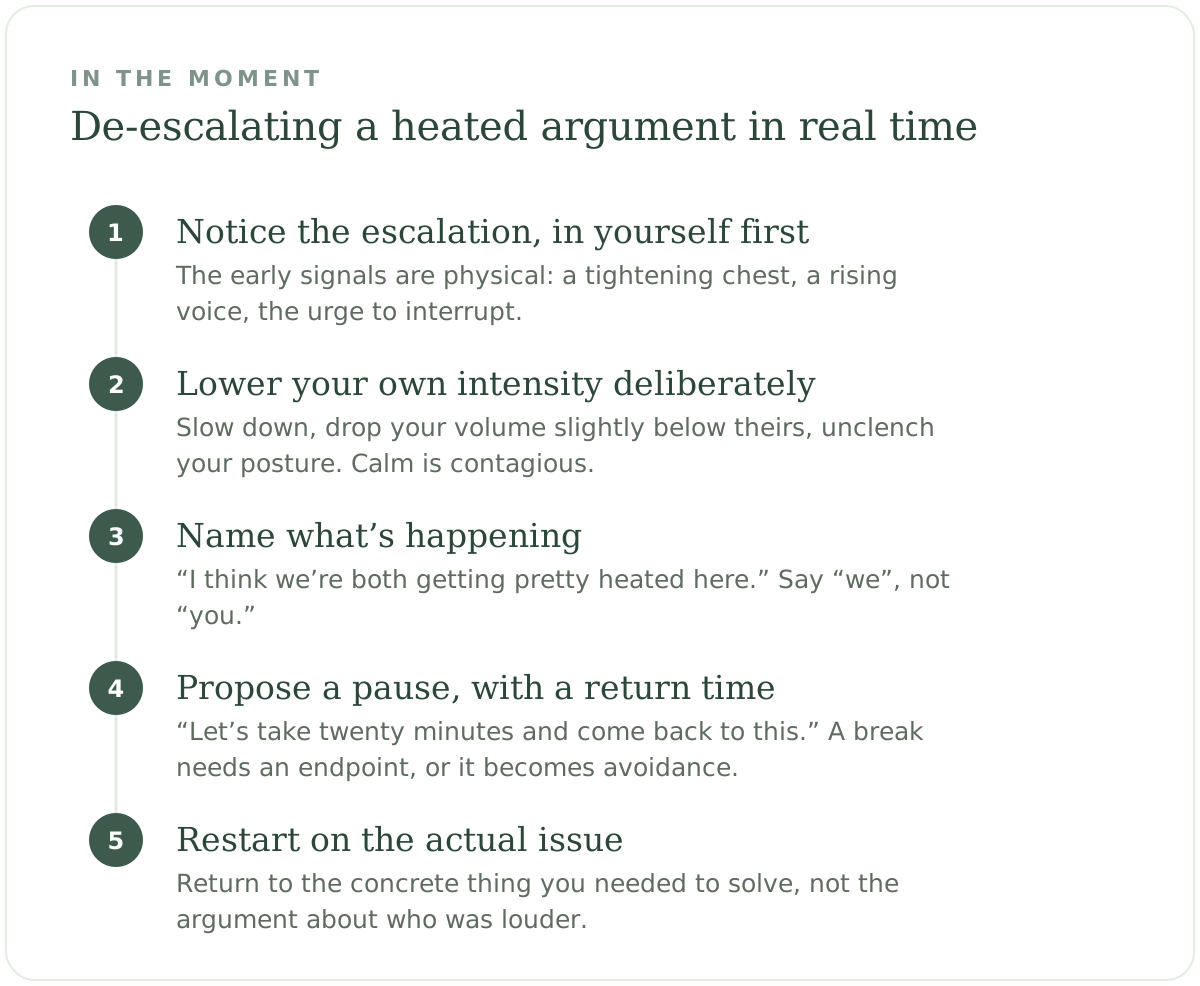
1. Notice the escalation, in yourself first. You can’t manage what you haven’t noticed. The early signals are physical: a tightening chest, a rising voice, the urge to interrupt, the feeling of being backed into a corner. Catching these early, before you’re fully flooded, is what makes everything else possible. This is the foundation skill of emotional regulation, and it’s the one worth practising most.
2. Lower your own intensity deliberately. Slow down. Drop your volume slightly below the other person’s. Unclench your posture. These aren’t just symbolic: a slower, quieter voice sends a genuine safety signal to the other person’s nervous system, and it’s contagious. You’re not performing calm, you’re choosing it, and inviting them to match it.
3. Name what’s happening. A simple, non-blaming observation can break the spell: “I think we’re both getting pretty heated here.” Naming the escalation, rather than the other person’s faults, pulls you both up to look at the conversation from above instead of staying trapped inside it. Crucially, say “we,” not “you.” “You need to calm down” pours fuel on the fire; almost nobody in history has calmed down on being told to.
4. Validate something, even if you disagree. You don’t have to concede the point to acknowledge the person. “I can see why that would be frustrating” or “you’re right that I said that” costs you nothing and lowers their defences immediately. People escalate when they feel unheard; a single genuine acknowledgement often takes the pressure out of the room.
5. Propose a pause, with a specific return time. If you’re both past the point of useful conversation, the most skilful move is to stop, temporarily. But a pause only works if it has an endpoint. “Let’s take twenty minutes and come back to this” is a de-escalation tool. “I’m done talking about this” is abandonment, and it usually escalates things further. The American Psychological Association notes that it takes at least twenty minutes for an activated nervous system to return to baseline, so a genuine reset needs real time, not thirty seconds.
6. Restart on the actual issue, not the argument about the argument. When you come back, resist relitigating who was louder or who started it. Return to the original problem, the concrete thing you actually needed to solve, and pick it up from there.
The mistakes that pour fuel on the fire
Just as important as knowing what to do is knowing what quietly makes escalation worse.
Telling someone to calm down. It reads as dismissive and controlling, and it almost always produces the opposite. Calm is transmitted by example, not instruction.
Bringing in past grievances. The moment “and another thing, last month you also…” enters an already-heated conversation, you’ve made the argument unwinnable and unsolvable. One conversation, one topic.
Going for the jugular. In a flooded state, people reach for the comment they know will hurt most: the insecurity, the old wound, the thing that can’t be unsaid. It provides a second of satisfaction and can cost weeks of repair. If you notice the urge, that’s your strongest signal to pause.
Stonewalling without explanation. Going silent and shutting down mid-argument, without saying you need a break, reads as contempt and tends to escalate the other person further. If you’re shutting down because you’re overwhelmed, say so: “I’m too flooded to think straight, I need a few minutes.” The difference between a pause and a shutdown is one sentence. For more on why people go silent under pressure, see our guide to couples communication patterns.
De-escalating when you’re not the one who’s flooded
Sometimes you’re relatively calm and the other person is the one climbing. The instinct is to match their energy or to argue harder while they can’t hear you. Neither works.
Instead, become the anchor. Keep your voice low and steady, give them space to vent without interrupting, and reflect back what you’re hearing (“so you’re feeling like I dismissed this earlier”). Avoid problem-solving while they’re still activated, because a flooded person doesn’t want solutions, they want to feel heard. Once their intensity starts to drop, and it will, if you’re not feeding it, you can move gently toward the actual issue. This is where genuine active listening does the most work.
Where FairTalk fits in
De-escalation is a skill, and like any skill it’s easier to build with structure and feedback. FairTalk gives conversations that structure: both people talk the issue through in one session while the AI listens impartially, and if things get heated, either of you can pause the session and return when you’re calmer, on your own terms.
The bigger help comes afterwards. Because all of the analysis happens once the conversation is done, when everyone is calmer, FairTalk’s summary shows you where the conversation escalated, how each person experienced it, and what each of you actually needed underneath the heat. Seeing the pattern from the outside, rather than being trapped inside it, is often what makes the next argument easier to steer. Over time, FairTalk is designed to help you notice your own escalation triggers, which is the first and most important de-escalation skill of all.
One important caveat. Everything in this guide assumes two people who are both, fundamentally, trying. Where there is emotional abuse, coercion, or a significant power imbalance, the problem is not that the conversation gets heated, and de-escalating your own behaviour will not fix it. Those situations need human professionals and, in some cases, specialist support services. FairTalk is not the right tool for them.
Frequently asked questions
How do you de-escalate an argument that’s already out of control?
Once an argument is fully escalated, subtle techniques won’t cut through, so go straight to the pause. Say clearly and without blame that you need to stop for a bit and will come back to it, then actually stop. Give it at least twenty minutes for both nervous systems to settle. Trying to resolve anything while you’re both flooded rarely works, because neither of you can properly process what the other is saying. The pause isn’t avoidance; it’s what makes a real resolution possible once you’re calm.
Isn’t de-escalating just letting the other person win?
No. De-escalating lowers the emotional temperature; it doesn’t concede the point. In fact, calming an argument down is what makes it possible to actually resolve the underlying issue in your favour or reach a genuine compromise. A flooded argument can’t be won by anyone, it just gets louder. The person who de-escalates isn’t surrendering; they’re the one moving the conversation back to where a real outcome is possible.
What if I’m the one who tends to lose control?
Start with the earliest warning signs, before you’re flooded rather than after. Learn your personal signals (a hot face, a clenched jaw, a racing heart) and treat them as a cue to slow down or call a pause, not push on. The timed break is your most reliable tool: stepping away for twenty minutes is not weakness, it’s exactly what the nervous system needs. Over time, naming your feelings out loud (“I’m getting really wound up”) both regulates you and signals to the other person that you’re trying.
How is de-escalation different from avoiding conflict?
Avoidance skips the issue entirely; de-escalation lowers the intensity so the issue can be addressed properly. The tell is what happens next: someone avoiding conflict pauses and never returns to the topic, while someone de-escalating pauses precisely so they can return to it and resolve it once things are calm. A pause with a genuine intention to come back is de-escalation. A pause designed to bury the issue is avoidance.