
If you are weighing up how to resolve a dispute, you have probably come across two very different options: a traditional mediator, and the newer category of AI-guided tools like FairTalk. They are often talked about as rivals, but that framing is misleading. They are better understood as different tools for different jobs, and the useful question is not which is better in the abstract, but which fits the conflict in front of you.
This is an honest side by side comparison across the things that actually matter, cost, speed, privacy, the experience, and whether the outcome is enforceable, followed by a clear guide to when each one is the right call. For a fuller explanation of the category itself, our guide to what AI conflict resolution is covers the ground; this article is specifically about how it stacks up against a traditional mediator.
Two different tools for two different jobs
Traditional mediation has been the gold standard for structured dispute resolution for decades. A trained, neutral third party facilitates dialogue between two people, drawing out underlying interests, managing the emotional temperature in the room, and steering both sides toward a mutually acceptable agreement. In skilled hands it is highly effective, and for complex or high-stakes disputes it is genuinely hard to beat.
FairTalk is built for a different job: the enormous volume of everyday conflict that never reaches a mediator at all. It gives two people the structure of a mediated conversation without a human mediator in the room. Both people take part in one guided session, and once it is complete the AI produces a fair summary of each perspective, where they align, where they differ, and a set of concrete next steps. For the full walkthrough, see how FairTalk works. The point of comparison, then, is not “which is better”, but “which is proportionate to this particular conflict”.
Cost
This is the starkest difference, and the main reason so much everyday conflict goes unresolved.
Traditional mediation is expensive. In Australia, private mediators typically charge between $250 and $500 an hour, and a full-day session can run to $2,800 to $3,500 or more per party, before GST and any venue hire. Even a relatively straightforward matter usually needs several hours. Bodies such as the Mediation Institute and the government’s dispute resolution services can point you toward accredited practitioners, but the fees are a real barrier for the ordinary disagreements most people are trying to resolve.
FairTalk removes that barrier. Rather than an hourly fee, it is a low subscription, which works out in the vicinity of a tenth of what the equivalent professional service costs, with no per-session charges, no venue, and no travel. The result is that a category of conflict that was simply priced out of professional help becomes something you can actually work through.
Speed and availability
Mediation runs on appointments. You have to find a mediator, coordinate a time that suits two people who may already be at odds, and often wait weeks for a slot, all within business hours. Conflict, unfortunately, does not keep office hours; it tends to peak in the evening and on weekends, precisely when no mediator is available.
FairTalk is available in minutes, at any hour, with one device between you and no scheduling. That immediacy matters more than it first appears: the gap between wanting to resolve something and being able to is often where avoidance sets in and a fixable problem hardens into an entrenched one.
Privacy
Both are confidential, but in different ways. A traditional mediation is private, yet it still involves disclosing your conflict to another person, and notes or records may exist as part of the process.
FairTalk is designed so that no human is ever in the room. The audio is held only in memory and deleted the moment transcription is complete, transcripts are never viewable, and session content is not sold or shared with third parties beyond the processing providers that run the service. For many people, the ability to work through something sensitive without another person hearing it is the deciding factor, and it is a genuinely different privacy model from sitting across a table from a stranger.
The experience and the outcome
A skilled human mediator brings something an AI does not: judgement. They read body language, sense what is not being said, adapt on the fly, and handle genuinely complex or volatile situations. For entrenched, high-conflict, or legally intricate disputes, that human judgement is exactly what you are paying for, and it is worth it.
FairTalk brings a different set of strengths: perfect consistency, total neutrality, and no fatigue or bias. It never takes sides, never gets tired late in a session, and applies the same structured process every time. Its analysis, delivered after the conversation rather than in the heat of it, lays out both perspectives and a concrete plan with equal weight given to each person, which is often where understanding that felt impossible mid-argument finally clicks.
Is the outcome enforceable?
This is a crucial distinction and a hard limit worth being clear about. A traditional mediation can produce a formal agreement that is documented and, where appropriate, made legally binding or lodged with a court. That enforceability is essential for parenting arrangements, financial settlements, and any dispute where the outcome needs to hold up legally.
A FairTalk resolution plan is a shared record of what both people agreed to, not a legal instrument. It is powerful for aligning two people and holding each other to what you committed to, but it is not enforceable in the way a formalised mediation agreement is. If your dispute needs an outcome with legal weight, that alone points you toward a professional. Services such as Legal Aid Queensland can help you understand when a dispute needs a formal, enforceable process.
When traditional mediation is the right call
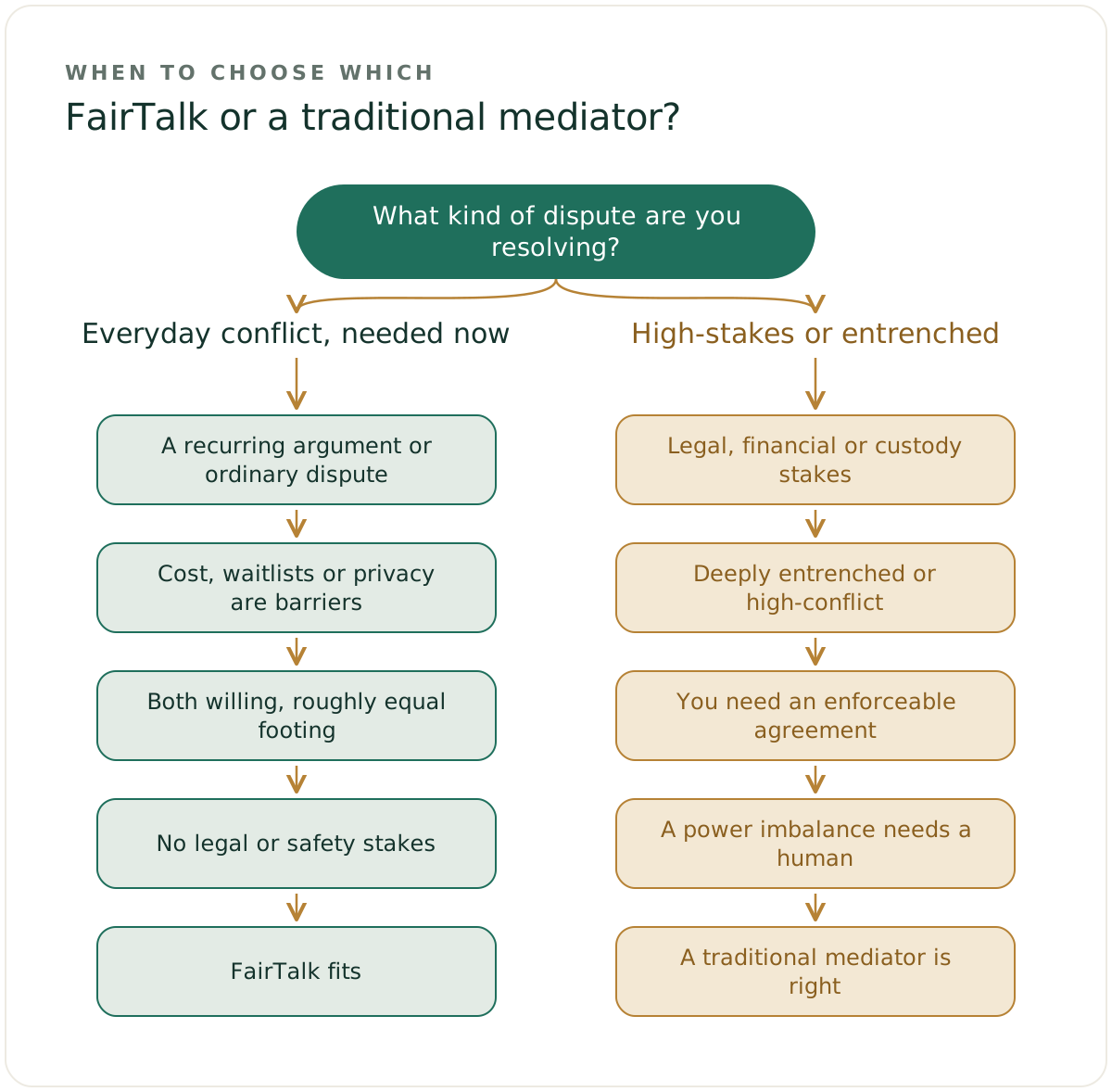
Reach for a professional mediator when the stakes or the complexity are high:
- The dispute has legal, financial, or custody implications, or needs an enforceable agreement.
- The conflict is deeply entrenched or high-conflict, with a long history that needs a skilled human to untangle.
- There is a power imbalance, or any element of abuse or coercion, where a self-directed tool is inappropriate and a human professional is essential.
- You specifically need the judgement, credentials, or legal standing that only a trained mediator provides.
In these situations the cost of mediation is not really a cost; it is insurance against a much larger one.
When FairTalk fits better
FairTalk is the proportionate choice for the vast middle ground of ordinary conflict:
- An everyday interpersonal dispute with a partner, family member, friend, neighbour, or colleague.
- You want to resolve it now, not in three weeks, and cost is a real consideration.
- Both people are willing and roughly equal in standing, with no safety concerns.
- Privacy matters and you would rather not involve another person.
This is the same territory covered by self-mediation; FairTalk is essentially a structured, guided version of doing it yourselves.
You do not have to choose only one
The most sensible approach for most people is not either/or. Use FairTalk for the everyday friction that would otherwise go unaddressed, and escalate to a professional mediator, or the right specialist service, for the serious, complex, or legally significant matters. Thought of that way, FairTalk is not competing with traditional mediation so much as filling the enormous gap beneath it, the conflicts that were never going to reach a mediator anyway. If you are also weighing AI support against professional therapy for relationship issues specifically, our comparison of an AI relationship coach versus couples therapy covers that decision.
The bottom line
Traditional mediation is the right tool when a conflict is high-stakes, entrenched, or needs a legally enforceable outcome, and its cost reflects the genuine value of skilled human judgement. FairTalk is the right tool when a conflict is part of ordinary life, needs resolving sooner rather than later, and does not justify the expense, delay, or exposure of a formal process. Most people will have use for both at different moments. The goal is simply to match the tool to the conflict, rather than leaving the everyday disputes unresolved because the only option you knew about felt too big.
Frequently asked questions
Is AI mediation as effective as a human mediator?
For everyday interpersonal disputes, a structured AI-guided process outperforms an unstructured attempt to talk it out, because most conflicts fail on process rather than goodwill. For complex, high-stakes, or legally significant disputes, an experienced human mediator remains clearly the better choice, because they bring judgement, adaptability, and legal standing that AI does not. They are best understood as suited to different tiers of conflict rather than as direct substitutes.
How much cheaper is FairTalk than traditional mediation?
Considerably. Private mediation in Australia typically costs between $250 and $500 an hour, with full-day sessions running to several thousand dollars per party. FairTalk is a low subscription rather than an hourly fee, in the vicinity of a tenth of what the equivalent professional service costs, with no venue, travel, or scheduling costs. The bigger saving, for many people, is the conflicts that get resolved at all because the barrier of cost and delay is removed.
Is a resolution reached through FairTalk legally binding?
No. A FairTalk resolution plan is a shared record of what both people agreed to and committed to doing, not a legal instrument. It is designed to align two people and support follow-through, not to be enforced in court. For parenting arrangements, financial settlements, or any dispute where the outcome needs to be legally enforceable, you should formalise the agreement through a qualified mediator or legal professional.
When should I use a professional mediator instead of FairTalk?
Choose a professional mediator when the dispute carries legal, financial, or custody stakes, when it is deeply entrenched or high-conflict, when you need an enforceable agreement, or when there is a power imbalance, abuse, or coercion that makes a self-directed tool inappropriate. In those cases the cost buys genuine value and protection. For the large volume of everyday conflict that falls short of that threshold, FairTalk is the more proportionate option.