If your relationship has hit a rough patch, the standard advice is to see a couples therapist. It is good advice, and for some situations it is the only right advice. But it comes with practical barriers that stop most couples from ever acting on it: sessions in Australia typically cost $150 to $300, waitlists run to weeks or months in many areas, and both partners have to agree to sit in a room with a stranger and talk about the hardest parts of their relationship.
A new category of tool has emerged in that gap: the AI relationship coach app. Available 24/7, private, and priced at a fraction of a single therapy session per month, these tools are changing who gets help and when. The honest question is not whether AI coaching is “as good as” therapy. They are different tools for different jobs. The question is which one fits the problem you actually have.
What an AI relationship coach actually does
An AI relationship coach is a structured tool that helps couples communicate and work through conflict, guided by an AI rather than a human practitioner. The better tools are not general-purpose chatbots. They apply established frameworks from conflict resolution practice, such as active listening, I-statements and interest-based negotiation, to your specific situation.
FairTalk’s approach, for example, is built around a single mediated conversation: both partners consent, talk the issue through naturally with the AI listening impartially, and receive a structured analysis of both perspectives, covering where you align, where you differ, and what each of you needs, followed by a resolution plan you both shape. For the full walkthrough, see how FairTalk works.
The strength of this model is exactly what it sounds like: structure, neutrality and availability at the moment of conflict, rather than three weeks later when an appointment opens up.
What couples therapy does that AI cannot
Couples therapy is a clinical relationship with a trained human being, and some of what makes it work cannot be replicated by software.
A therapist can diagnose and treat mental health conditions that drive relationship conflict: depression, anxiety, trauma responses, personality patterns. They can recognise when what presents as a communication problem is actually something deeper. They can work with a couple over months to unwind patterns that took decades to form. And they carry professional and ethical obligations, including the ability to recognise abuse and respond appropriately.
The American Psychological Association maintains standards for evidence-based couples therapy for good reason: for clinically complex situations, the human therapeutic relationship is itself part of the treatment. No responsible AI tool should claim otherwise, and FairTalk doesn’t.
The practical comparison
Where the two options genuinely compete (everyday conflict, recurring arguments, communication breakdowns), the practical differences matter.
Cost. Couples therapy in Australia typically runs $150 to $300 per session, and meaningful progress usually takes multiple sessions. An AI couples therapy app alternative like FairTalk is a monthly subscription, with the professional services serving the same purpose costing in the vicinity of ten times more.
Access. Therapy is bound to business hours and availability. Beyond Blue has documented the persistent gap between demand for relationship and mental health support in Australia and the available supply; waitlists of weeks or months are common outside major cities. AI coaching is available at 11pm on a Tuesday, which is when the argument actually happens.
Privacy. Many people never seek help because of the stigma of sitting in a waiting room. An AI tool on your phone removes that barrier entirely. FairTalk goes further: session content is never shared with third parties, audio is deleted once the session is complete, and you can delete your data at any time.
Speed to first help. The distance between “we should get help” and actually getting it matters more than most comparisons admit. For therapy, that distance is finding a therapist, possibly a GP referral, a waitlist, and coordinating two diaries, during which the willing moment often passes. For an AI tool, it is both of you consenting on the couch tonight. Conflict help that arrives while both people still want it has a structural advantage over help that arrives six weeks later.
The trust curve. With a therapist, the first sessions are largely spent building enough trust to be honest. Research on perspective-sharing shows people disclose more freely when they feel free of judgement, which is one reason an impartial AI can surface honest input from the first session.
Depth. This one goes the other way. A skilled therapist will notice things you did not say, connect this argument to your history, and challenge you in ways an AI tool is not designed to. For entrenched or clinically complicated situations, that depth is worth every dollar.
How much does couples therapy cost in Australia?
A standard session with a couples therapist in Australia typically costs between $150 and $300, and meaningful progress usually takes a course of sessions over several months. Private mediators charge more again, usually $250 to $500 per hour. Medicare rebates rarely help here, because relationship counselling is generally not covered under a mental health treatment plan, so most couples pay the full fee themselves.
That is the context for the comparison in this article. Professional services serving the same purpose as an AI tool tend to be in the vicinity of ten times more expensive than a monthly subscription. Cost should never be the only factor in the decision, but for many couples it quietly decides whether they get help at all.
What the research says
The evidence base for AI in dispute resolution is young but growing quickly, and it points in a consistent direction: AI works best as a structured facilitator rather than a replacement for human judgement in complex situations.
A 2025 systematic review published on SSRN, covering more than 50 studies and industry reports, found that hybrid AI and human systems achieved 23% higher resolution rates in disputes than either approach used alone, a finding that supports the “both, not either” model rather than a winner-takes-all comparison. Research from the Universities of Manchester and Helsinki published in 2023 found that large language models could outperform humans on emotional awareness tasks in controlled conditions. That is not evidence that AI understands emotion the way a person does, but it is evidence that it can respond to emotional language with genuine contextual sensitivity.
The picture that emerges: AI tools are credible for structured, everyday conflict resolution, and nothing in the research suggests they substitute for clinical care where clinical care is needed.
When AI coaching is the right fit
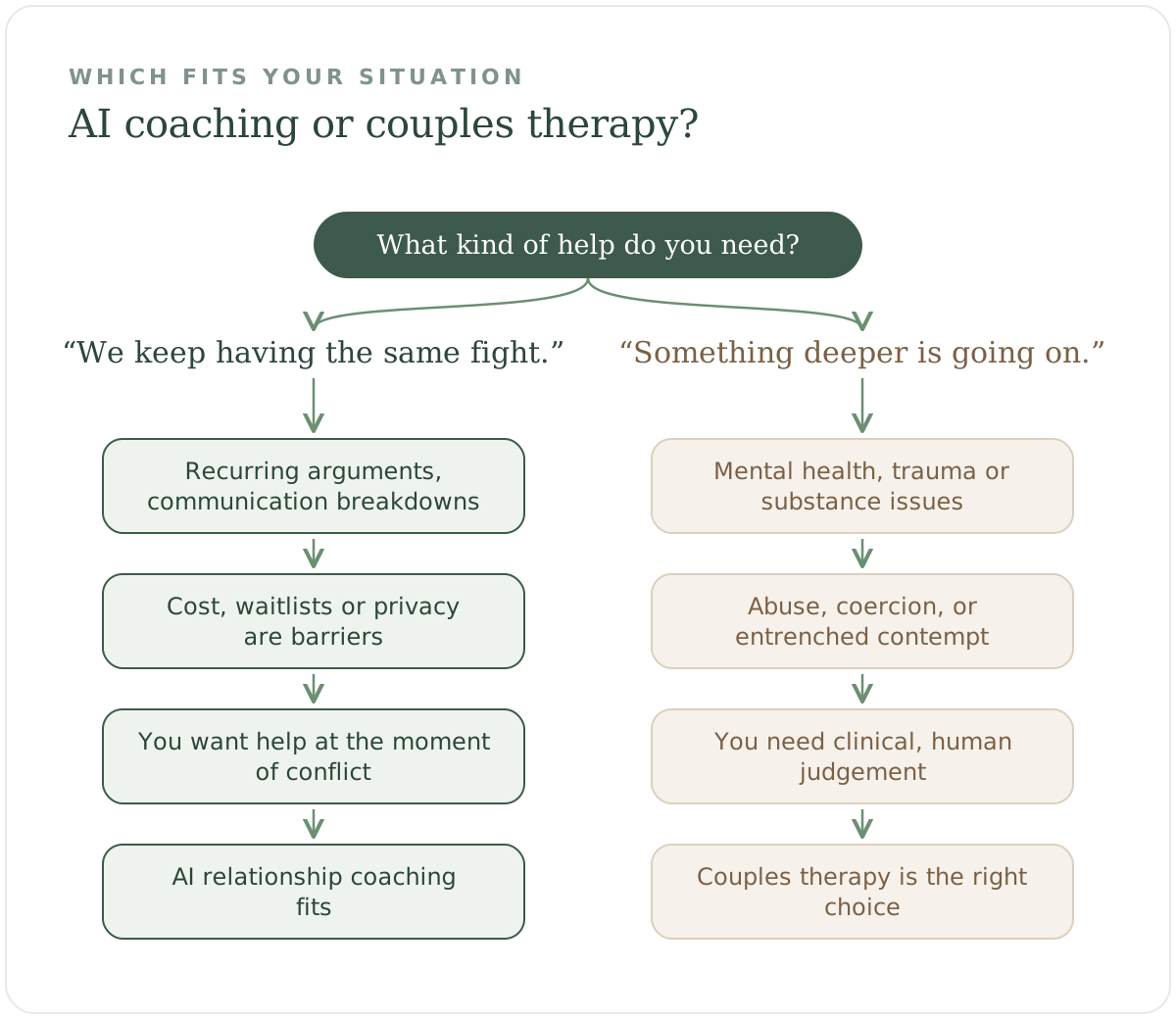
The evidence and the honest experience of the category point to a clear profile. AI relationship coaching suits couples who:
- Have recurring arguments that never quite get resolved, the same fight on a loop
- Struggle with communication breakdowns: interrupting, escalating, shutting down
- Want help at the moment of conflict, not weeks later
- Are priced out of therapy or can’t get access to it locally
- Want a private, low-stakes first step before committing to professional help
For this group, which is most couples in conflict most of the time, a structured tool used early beats professional help never accessed at all. As covered in the real cost of unresolved conflict, the most expensive option is usually doing nothing while the conflict compounds.
When couples therapy is the right choice
Choose a qualified therapist, not an AI tool, when any of the following is true:
- Mental health is part of the picture. Depression, anxiety, trauma, or substance issues driving the conflict need clinical care.
- There is abuse, coercion, or fear. No AI tool is appropriate here. Specialist support services and human professionals are.
- Contempt and mistrust are entrenched. When goodwill has drained away over years, rebuilding it is long-form human work.
- You’ve genuinely tried and nothing shifts. If structured attempts to change the pattern keep failing, that persistence is itself a signal that deeper work is needed.
Psychology Today maintains a directory of accredited couples therapists if this list sounds like your situation.
It’s not actually either/or
The framing of AI instead of couples therapy misses how the two combine in practice. Plenty of couples use both: a therapist for the deeper work at whatever cadence they can afford, and an AI tool for the Tuesday-night disagreements that can’t wait for the next appointment.
Used this way, an AI coach also makes therapy more productive. Arriving with documented resolution plans, a record of what you’ve each committed to, and a clearer articulation of your own needs gives a therapist far more to work with than “we’ve been fighting again.”
Where FairTalk fits in
FairTalk sits deliberately on the coaching-and-mediation side of this line. It is a structured conflict resolution tool, not a therapy substitute: one conversation between the two of you, an impartial AI analysis of both perspectives, and a documented path forward, available whenever the conflict actually happens.
It is also honest about its limits. Situations involving abuse, safety, or clinical mental health need human professionals, and FairTalk says so rather than pretending otherwise. To see how FairTalk compares with the other tools in the category, see the best conflict resolution apps in 2026.
Frequently asked questions
Is an AI relationship coach as effective as couples therapy?
They solve different problems. For everyday communication breakdowns and recurring disputes, structured AI-guided processes outperform unstructured attempts at resolution, and their accessibility means help actually happens. For clinically complex situations involving mental health conditions, trauma, or entrenched relational distress, couples therapy is more effective and the appropriate choice. Comparing them head-to-head misses that most couples’ real alternative to an AI tool is not therapy, but nothing.
How much cheaper is AI coaching than couples therapy?
Couples therapy in Australia typically costs $150 to $300 per session, with most courses of therapy running many sessions. AI coaching tools are generally priced as a monthly subscription, and the professional services serving the same purpose tend to be in the vicinity of ten times more expensive. Over a year of fortnightly therapy versus a year of a subscription, the difference runs to thousands of dollars.
Will my partner actually use an AI tool?
Reluctant partners are common to both options, and the barrier is usually lower for an AI tool. There is no stranger, no waiting room, no diary coordination, and no implication that the relationship is “in trouble enough for therapy.” A private tool at home, tried once for twenty minutes, is an easier yes. Both people do need to consent and participate for a mediated session to work.
Is AI relationship coaching private?
Check each platform’s privacy policy, because practices vary. FairTalk’s position: session content is never shared with employers, courts, or any third party; audio is deleted once the session is complete; and both participants can delete their session data at any time within the app. For many people this is meaningfully more private than therapy, which involves waiting rooms, referrals, and health records.
Can I use FairTalk while we’re in couples therapy?
Yes, and the combination works well. Use therapy for the deeper patterns and FairTalk for the disputes that come up between appointments. The documented resolution plans from FairTalk sessions can also give your therapist a clearer picture of how conflict actually plays out at home.