
Conflict is not a sign that something has gone wrong in your life. It is a sign that you have relationships. Anywhere two people care about something, they will sometimes disagree, and the people closest to us, partners, family, friends and neighbours, are precisely the ones we clash with most, because they matter most. The question is never how to avoid personal conflict. It is how to resolve it well.
The encouraging part is that the skills that resolve conflict are learnable, and they are largely the same whoever the conflict is with. This guide is the starting point: the universal principles for working through any personal disagreement, and a map to the more specific guides for your exact situation, whether that is a partner, a family member, a friend, or a neighbour.
What personal conflict actually is
Personal conflict is disagreement with the people in your personal life, as distinct from the professional kind you navigate at work. It covers everything from a recurring argument with a partner to a falling out with a friend, tension with a family member, or a dispute with a neighbour. (If the friction you are dealing with is at work, our guide to workplace conflict resolution is the better starting point.)
What sets personal conflict apart is how much is at stake emotionally. These are ongoing relationships with history and a future, so a disagreement is rarely just about the surface issue. That is what makes personal conflict feel harder than a transactional dispute, and also why resolving it well matters so much.
Why personal conflict is so hard to resolve
Three things make conflict with the people we are close to uniquely difficult.
The first is the emotional stakes. When someone matters to you, their disapproval or distance registers as a genuine threat, which raises the temperature far faster than a disagreement with a stranger.
The second is history. A dispute with a partner or sibling is rarely about the thing in front of you; it is the latest entry in a long pattern, so both people are often reacting to years of context at once.
The third is your own biology. Once a conflict feels threatening, the brain shifts into fight or flight and the capacity for calm, rational thought drops sharply, which is why the same argument goes in circles. We cover the mechanics in the science of conflict, and the particular case of someone going silent in why people shut down in arguments.
The universal principles for resolving any personal conflict
Whoever the conflict is with, the same core process works. The specifics change; the principles do not.
-
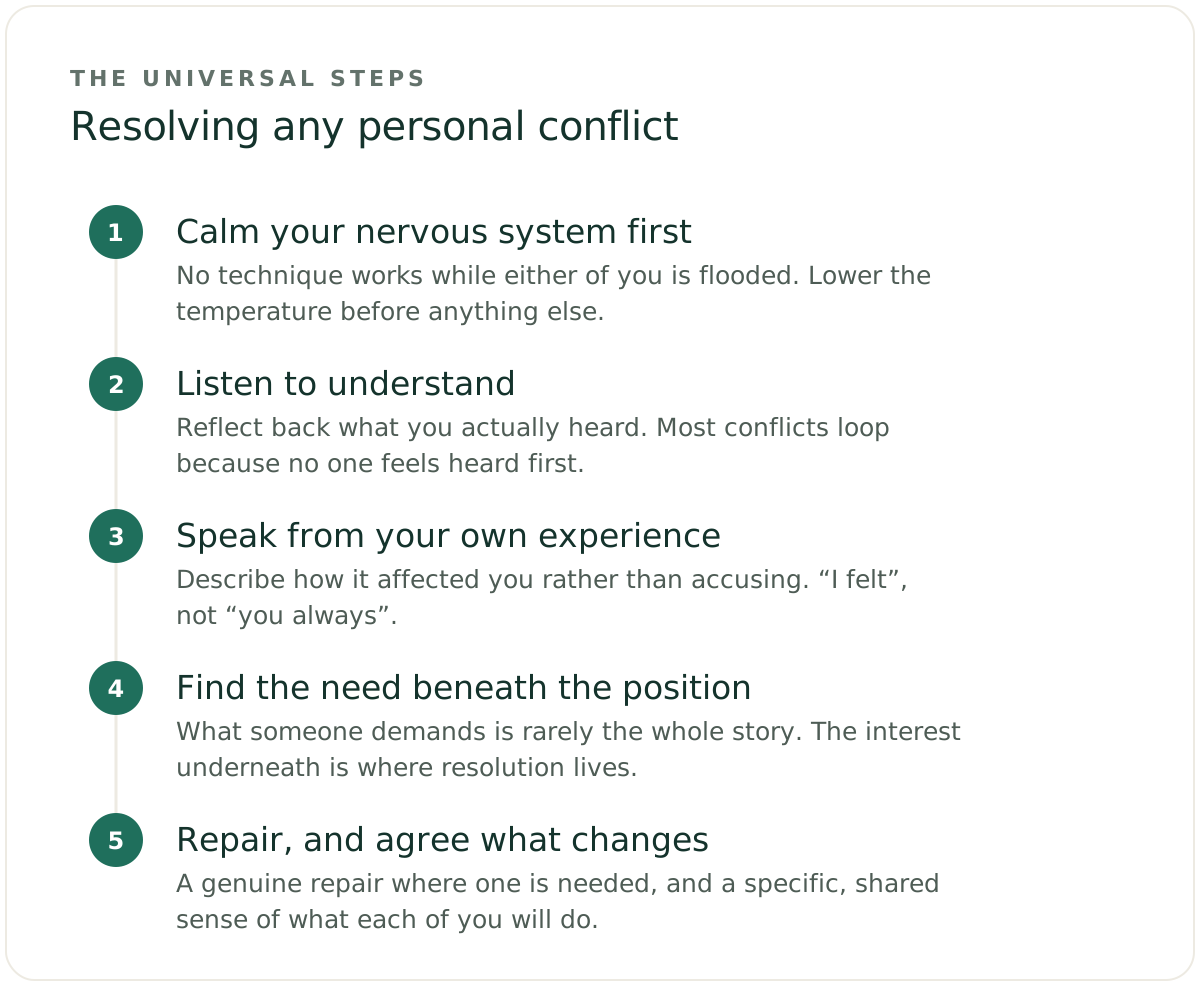
Calm your nervous system first. No technique works while either of you is flooded, so the first move is always to lower the temperature. Our guide to de-escalation techniques covers how to do this in the moment.
-
Listen to understand, not to reply. Most conflicts loop because neither person feels heard before solutions are attempted. Reflecting back what you actually heard is the single highest-leverage skill, and active listening is where to build it.
-
Speak from your own experience. Describe how something affected you rather than accusing the other person, the shift from “you always” to “I felt”, which our guide to I-statements versus you-statements sets out in full.
-
Look for the need beneath the position. What someone demands is rarely the whole story; the interest underneath it usually is. Getting from positions to interests is where resolution actually becomes possible, and it is the heart of self-mediation.
-
Repair, and agree what changes. End with a genuine repair where one is needed, covered in how to apologise properly, and a specific, shared sense of what each of you will do differently.
Resolving conflict, by relationship
The principles are universal, but every relationship has its own dynamics. Here is where to go for your specific situation.
With a partner. Recurring arguments and the patterns behind them are covered in how to stop fighting with your partner and the five communication patterns that predict relationship breakdown. If a specific fight has left damage, how to fix a relationship after an argument covers the repair, and if you are wondering whether the frequency is normal, are arguments normal in a relationship has the research.
With family. Disputes with parents, adult children, or siblings are their own challenge, covered in how to resolve a family dispute, with the parent-and-teenager dynamic covered specifically in parent and teenager communication.
With friends. Falling outs are uniquely easy to leave unrepaired; conflict resolution for friends covers how to mend one before the friendship quietly fades.
With neighbours. Shared-space tensions escalate fast when handled badly; how to resolve a neighbour dispute walks through the approach step by step.
The skills that carry across every relationship
Underneath all of the above sits a small set of transferable skills. Building them once pays off in every relationship you have: managing your own emotions, the broader picture of emotional intelligence in relationships; setting healthy boundaries without starting a fight; raising something hard in difficult conversations; and, when a conflict has left lasting hurt, how to forgive someone so it stops costing you. For the wider habits that keep relationships healthy in the first place, see building healthier connections.
When personal conflict needs outside help
Self-directed resolution has a ceiling, and recognising it is a strength. Where there is abuse, coercion, or a power imbalance that stops one person speaking freely, a self-guided approach is the wrong tool, and a qualified professional or specialist service is needed instead. The same is true where conflict is driven by an underlying mental health issue. In Australia, Relationships Australia offers counselling and family dispute resolution, and Beyond Blue provides free mental health support.
Where FairTalk fits in
Most personal conflict is not beyond repair; it just outruns the moment. FairTalk is built to give that moment structure. When both people take part, you talk the issue through in one guided conversation, and the analysis afterwards lays out each perspective, where you align, where you differ, and concrete next steps, with the same summary for both of you. And when the other person is not ready, you can use it on your own to get a structured read on your side and the actions you can take to move things forward. It will not replace professional help where that is genuinely needed, but for the everyday personal conflict that makes up most of life, it is a fair, structured place to start.
Frequently asked questions
What is personal conflict?
Personal conflict is disagreement or tension with the people in your personal life, such as a partner, family member, friend, or neighbour, as opposed to conflict at work. It tends to be more emotionally charged than a transactional dispute, because the relationships are ongoing, carry history, and matter to you. That emotional weight is what makes personal conflict feel harder to resolve, and also why resolving it well is worth the effort.
How do you resolve personal conflict?
The same core process works across every relationship: calm your nervous system before you engage, listen to genuinely understand the other person rather than waiting to reply, describe how the situation affected you instead of accusing them, look for the underlying need beneath each stated position, and finish with a genuine repair and a specific agreement about what changes. The details differ by relationship, but those five principles are the backbone of resolving any personal conflict.
Why is conflict with people close to you so hard?
Because so much more is at stake. When someone matters to you, disapproval or distance registers as a real threat, which escalates things quickly. Add the long shared history that most close relationships carry, so you are rarely arguing about just the surface issue, and the brain’s tendency to shift into fight or flight under threat, and you have the conditions for the same argument to repeat. Understanding that these reactions are largely automatic is the first step to handling them better.
When should you get professional help for personal conflict?
Seek professional support when there is abuse, coercion, or a power imbalance significant enough that one person cannot speak freely, or when the conflict is driven by an underlying mental health condition. In those situations a counsellor, mediator, or relevant support service protects both people in a way a self-directed approach cannot. Self-help tools and guides are built for the large middle ground of everyday conflict, not for situations involving safety or genuine imbalance.