Passive-aggressive behaviour is expressing anger or resentment indirectly instead of saying it: the sarcastic “fine”, the heavy sigh, the job done badly on purpose, the silence that is meant to be noticed. It usually comes from feeling unable to raise a problem openly, and it eases when both people make it safe to say things directly.
Almost everyone does it sometimes. In small doses it is a passing moment of frustration. As a habit, it is corrosive, because the real issue never gets said out loud, so it never gets sorted out. This guide covers what passive-aggressive behaviour looks like in a relationship, why people fall into it, how to respond when someone does it to you, and how to stop if you recognise it in yourself.
What is passive-aggressive behaviour?
The American Psychological Association describes passive-aggressive behaviour as behaviour that seems harmless, accidental or neutral, but that indirectly shows an aggressive motive. The key word is indirectly. The anger is there, but it comes out sideways, in a way that can always be denied.
That deniability is what makes it so frustrating to be on the receiving end. You can feel the hostility, but if you mention it, you may hear “I didn’t say anything” or “I was only joking”, and end up wondering whether you imagined it.
It is a pattern of behaviour, not a diagnosis. Labelling a partner as “a passive-aggressive person” rarely helps. Noticing the specific behaviour, and what might be driving it, usually does.
Signs of passive-aggressive behaviour in a relationship
Passive aggression is easiest to spot by the gap between what is said and what is meant:
| What it looks like | What it might really be saying |
|---|---|
| ”Fine.” “Whatever you want." | "I’m not fine, but I don’t feel I can say why.” |
| Sarcasm, or a compliment with a sting in it | ”I’m annoyed with you, and I want you to feel it.” |
| Sighing, slamming cupboards, pointed silence | ”I’m upset and want you to notice without me having to say it." |
| "Forgetting”, or doing a job badly | ”I didn’t want to agree to this in the first place.” |
| Saying yes, then not following through | ”I didn’t feel able to say no.” |
| A joke with an edge, in front of other people | ”I’m hurt, and this is the only way I can say it.” |
| Hints and comments instead of requests | ”I need something from you, but asking feels too risky.” |
One of these on its own, on a bad day, is not a pattern. When the same behaviours keep appearing, and the real issue never gets raised directly, it is worth talking about.
Why people become passive-aggressive
Passive-aggressive behaviour is usually a strategy someone learned for handling anger when direct anger did not feel possible. Common reasons include:
- Open anger was not safe or allowed growing up. Someone raised in a home where disagreement was punished, mocked or ignored may have learned to express it only in ways that could be denied.
- Fear of conflict. Some people would rather sigh than risk an argument, especially if they want to be seen as easygoing.
- Feeling unheard or powerless. If someone has asked directly before and been ignored or overruled, indirect resistance can feel like the only option left.
- Unspoken expectations. Resentment builds when one person expects something they have never actually asked for, and then feels let down when it does not happen.
- Hurt underneath the anger. Like most anger, passive aggression often protects something more vulnerable, a pattern our guide to the anger iceberg explains.
None of these makes the behaviour okay. But knowing what is driving it changes how you respond.
Why it does so much damage
Passive aggression feels smaller than shouting, but it can wear a relationship down just as surely:
- The real problem never gets discussed. You end up arguing about the tone of a “fine” instead of the issue underneath it.
- It creates doubt. The deniability leaves the other person second-guessing themselves, which erodes trust.
- It slides into contempt. Sarcasm, mockery and eye-rolling are forms of contempt, one of the patterns the Gottman Institute calls the Four Horsemen, and the one its research links most strongly to relationships breaking down.
- Resentment builds on both sides. One person feels unheard, the other feels punished without being told why, and both start keeping score.
How to respond to passive-aggressive behaviour
The aim is not to win the exchange or catch the other person out. It is to make it easier for them to say directly what they have been saying indirectly.
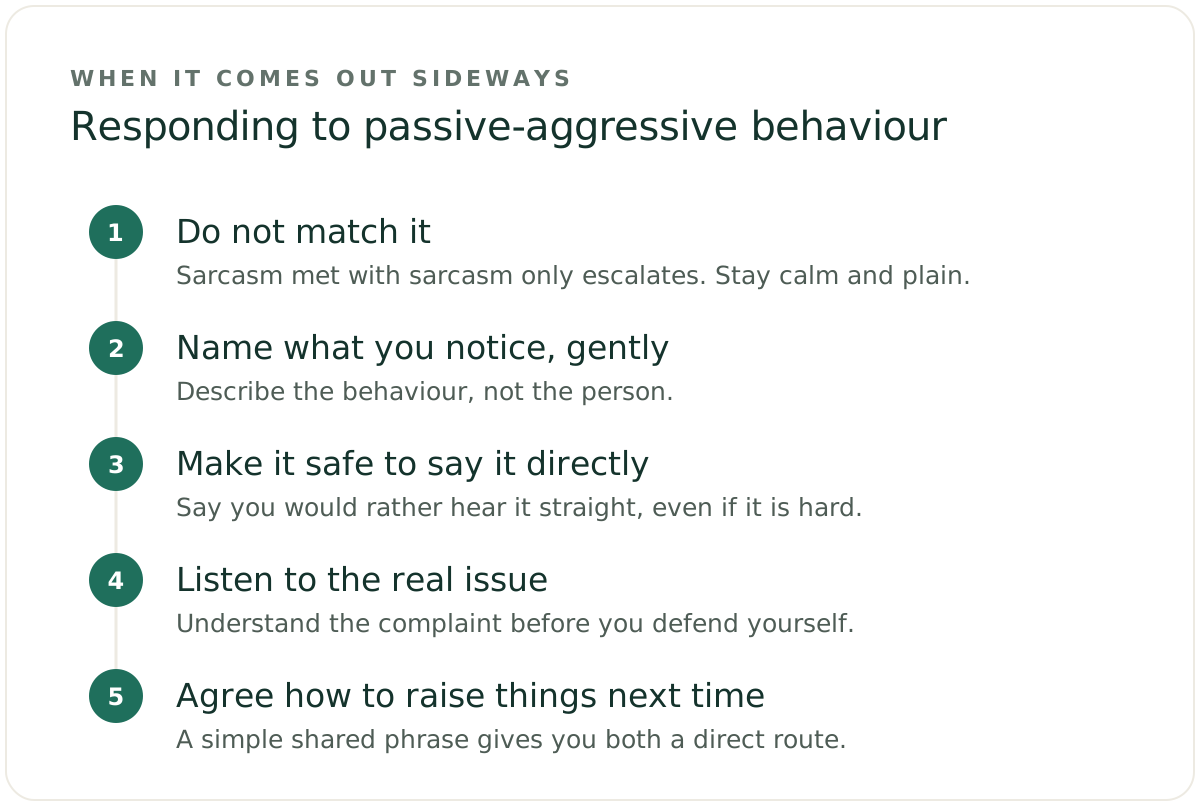
- Do not match it. Sarcasm met with sarcasm only escalates. Stay calm and plain.
- Name what you notice, gently. Describe the behaviour, not the person: “You said ‘fine’, but you seem upset. Is something bothering you?” Avoid “You’re being passive-aggressive”, which invites a denial.
- Make it safe to say it directly. “I’d rather hear it straight, even if it’s hard to hear. I won’t bite your head off.”
- Listen to the real issue. When they do say it, resist the urge to defend yourself straight away. Understanding the complaint first is what makes the next honest conversation more likely.
- Agree how to raise things next time. A simple shared phrase, such as “Can I raise something?”, gives you both a direct route for the next frustration.
An example
Sam has asked Alex twice to stop leaving dishes in the sink. Tonight Alex comes into the kitchen to find Sam washing up loudly, sighing, and saying “No, it’s fine, I’ll just do everything as usual.”
A passive-aggressive reply would be “Well, you clearly love doing it.” A defensive one would be “I was going to do them later!” Neither gets anywhere.
An attuned reply sounds more like: “You don’t sound fine. Are the dishes getting to you again?” That gives Sam a way to say the real thing: “Yes. I feel like I’m the only one who notices, and asking hasn’t worked.” Now there is something to solve, such as agreeing who does the dishes on which nights, instead of a cold evening.
If the behaviour continues, you can hold a calm boundary without escalating: “I can tell something’s wrong. I’m happy to talk about it whenever you’re ready to tell me what it is.” Then leave the door open, and do not chase.
If you are the passive-aggressive one
Recognising it in yourself is the hardest and most useful step. A few things help:
- Notice the urge. The sigh, the “fine”, the slammed drawer: treat each one as a signal that there is something you want to say.
- Find the actual message. Ask yourself what you would say if you knew it would be heard fairly. Usually it is a feeling and a request.
- Say it smaller and earlier. “It bothered me that you were late again” is far easier to say on day one than on day thirty. Our guide to I-statements versus you-statements shows how to phrase it without blame.
- Practise saying no. Much passive aggression starts with a yes you did not mean. A clear no up front avoids a resentful yes later.
- Repair when you slip. “Sorry, that ‘fine’ was me being annoyed. What I actually meant was…” goes a long way.
Passive aggression with family, flatmates and colleagues
It is not only a couples problem. Families, flatmates and workmates fall into it too: the note stuck on the fridge, the group chat comment aimed at one person, the relative who agrees to host and then makes everyone feel the cost, the colleague who keeps “forgetting” to copy you in. The same approach works in each case. Name what you notice without accusing, make it easy for the other person to say the real thing, and agree a direct way to raise problems next time. At work, keep it factual and private, and if the behaviour becomes bullying or deliberate exclusion, raise it through your workplace’s formal channels rather than handling it alone.
When it is more than a communication habit
Most passive-aggressive behaviour is an unhelpful habit between two people who both feel safe. Sometimes it is something more. Deliberately sabotaging a partner’s plans, using silence to punish rather than to cool down, humiliating someone in front of others, or making them afraid to raise anything at all can be part of a pattern of emotional abuse. Our guide to stonewalling explains the difference between withdrawing because you are overwhelmed and the silent treatment used as control.
If you feel afraid of your partner, or they control your money, contacts or decisions, contact 1800RESPECT on 1800 737 732 for confidential support, or 000 in an emergency.
Where FairTalk fits in
Passive aggression thrives where saying things directly feels too risky. FairTalk gives a disagreement a set time and a fair structure, so the issue behind the sighs and hints can finally be said out loud. You talk the issue through together while FairTalk listens without taking sides, and either of you can pause if it gets heated. Afterwards, you both get a fair picture of each other’s perspective and a way forward you have shaped together, along with guidance on the communication skills each of you could build.
If the other person is not ready to talk yet, the solo session feature lets you work through your own side first, so you are clear about what you actually want to say. FairTalk is not therapy, and it is not suitable where there is abuse, coercion or a power imbalance.
Frequently asked questions
What is passive-aggressive behaviour?
Passive-aggressive behaviour is expressing anger or resentment indirectly rather than saying it openly. It looks harmless, accidental or neutral on the surface, such as a sarcastic “fine”, a pointed sigh or a job done badly, but it carries an aggressive message underneath. Because it can always be denied, the real issue rarely gets discussed.
What are examples of passive-aggressive behaviour in a relationship?
Common examples include saying “fine” when you are clearly not, sarcasm and backhanded compliments, sighing or slamming things to be noticed, “forgetting” agreed tasks, saying yes and then not following through, and jokes with an edge in front of other people. One instance on a bad day is normal. A repeated pattern is worth raising.
How do you respond to a passive-aggressive partner?
Stay calm and do not match it. Gently describe what you notice rather than labelling them, for example “You said ‘fine’, but you seem upset”, and make it clear you would rather hear the problem directly. When they do raise it, listen before defending yourself, and agree a simple way to raise things openly next time.
Why are some people passive-aggressive?
Usually because expressing anger directly did not feel safe or effective. Common reasons include growing up where open disagreement was punished, fear of conflict, feeling unheard when asking directly in the past, and resentment from expectations that were never said out loud. It is a learned habit, and it can be unlearned.
Is passive-aggressive behaviour a form of emotional abuse?
Not usually. Most passive-aggressive behaviour is an unhelpful way of handling frustration. It can become part of emotional abuse when it is used deliberately to punish, humiliate or control someone, or leaves them afraid to speak up. If you feel afraid of your partner, contact 1800RESPECT on 1800 737 732.