
The anger iceberg is the idea that anger is often only the visible tip of what someone feels in an argument. Underneath it, out of sight, there are usually softer and more exposed feelings, such as hurt, fear, embarrassment or disappointment, and anger shows up first to protect them.
That is why so many arguments go nowhere. Each person reacts to the anger they can see, and the feelings underneath never get said. This guide explains the anger iceberg, the feelings that most often sit below the waterline, and how to turn the idea into a calm conversation both of you can have once a heated moment has passed.
What is the anger iceberg?
The image is best known through the Gottman Institute, which describes anger as an emotion built into the brain to protect us. Its anger iceberg draws anger as the small part of an iceberg above the water. Most of an iceberg sits below the surface, and in the same way, most of what a person feels in an argument is hidden from the other person, and sometimes from themselves.
That does not make anger fake or wrong. Anger is a basic, valid emotion, and sometimes it is exactly the right response: to being treated unfairly, to a promise being broken, to someone crossing a line. The iceberg simply says that anger is often not the whole story. When it arrives quickly and loudly, it is frequently standing guard over something more vulnerable.
Therapists who work closely with emotions make a similar distinction. In emotion-focused therapy, a reaction that comes straight from a situation, such as sadness at a loss or fear in the face of danger, is called a primary emotion. A secondary emotion is a reaction to that first feeling. As a 2020 review in the Journal of Clinical Medicine explains, secondary emotions often conceal or interrupt the primary ones underneath, and one of its examples is rage in response to shame.
What sits under anger
The feelings below the waterline vary from person to person and from argument to argument. These are some of the most common, with how they tend to sound once anger has taken over:
| Under the surface | What it can sound like on top |
|---|---|
| Hurt | ”Fine. Do whatever you want.” |
| Fear of losing someone or of things falling apart | ”You’re never here anyway.” |
| Embarrassment or shame | ”Why would you say that in front of everyone?” |
| Disappointment | ”I don’t know why I bother.” |
| Feeling unheard | ”I’ve told you this a hundred times!” |
| Feeling taken for granted | ”Do you think I’m the only one who lives here?” |
| Loneliness | ”You care more about your phone than about me.” |
| Exhaustion or overwhelm | ”I can’t do everything around here!” |
Notice how few of the lines on the right actually name the feeling on the left. That is the iceberg at work. The anger gets said out loud, and the feeling it is protecting does not. The other person responds to what they can see, the accusation, and defends themselves against it, so the real issue never gets discussed. Criticism met with defensiveness is one of the patterns the Gottman Institute calls the Four Horsemen, and the iceberg helps explain why it is so hard to break.
Why anger takes the top spot
Anger is a high-energy, self-protective emotion. It makes us feel bigger and stronger at the very moment we feel most exposed. Saying “I felt humiliated when you corrected me in front of your parents” means admitting you were hurt, to the person who hurt you. Saying “You always have to make me look stupid” feels safer, because it puts the other person on the back foot instead.
Anger is also fast. When an argument feels threatening, the brain’s threat system reacts before the thinking parts have caught up, which is why people say things in the heat of a row that they only understand later. Our guide to the science of conflict explains this amygdala hijack in more detail. In the moment, there is rarely room to ask what is underneath. That is work for afterwards.
And for many people, anger is simply the feeling they were allowed to show growing up. Someone raised in a home where tears or fear were mocked may have learned to turn every vulnerable feeling into irritation, often without realising it.
How to find what is under your own anger
You cannot see under someone else’s waterline until you have looked under your own. Once you have calmed down, a few questions help:
- What was I afraid would happen? That they would leave, that you would be blamed, that it would always be like this?
- What did I want them to understand? Often the real message is something like “I am exhausted” or “I felt alone with this.”
- When did I first feel it? The anger may have arrived at the end of the argument, but the hurt might have started hours earlier, with a comment, a forgotten plan or a tone of voice.
- Is this familiar? If the same feeling turns up across lots of different arguments, it may be about something older than this one.
It can help to finish the sentence “I was angry because I felt…” with a feeling rather than an accusation. “I felt like you did not care” is a feeling. “I felt like you were being selfish” is a judgement dressed up as one.
Turning the iceberg into a conversation after a heated moment
The anger iceberg is most useful after an argument, once both of you have settled. It gives you a shared, blame-free way to talk about what happened: not who was wrong, but what was going on underneath for each of you.
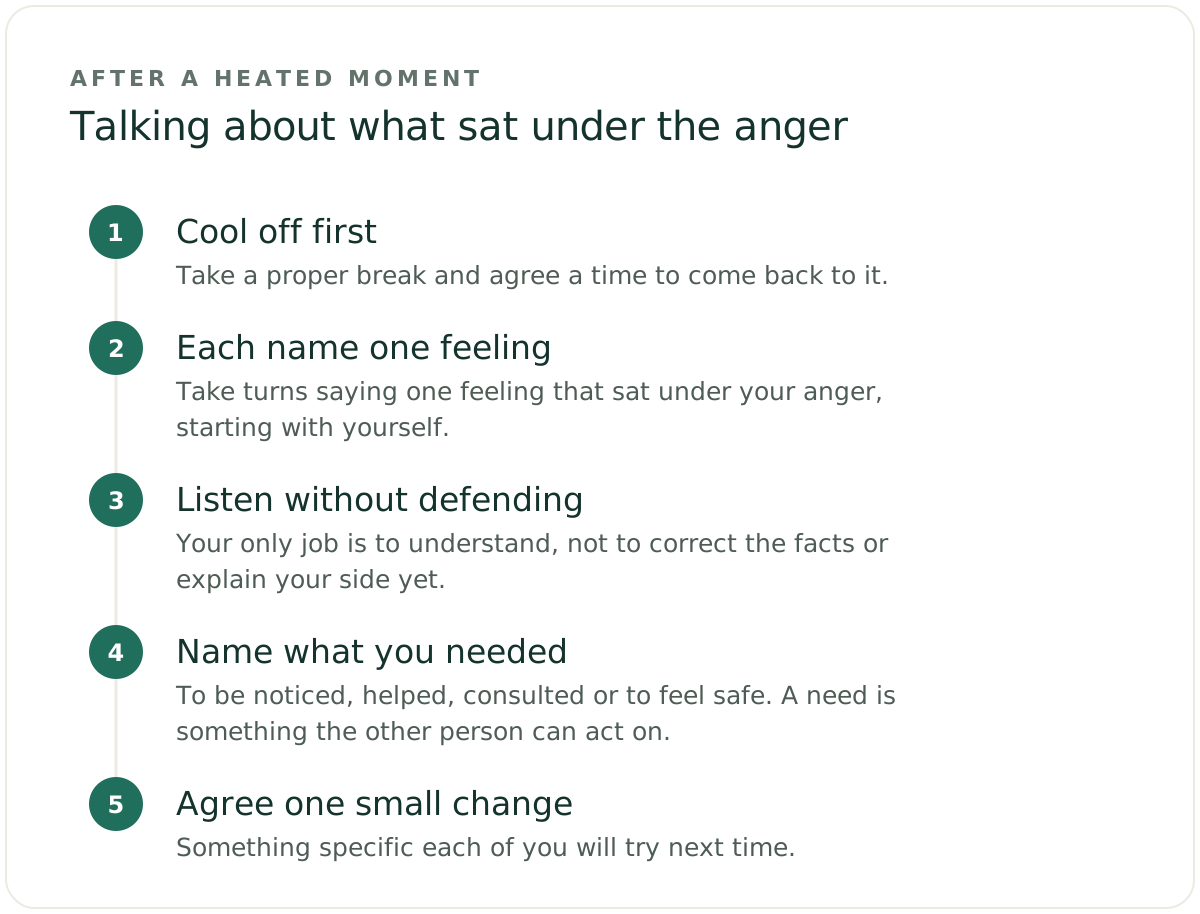
- Cool off first. Trying to dig under anger while you are both still worked up rarely works. Take a proper break and agree a time to come back to it.
- Each name one feeling under the anger. Take turns, and start with yourself: “When you said I never help, I got angry. Under that, I think I felt unappreciated.” One feeling is enough.
- Listen without defending. When it is your turn to listen, your only job is to understand. Not to correct the facts, and not to explain your side yet. “That makes sense. I did not realise you felt that” goes a long way.
- Name what you needed. Under most feelings is a need: to be noticed, to be helped, to be consulted, to feel safe. “What I needed was for you to check with me before you said yes” is something the other person can actually act on.
- Agree one small change. Finish with something specific each of you will try next time, rather than a promise never to argue again.
A few phrases that make it easier to start:
- “I think the anger was covering something else. Can I try to explain what?”
- “I came across as angry, but I think I was actually scared.”
- “What was going on for you under all that?”
- “I don’t need you to agree with me. I just want you to know what it felt like.”
Naming a feeling often takes some of the heat out of it, for both people. For the rest of the repair conversation, our guide to fixing a relationship after an argument walks through what comes next.
When it is the other person who is angry
Seeing the iceberg in someone else can make their anger easier to sit with. Instead of only hearing the accusation, you can wonder what might be under it. Are they hurt, worried, worn out? A calm “It sounds like something really got to you. What was it?” can do more than any defence.
But understanding someone’s anger is not the same as accepting how they express it. The iceberg explains anger. It does not excuse yelling, insults, intimidation or threats, and it does not make you responsible for managing someone else’s feelings. If a partner’s raised voice is a regular part of your arguments, our guide to why a partner yells sets out where the line sits.
When anger is not safe
If anger in your relationship comes with fear, threats, put-downs, controlling behaviour or anything physical, that is not a communication problem, and no technique will fix it. Contact 1800RESPECT on 1800 737 732 for confidential support, or 000 in an emergency.
If you are worried about your own anger, there is support for that too. MensLine Australia (1300 78 99 78) offers counselling for men, and the Men’s Referral Service (1300 766 491) supports men who are concerned about their use of violence or controlling behaviour. Anyone can talk to their GP about anger, and Lifeline (13 11 14) is there any time for crisis support.
Where FairTalk fits in
The feelings under anger are hardest to reach in the middle of an argument, which is exactly when they matter most. FairTalk gives two people a calmer setting for the conversation that comes after. You talk the issue through together while FairTalk listens without taking sides, and either of you can pause if it gets heated. Afterwards, you both get a fair picture of each other’s perspective and a way forward you have shaped together, along with guidance on the communication skills each of you could build.
Seeing both sides laid out fairly can make it easier to notice the hurt or worry that sat under the sharp words. If the other person is not ready to talk yet, the solo session feature lets you work through your own side first, so you understand what was under your anger before you raise it with them. FairTalk is not therapy, and it is not suitable where there is abuse, coercion or a power imbalance.
Frequently asked questions
What is the anger iceberg?
The anger iceberg is a way of picturing anger as the visible tip of an iceberg, with other feelings hidden below the surface. Those hidden feelings, such as hurt, fear, embarrassment, disappointment or loneliness, are often what the anger is protecting. The Gottman Institute popularised the image, and therapists use it to help people understand what drives an argument.
Is anger a secondary emotion?
Sometimes. Anger can be a direct, primary response, for example to being treated unfairly. But it often appears as a secondary emotion, a reaction to a more vulnerable feeling such as hurt or shame underneath. Working out which it is helps you respond to the right thing.
What emotions are under anger?
Common ones are hurt, fear, embarrassment, shame, disappointment, loneliness, feeling unheard or taken for granted, and exhaustion. Which one sits under a particular argument varies from person to person, so the best way to find out is to ask yourself, and each other, once things have calmed down.
How do you use the anger iceberg in a relationship?
Use it after an argument, not during one. Once you have both calmed down, take turns naming one feeling that sat under your anger, listen without defending, say what you needed, and agree one small thing to try next time. It turns a fight about who was wrong into a conversation about what each of you felt.
Does understanding someone’s anger mean I have to accept it?
No. Understanding what drives anger can help you respond with more care, but it does not excuse yelling, insults, threats or intimidation. If anger in your relationship makes you feel afraid, contact 1800RESPECT on 1800 737 732, or 000 in an emergency.