Couples therapy is therapy in which both partners in a relationship work with the same therapist at the same time, to address the problems between them, very often including how they communicate. It is one of the most effective ways to help a struggling relationship. But cost, distance, time and privacy stop many couples from ever starting.
This guide explains what couples therapy involves and why communication sits at the centre of it. It then looks honestly at the obstacles that keep so many couples away from the therapist’s room, and at what you can do when therapy is not within reach, or not yet.
What couples therapy is
The APA Dictionary of Psychology describes couples therapy as treatment in which both partners in a committed relationship are seen together by the same therapist or therapists. It deals with problems within and between the two people that affect the relationship. That might be one partner’s undiagnosed depression spilling into the relationship, or two people who simply cannot talk to each other without it going wrong. Some therapists see each partner on their own early on, but most of the work happens with both of you in the room.
In Australia, couples therapy is offered by psychologists, counsellors, social workers and family therapists, in private practice, through not-for-profit services and increasingly by video. People go for all sorts of reasons: an argument that keeps repeating, growing distance, a breach of trust, a big life change such as a new baby or a move, or a decision about whether to stay together.
And it works for most couples who try it. A widely cited review of a decade of research, published in the Journal of Marital and Family Therapy in 2012, concluded that couple therapy positively affects about 70 percent of the couples who receive it, with results comparable to individual therapy and far better than no treatment.
Why communication sits at the centre of it
Whatever brings a couple to therapy, the work almost always comes back to communication: how you raise a problem, how you listen, what happens when you disagree, and how you repair afterwards. The APA’s own example of a reason for couples therapy is two people who have trouble communicating effectively with each other.
That focus matters because communication is learnable, and improving it changes more than the arguments. A 2008 meta-analysis in the Journal of Consulting and Clinical Psychology, drawing on 117 studies, found that relationship education programmes improved both couples’ communication skills and the overall quality of their relationships.
In everyday terms, better communication tends to mean:
- Problems get raised earlier, while they are still small, rather than after months of resentment.
- Arguments stay on the issue instead of turning into a contest about who is the worse person.
- Both people feel understood, even when they still disagree.
- Repairs land. An apology or a softening moment is accepted rather than brushed aside.
- The benefits spread. Couples who handle conflict well bring that calm to parenting, family gatherings and life generally.
If you want to start on the skills themselves, our guide on how to improve communication in a relationship covers the core ones.
The barriers that keep couples from therapy
Knowing therapy works is one thing. Getting there is another. These are the obstacles couples run into most often.
Cost
Couples therapy is a significant expense, and progress usually takes several sessions. Private sessions in Australia commonly cost around $100 to $330 each, and Medicare rarely covers couples sessions. Our guide to couples counselling cost sets out the figures, where they come from, and the lower cost options that exist.
Where you live
Therapists are not spread evenly across the country. The Australian Institute of Health and Welfare reports that the mental health workforce is concentrated in major cities, most sharply for psychologists, with far fewer per person in remote areas. For couples in rural and remote Australia, the nearest couples therapist may be hours away. Video sessions help, but they still depend on a reliable connection, somewhere private at home, and a time that suits everyone. In a small town there is also the chance that the only counsellor nearby is someone you know socially.
Finding a therapist you both connect with
The relationship with the therapist matters a great deal. A 2018 meta-analysis of 295 studies, covering more than 30,000 people in therapy, found a consistent link between the strength of the client and therapist relationship and how well therapy works. In couples therapy that relationship has to work for two people at once, and it is common for one partner to feel the therapist understands the other one better. Finding the right fit can mean trying more than one therapist, which adds cost and delay.
Telling a stranger about your private life
For many people, the hardest part is the idea of sitting across from someone they do not know and talking about the most private parts of their relationship: money, sex, family, the things said in the worst moments. Some partners refuse to go for exactly this reason, and a therapy that only one person will attend is not couples therapy. If that sounds familiar, our guide to the reluctant partner covers how to make progress on your own and invite them in without pressure.
Time and scheduling
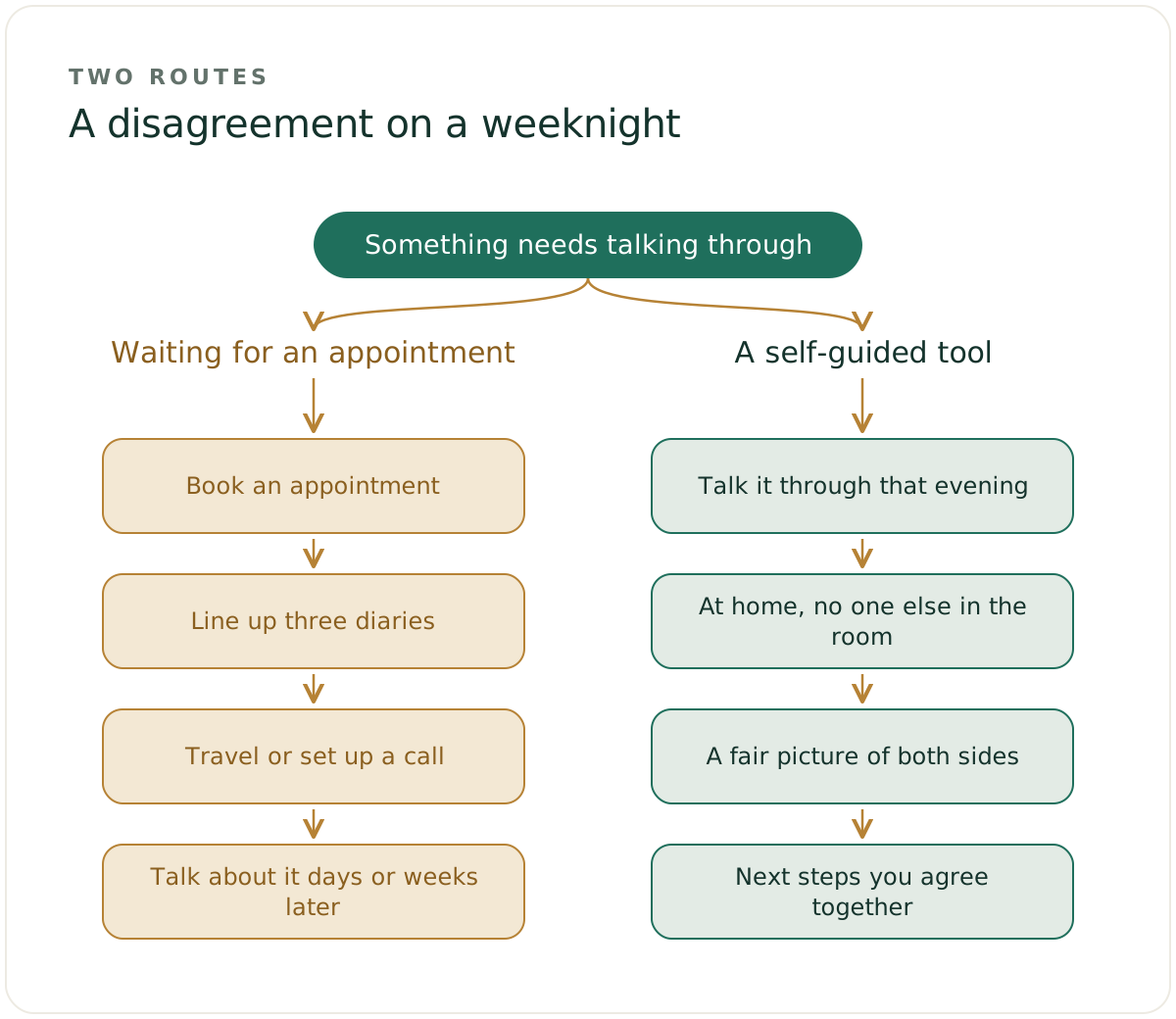
Couples therapy needs three diaries to line up: yours, your partner’s and the therapist’s. Shift work, children, long commutes and work hours make that harder than it sounds, and some practitioners have waiting lists. Then there is timing. Conflict happens at nine o’clock on a Sunday night, but the next appointment might be in two weeks. By then the moment has passed, the details have blurred, and the conversation starts from a weaker place.
Where FairTalk fits in
FairTalk was built for exactly these obstacles, for the everyday disagreements that would otherwise go unaddressed. You talk the issue through together while FairTalk listens without taking sides, and either of you can pause if it starts to get heated. Afterwards, you both get a fair picture of each other’s perspective and a way forward you have shaped together, along with guidance on the communication skills each of you could build. You can read more about the idea behind it in how FairTalk works.
Here is how that answers each barrier:
- Cost. Professional services serving the same purpose are in the vicinity of ten times more expensive than the app subscription.
- Where you live. It works wherever the two of you are together, whether that is a city apartment or a property hours from the nearest town. No travel, no waiting for a practitioner to have space.
- Connecting with a therapist. FairTalk is designed to be impartial: it gives both of you the same attention and does not side with whoever is more persuasive, so there is no worry about the therapist liking one of you more.
- Privacy. No other person is in the room or listening in. FairTalk does not keep the audio of your conversation, and what you share is never sold or used for advertising.
- Time. It is there when the disagreement actually happens, on a weeknight or a weekend, with no appointment to wait for and no third diary to match.
And if your partner is not ready to take part, FairTalk also offers a one-person conversation, so you can work through your own side and decide what to do next.
FairTalk is not therapy, and it is not a replacement for it where therapy is needed. Many couples use both: a therapist for the deeper work, and FairTalk for the day-to-day disagreements in between. Our comparison of an AI relationship coach and couples therapy looks at where each one fits.
When couples therapy is still the right choice
Some situations need a qualified professional, whatever the obstacles:
- the same conflict keeps escalating and you cannot discuss it without it blowing up
- there has been an affair or another serious breach of trust
- you are deciding whether to stay together or separate
- depression, anxiety, addiction or trauma is part of the picture
- one of you has stopped engaging altogether
If there is violence, fear or controlling behaviour in the relationship, joint sessions are not always safe and FairTalk is not the right tool either. Contact 1800RESPECT on 1800 737 732, or 000 in an emergency.
Frequently asked questions
What is couples therapy?
Couples therapy is therapy in which both partners in a relationship work with the same therapist at the same time. It addresses problems within and between the two people that affect the relationship, such as recurring conflict, distance, a breach of trust or difficulty communicating. In Australia it is offered by psychologists, counsellors, social workers and family therapists, in person or by video.
Does couples therapy help with communication?
Yes. Communication is at the centre of most couples therapy, and research supports it: a 2008 meta-analysis of 117 studies found that relationship education programmes improved couples’ communication skills and the overall quality of their relationships. Better communication usually means problems are raised earlier, arguments stay on the issue, and both people feel understood.
Can you get couples therapy if you live in a rural or remote area?
Yes, though it is often harder. The mental health workforce in Australia is concentrated in major cities, so many rural and remote couples rely on video sessions, which need a reliable connection and somewhere private at home. Self-guided tools that work wherever the two of you are together can help with everyday disagreements in the meantime.
What if we can’t afford couples therapy?
There are lower cost options. Relationships Australia sets most fees by income and offers some free services, and Family Relationship Centres provide free sessions for families going through separation. For everyday disagreements, self-guided tools cost a fraction of private therapy, while therapy remains the right choice for serious or long-standing problems.
What if my partner won’t go to couples therapy?
You can still make progress on your own. Individual counselling can help you understand your side of the pattern, and a one-person conversation in a self-guided tool can help you get clear on what you need and what to do next. Sometimes one partner changing how they approach conflict is what makes the other willing to take part later.