Attunement in a relationship is the ability to tune in to your partner’s feelings and respond with understanding, even when you disagree. The Gottman Institute describes it as the capacity to be in harmony with your partner’s feelings, and breaks it into six skills known as ATTUNE: three for the person raising an issue and three for the person listening.
Attunement is not the same as agreeing. You can see a situation completely differently from your partner and still let them know you understand how it feels to them. That is often what turns an argument from a contest into a conversation. This guide covers what attunement is, why it matters, the six ATTUNE skills with examples of what to say, and how to practise attunement day to day.
What is attunement?
The Gottman Institute, in its guide to practising emotional attunement, describes attunement as being aware and considerate of your partner’s feelings: even if you disagree, you stay open to their different experience and can still show them care.
The word is also used in child development, where it describes a parent tuning in to a baby’s signals and responding to them. The idea between adults is much the same. You notice what the other person is feeling, you show them you have noticed, and you respond to the feeling rather than only to the words.
Why attunement matters
Attunement sits underneath many of the things couples say they want: trust, closeness and feeling heard. The Gottman Institute’s guide to building trust puts it simply: the basis of trust is the idea of attunement. When you repeatedly experience your partner tuning in to how you feel, you come to trust that they have your back.
It also changes how arguments go. In its article Understanding Must Precede Advice, the Gottman Institute reports that problem solving or giving advice before understanding your partner’s feelings is counterproductive and actually interferes with reaching a resolution. Many arguments stall not because the problem is hard, but because one person still does not feel understood.
What attunement looks like in practice
The difference is easiest to see side by side. Imagine your partner says, “I’m dreading work tomorrow.”
| Response | What it does |
|---|---|
| ”Just quit, then.” | Fixing. Jumps to a solution before understanding the feeling. |
| ”Everyone hates Mondays.” | Dismissing. Tells them the feeling is not worth talking about. |
| ”You think you’ve got it bad? Wait till you hear about my day.” | Turning it to yourself. Moves the attention away from them. |
| ”What’s making tomorrow feel so heavy?” | Attuned. Notices the feeling and invites them to say more. |
None of the first three responses is cruel, and most come from a wish to help. But each one leaves the other person alone with the feeling. The attuned response is often shorter and simpler than people expect.
Signs of attunement in a relationship
Attuned couples are not mind readers, and they still misread each other. What sets them apart is how often each person notices and responds. Signs that attunement is working:
- You can tell when something is off with your partner, and you ask rather than guess.
- When you raise a worry, your partner asks questions before offering advice.
- You can disagree without either of you being told you are overreacting.
- After an argument, you each understand why the other was upset, even if you still see it differently.
- Small signals get noticed: a quiet evening, a short reply, a sigh.
Signs it is missing include having to explain the same feeling again and again, conversations that keep swinging back to the other person’s problems, and a sense that your moods are only noticed when they become a problem.
The ATTUNE model: six skills
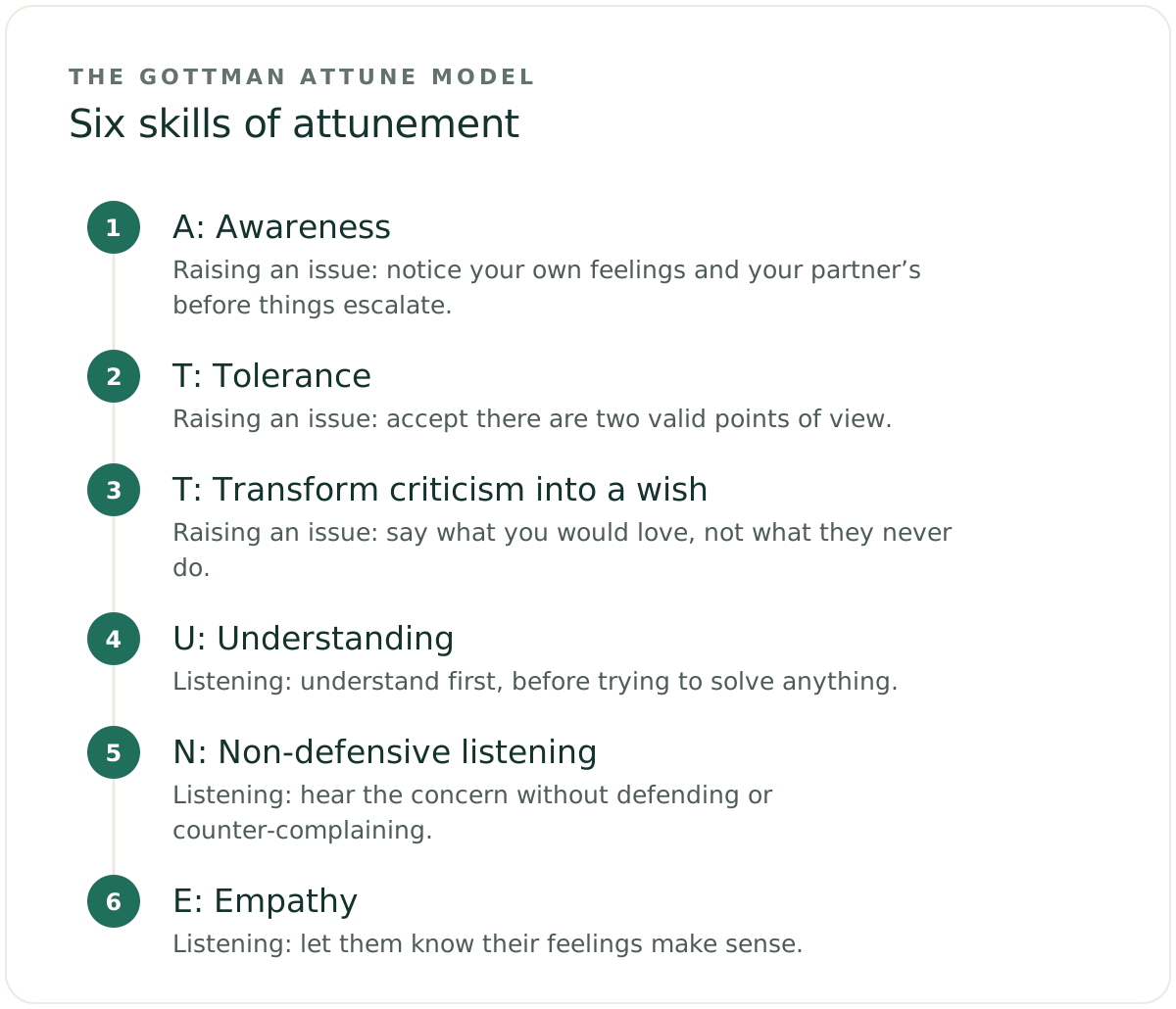
In the version described in Understanding Must Precede Advice, ATTUNE splits into two roles: the person raising a concern, and the person listening. (Some Gottman materials use “turning toward” for the second T, but the idea is the same.)
For the person raising an issue
A: Awareness. Notice your own feelings, and notice when your partner is struggling, before things escalate. “I can feel myself getting tense about the money stuff. Can we talk about it before it builds up?”
T: Tolerance. Accept that there are two valid points of view in most disagreements, and that your partner’s feelings make sense from where they stand, even when you see it differently.
T: Transforming criticism into a wish. Every criticism hides a wish. Instead of “You never plan anything,” try “I’d love it if you planned a night out for us this month.” Our guide to I-statements versus you-statements covers this shift in detail.
For the person listening
U: Understanding. Your first job is to understand, not to solve. Ask questions until you could explain your partner’s feelings back to them in a way they would agree with.
N: Non-defensive listening. Hear the concern without immediately defending yourself, explaining or counter-complaining. Defensiveness is one of the patterns the Gottman Institute calls the Four Horsemen, and it is the quickest way to shut attunement down.
E: Empathy. Let your partner know their feelings make sense: “No wonder you felt left out. I’d have felt the same.” Empathy does not mean you caused the feeling or agree with every point. It means you understand.
Attunement in the middle of an argument
Attunement is easiest when things are calm and hardest when you are upset, which is exactly when it is needed. A few things help:
- Notice when you are too flooded to attune. If your heart is racing and you are rehearsing your reply, you are not listening. Take a break and agree a time to come back.
- Reflect before you respond. “So what you’re saying is you felt I didn’t back you up in front of my mum?” It slows the argument down and catches misunderstandings early.
- Ask about the feeling, not just the facts. “What was the hardest part of that for you?” tends to open a conversation that “That’s not what happened” closes.
- Ask what they need. “Do you want me to help fix it, or do you just need me to listen?” is one of the most attuned questions there is.
Attunement is closely related to active listening, and practising one strengthens the other.
How to practise attunement day to day
You do not have to wait for an argument to build the skill. The Gottman Institute suggests a weekly State of the Union meeting, a regular time to talk about how the relationship is going, as a way to start building the skills of attunement. A simple version:
- Start with appreciation. Name one or two things your partner did that week that you valued.
- Take turns raising one issue. Use the speaker skills: awareness, tolerance, and a wish rather than a criticism.
- Listen with the listener skills. Understand first, do not defend, and show empathy.
- Finish with what you each need. One small thing for the week ahead.
Over time, the same habits show up in ordinary moments, and they are a big part of emotional intimacy: feeling known and understood by the person you share your life with.
When attunement only goes one way
Attunement works when both people practise it. If you are always the one tuning in to your partner’s moods while your own feelings are ignored or dismissed, that imbalance is worth raising directly.
And attunement is never a reason to put up with harm. If you find yourself constantly monitoring your partner’s moods because you are afraid of how they will react, that is not attunement, it is fear. Contact 1800RESPECT on 1800 737 732 for confidential support, or 000 in an emergency.
Where FairTalk fits in
Attunement is hardest to practise in the conversations that matter most. You talk the issue through together while FairTalk listens without taking sides, and either of you can pause if it gets heated. Afterwards, you both get a fair picture of each other’s perspective and a way forward you have shaped together, along with guidance on the communication skills each of you could build.
Seeing your partner’s perspective laid out fairly, in their terms, is a practical way to understand what they were feeling, even when you disagreed. If your partner is not ready to talk yet, the solo session feature lets you work through your own side first. FairTalk is not therapy, and it is not suitable where there is abuse, coercion or a power imbalance.
Frequently asked questions
What is attunement in a relationship?
Attunement in a relationship is the ability to tune in to your partner’s feelings and respond with understanding, even when you disagree. The Gottman Institute describes it as the capacity to be in harmony with your partner’s feelings. It involves noticing what the other person feels, showing them you have noticed, and responding to the feeling rather than only the words.
What does ATTUNE stand for?
ATTUNE is an acronym from the Gottman Institute for six attunement skills: awareness, tolerance, transforming criticisms into wishes, understanding, non-defensive listening and empathy. The first three are for the person raising an issue, and the last three are for the person listening. Some Gottman materials use “turning toward” for the second T.
What is the difference between attunement and empathy?
Empathy is one part of attunement. Attunement is the wider skill of noticing your partner’s feelings, understanding them before trying to fix anything, listening without getting defensive, and then responding with empathy. You can feel empathy without showing it, while attunement means your partner can tell you have understood.
How do you practise attunement with your partner?
Start by asking about feelings before offering solutions, reflecting back what you heard, and asking whether your partner wants help or just wants you to listen. A regular weekly check-in, where you take turns raising one issue and listening without defending, builds the habit over time.
Can you be attuned to someone and still disagree with them?
Yes. Attunement means understanding how a situation feels to your partner, not agreeing with their view of it. Showing that you understand often makes it easier to talk through the disagreement itself, because neither person is still fighting to be heard.