
Emotional intimacy is the feeling of being truly known and accepted by another person. You can share what you think, feel and worry about, and trust that they will respond with care. It is built through small moments of openness and responsiveness, and it fades when hurt, conflict or busyness go unaddressed for too long.
The good news is that emotional closeness is not a fixed trait some couples have and others lack. It rises and falls, and it can be rebuilt. This guide covers what emotional intimacy is, the signs it is fading, the everyday things that erode it, including conflict that is handled badly or avoided altogether, and practical ways to build it back.
What is emotional intimacy?
Emotional intimacy is closeness at the level of thoughts and feelings rather than touch. It is different from physical intimacy, though the two often rise and fall together. A couple can share a bed and a household and still feel emotionally distant, and two people can feel deeply close without any physical relationship at all.
Research suggests it grows from two things working together. A well-known 1998 study in the Journal of Personality and Social Psychology, Intimacy as an interpersonal process, looked at self-disclosure, the other person’s disclosure, and perceived partner responsiveness. In plain terms: you share something real, and you feel that the other person understood it and cared. Sharing is only half of it. Feeling understood is the other half.
Signs of emotional intimacy, and signs it is fading
Closeness is easiest to see by contrast:
| When you feel close | When closeness is fading |
|---|---|
| Your partner is one of the first people you tell when something happens | You tell friends first, or no one |
| Conversations go beyond logistics | Most conversations are about schedules, bills and chores |
| You can disagree without fear of how they will react | You avoid topics to keep the peace |
| Small attempts to connect get a response | Comments, questions and touches go unanswered |
| You feel accompanied, even on hard days | You feel lonely, even in the same room |
Most couples move between these columns over time, especially through busy or stressful seasons. The warning sign is not a bad month. It is when the right-hand column has quietly become normal.
What erodes emotional closeness
Emotional distance rarely comes from one dramatic event. It usually builds from a few ordinary patterns:
- Bids that go unanswered. The Gottman Institute calls small attempts to connect “bids”. In its research on turning toward, couples who were still married at a six year follow-up had turned towards each other’s bids 86% of the time, compared with 33% for couples who divorced. Our guide to building healthier connections covers bids in more detail.
- Conflict that is never resolved. Each argument left hanging adds a layer of resentment, and resentment makes openness feel risky.
- Conflict that is avoided altogether. Keeping the peace by never raising anything can feel like closeness, but it often means each person is hiding part of themselves.
- Criticism and contempt. If sharing a feeling might be met with a put-down or an eye-roll, people stop sharing. These are two of the patterns the Gottman Institute calls the Four Horsemen.
- Busyness and screens. Work, children and phones crowd out the unstructured time where real conversation tends to happen.
- Stress and exhaustion. When one or both of you are running on empty, there is little left over for curiosity and care.
How to build emotional intimacy
Rebuilding closeness works best in small, regular steps rather than one big conversation. They overlap with the wider relationship advice that research supports.
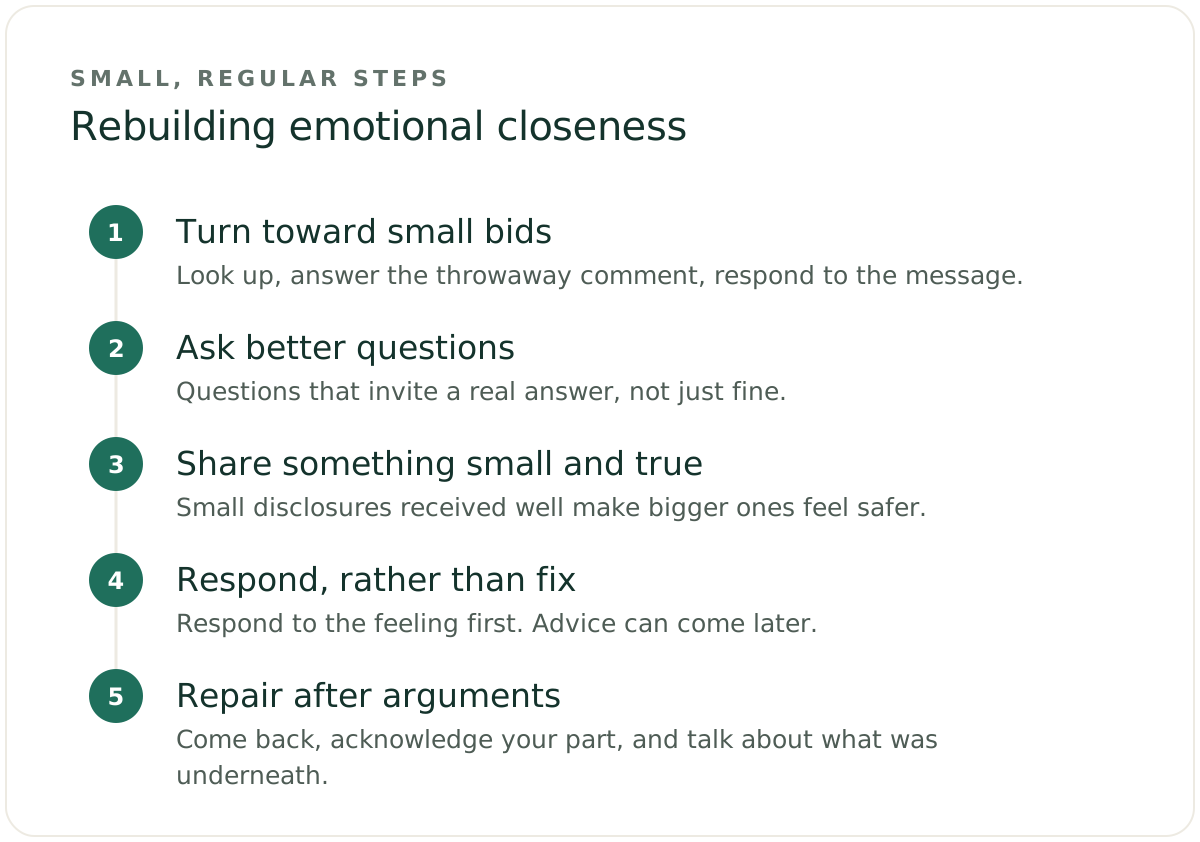
1. Turn toward small bids
Look up when your partner speaks. Answer the throwaway comment. Respond to the message. None of this is dramatic, and that is the point: closeness is built in dozens of moments most people barely notice.
2. Ask better questions
“How was your day?” gets “Fine.” Questions that invite a real answer work better:
- “What was the best and worst part of today?”
- “What’s been on your mind lately that we haven’t talked about?”
- “What are you looking forward to this month?”
- “Is there anything you’ve been wanting from me that you haven’t asked for?”
Psychologist Arthur Aron and colleagues showed how powerful this can be. In a 1997 study titled The Experimental Generation of Interpersonal Closeness, pairs of participants spent about 45 minutes taking turns on questions and tasks that grew gradually more personal, and they felt closer afterwards than pairs who spent the same time on small talk. Couples can use the same idea at home: take turns, go a little deeper each time, and listen properly to the answer.
3. Share something small and true
You do not have to start with your deepest fear. Start with something small and real: “I felt a bit left out at dinner with your friends,” or “I’m more worried about work than I’ve been letting on.” Small disclosures that are received well make bigger ones feel safer.
4. Respond, rather than fix
When your partner shares something, the urge to solve it can shut the conversation down. Try responding to the feeling first: “That sounds really frustrating. What happened?” Feeling understood is what turns sharing into closeness. Advice can come later, if they want it. This is the heart of attunement in relationships.
5. Repair after arguments
Every couple argues. What protects closeness is coming back afterwards, acknowledging your part and talking about what happened underneath. Our guide to fixing a relationship after an argument walks through how.
Why talking about hard things brings you closer
It can seem as though avoiding conflict would protect emotional intimacy. Usually it does the opposite. Each unspoken frustration is a small part of yourself held back, and over time the relationship becomes polite rather than close.
Couples who can raise a problem, disagree honestly and still feel respected tend to feel closer afterwards, not further apart. That is why the way you argue matters so much. Agreeing a set of fair fighting rules can make hard conversations feel safe enough to have.
When distance is a sign of something more
Sometimes emotional distance is a symptom rather than the problem:
- Depression or anxiety. Withdrawal, flatness and loss of interest can be signs of a mental health condition. Encourage your partner to see their GP, and look after yourself too.
- A breach of trust. After an affair or a serious betrayal, rebuilding closeness usually needs more than everyday habits, and a couples counsellor can help.
- Fear or control. If you feel afraid of your partner, or they control your money, contacts or decisions, distance is a protective response, not an intimacy problem. Contact 1800RESPECT on 1800 737 732 for confidential support, or 000 in an emergency.
Where FairTalk fits in
Emotional distance often grows around the issues a couple has stopped raising because every attempt ends in the same argument. FairTalk gives those conversations a fairer setting. You talk the issue through together while FairTalk listens without taking sides, and either of you can pause if it gets heated. Afterwards, you both get a fair picture of each other’s perspective and a way forward you have shaped together, along with guidance on the communication skills each of you could build.
Feeling heard on a difficult topic, and hearing your partner properly in return, is one of the quickest routes back to closeness. If your partner is not ready to talk yet, the solo session feature lets you work through your own side first. FairTalk is not therapy, and it is not suitable where there is abuse, coercion or a power imbalance.
Frequently asked questions
What is emotional intimacy?
Emotional intimacy is the feeling of being truly known and accepted by another person, so that you can share your thoughts, feelings and worries and trust that they will respond with care. It is built when one person shares something real and the other responds with understanding. It is different from physical intimacy, though the two often affect each other.
What are the signs of a lack of emotional intimacy?
Common signs are conversations that rarely go beyond logistics, telling friends things before your partner, avoiding topics to keep the peace, small attempts to connect going unanswered, and feeling lonely even when you are together. Most couples go through distant patches, so the concern is when these become the normal pattern.
How do you build emotional intimacy in a relationship?
Build it through small, regular habits: respond to your partner’s attempts to connect, ask questions that invite a real answer, share something small and true about how you feel, respond to their feelings before offering solutions, and repair after arguments. Consistency matters more than any single deep conversation.
Can emotional intimacy be rebuilt?
Yes, in most relationships where both people want it. Closeness rises and falls over time, and it can be rebuilt through regular small moments of openness and responsiveness, and by dealing with the conflicts that created the distance. After a serious breach of trust, a couples counsellor can help.
What is the difference between emotional and physical intimacy?
Emotional intimacy is closeness in thoughts and feelings, while physical intimacy is closeness through touch and sex. A couple can have one without the other, but they often influence each other, and many people find physical closeness harder when they feel emotionally distant.