
To compromise in a relationship, each person says plainly what they want and why it matters, listens for the need behind the other person’s position, then looks for an option that protects what matters most to both. Sometimes that means each giving a little. Sometimes there is a better answer than meeting in the middle.
Negotiation and compromise sound like boardroom words, but most of us use them every day: deciding whose family to visit at Christmas, how to split the chores, which restaurant to book, who takes the Friday shift. Done well, they keep relationships fair and calm. Done badly, one person quietly gives in again and again, and resentment builds where agreement should be. This guide covers how to do it well, with a partner, a friend, a family member or a colleague.
Negotiation and compromise are not the same thing
Negotiation is the conversation: two people with different wants talking their way towards an agreement. Compromise is one possible outcome of that conversation, where each person gives up part of what they wanted so you can meet somewhere in between.
The distinction matters, because compromise is not always the best result. If you want to see the coast this weekend and your partner wants a quiet weekend at home, splitting the difference might mean half a day at the beach that suits neither of you. Asking why each of you wants what you want might reveal that you need to get out of the house and they need to avoid a long drive, and a quiet beach twenty minutes away gives you both what you were really after.
That shift, from what each person is demanding to why they want it, is the heart of good negotiation. The Program on Negotiation at Harvard Law School calls it focusing on interests rather than positions, one of the core principles of the well-known negotiation book Getting to Yes. A position is the demand (“we’re going to my parents’ for Christmas”). An interest is the reason behind it (“Mum isn’t well and I’m worried this could be her last good one”). Positions clash. Interests often fit together better than you expect.
When compromise is healthy, and when it is not
Healthy compromise is a sign of a strong relationship. It means both people care enough about each other’s needs to give something up. But compromise can also go wrong.
Healthy compromise looks like:
- both people giving something, even if not always in equal measure on every issue
- give and take that balances out over time, so neither person is always the one who bends
- each person being clear about what matters most to them and holding onto that
- an agreement both people can say yes to without resentment
Unhealthy compromise looks like:
- one person always giving in to keep the peace
- giving up something central to who you are, such as your values, your safety, your health or your important relationships
- “splitting the difference” on things that cannot be split in half, such as whether to have children or whether to move to another country
- agreeing to something you have no intention of keeping, just to end the conversation
If you notice you are always the one compromising, that is worth naming. Knowing where your limits are, and holding them kindly, is part of setting healthy boundaries, and it makes you a better negotiator, not a more difficult one.
How to negotiate a fair compromise, step by step
The same process works whether the other person is your partner, your sister or the person at the next desk.
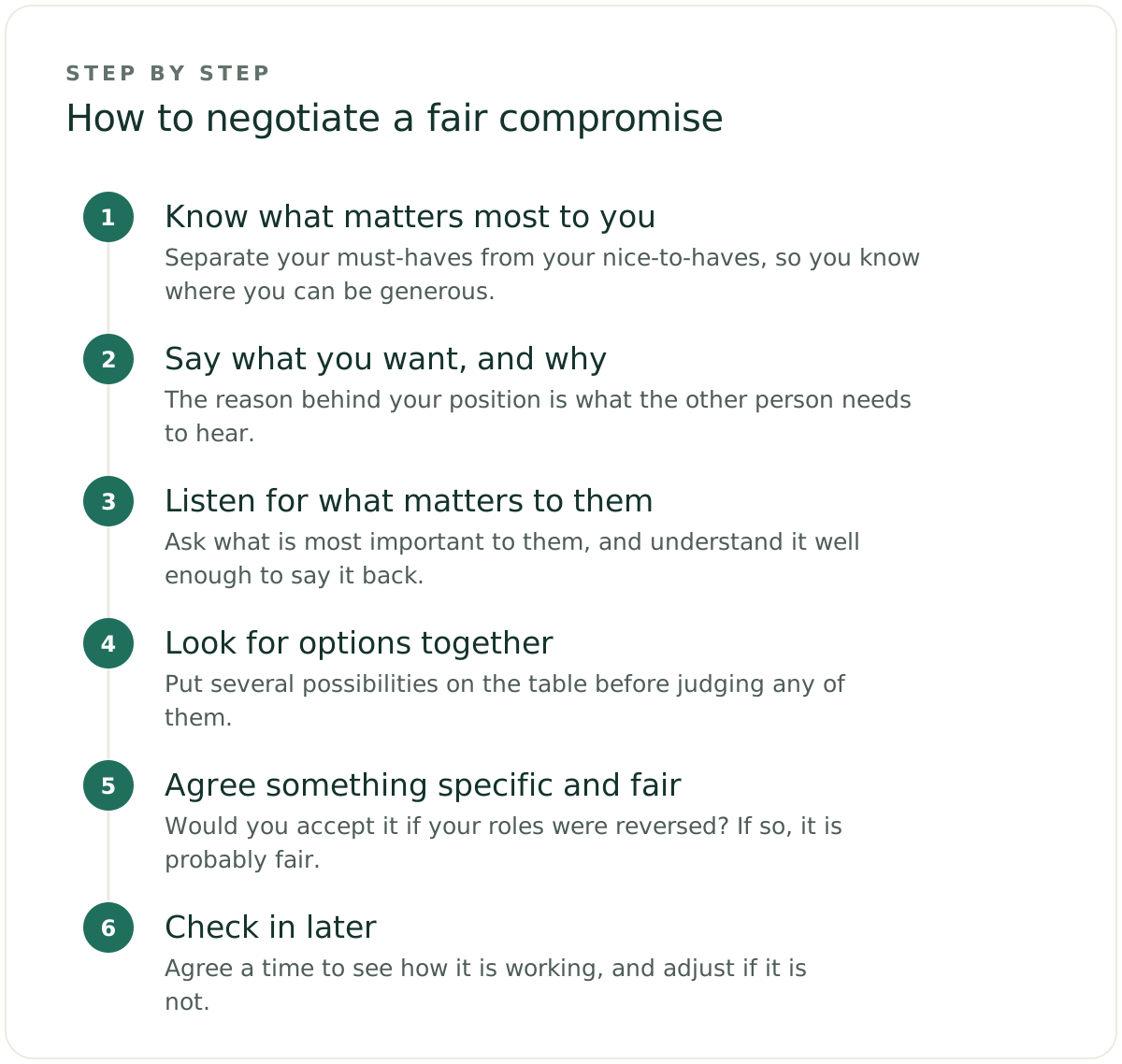
- Know what matters most to you. Before the conversation, separate your must-haves from your nice-to-haves. Most disagreements involve one or two things you really care about and several you could happily let go. Knowing which is which tells you where you can be generous.
- Say what you want, and why. Relationships Australia puts it simply: listen to understand the other person’s intentions, needs and wants, then state what you want and need, and negotiate where you differ. Try: “I’d really like us to do Christmas with my family this year, because I’m worried about Mum.”
- Listen for what matters to them. Ask “What’s most important to you about this?” and listen to the answer without preparing your rebuttal. The goal is to understand their interest well enough to say it back to them.
- Look for options together. Put several possibilities on the table before you judge any of them. Christmas Day with one family and Boxing Day with the other. Alternating years. Hosting both families. A creative option nobody thought of at the start is often the best one.
- Agree something specific and fair. “We’ll sort it out” is not an agreement. “Christmas lunch with your family this year, my family next year, and we’ll both call Mum on the day” is. A useful test of fairness: would you accept this agreement if your roles were reversed?
- Check in later. Agree a time to see how it is working, and be willing to adjust. A compromise that turns out not to work is not a failure, just information.
If emotions run high partway through, pause and come back to it. A negotiation conducted while either person is flooded rarely produces an agreement that lasts. The wider set of conflict resolution strategies covers keeping a heated conversation on track.
Compromise with a partner
Partners negotiate constantly, about money, chores, time with friends, family, sex, holidays and where to live. A few things make it easier:
- Raise things early. It is far easier to negotiate who does the dishes than to negotiate months of built-up resentment about who does the dishes.
- Negotiate roles, not just tasks. Rather than arguing chore by chore, agree who generally looks after what: bills, meals, school forms, the car.
- Keep the big picture in view. You are not opponents trying to win a point. You are two people trying to build a life that works for both of you.
Compromise with friends
Friendships have fewer formal structures than families or workplaces, so negotiation tends to happen quietly or not at all. Friends drift apart over unspoken mismatches: one always organises, one always picks the venue, one keeps suggesting plans the other cannot afford.
Naming it lightly is usually enough: “I love catching up, but dinners in the city are getting expensive for me. Could we alternate with something cheaper?” Most friends are relieved to be asked.
Compromise with family
Family negotiations carry history. A disagreement about where to hold a birthday can carry decades of who was favoured and who always gave way. It helps to keep the conversation on the present decision, involve everyone affected, and accept that you may not get every relative to agree. Our guide to family conflict covers the longer-running tensions.
For families going through separation, negotiating arrangements for children is one of the hardest conversations there is. Australia’s Family Relationship Centres offer help through family dispute resolution, and the government’s Family Relationships Online site explains how to find your nearest centre, or you can call the Family Relationship Advice Line on 1800 050 321.
Compromise with colleagues
At work, negotiation is often about workload, deadlines, priorities and how a shared task gets done. The Fair Work Ombudsman notes that many workplace issues can be resolved quickly and informally by talking them through, and that most problems at work come down to a misunderstanding. It offers free online courses on having difficult conversations at work, and suggests preparing before you talk and, if talking does not fix it, putting your concerns in writing. With a colleague, a few habits help:
- work out beforehand what you need and whether it is realistic
- describe the problem and its impact rather than blaming
- listen more than you talk, and ask how they see it
- offer solutions tentatively (“I wonder whether we could…”) rather than as demands
- confirm what you agreed, ideally in writing
Where there is a significant power imbalance, such as a disagreement with your manager about your hours or pay, it may not be a negotiation between equals. The Fair Work Infoline on 13 13 94 can explain your rights. Our guide to workplace conflict resolution covers disputes between colleagues in more depth.
When negotiation is not the answer
Negotiation assumes two people who both feel free to say what they want and to say no. That is not always the case. If one person controls the other, makes threats, or makes them afraid to disagree, the problem is not a lack of compromise, and asking the less powerful person to meet in the middle can make things worse. If that sounds familiar in a relationship, contact 1800RESPECT on 1800 737 732, or 000 in an emergency.
Where FairTalk fits in
Negotiation is hardest when you are both too close to the issue to hear what the other person actually needs. In a FairTalk session, you talk the disagreement through together while FairTalk listens without taking sides, and either of you can pause if it gets heated. Afterwards, you both get a fair picture of each other’s perspective and a way forward you have shaped together, along with guidance on the skills each of you could build. Seeing the other person’s interests laid out calmly, rather than only their demands, is often what makes a fair compromise possible.
Frequently asked questions
What is the difference between negotiation and compromise?
Negotiation is the conversation two people have to reach an agreement, while compromise is one possible outcome, where each person gives up part of what they wanted. Not every negotiation should end in compromise. Often the best result comes from understanding why each person wants what they want, which can reveal an option that gives both people what matters most to them.
How do you compromise in a relationship without losing yourself?
Know your must-haves before you start, and be generous on the things that matter less to you. Healthy compromise means both people give something and it balances out over time; it never means giving up your values, your safety or something central to who you are. If you are always the one giving in, name the pattern and agree on a fairer way to decide.
Is compromise healthy in a relationship?
Yes, when it is mutual. Compromise shows that both people care about each other’s needs enough to give something up. It becomes unhealthy when one person always gives way, when it is used to avoid a real conversation, or when someone is asked to compromise on their safety or core values.
How do you negotiate with a colleague?
Prepare by working out what you need and whether it is realistic, then raise the issue early and privately. Describe the problem and its impact rather than blaming, listen to how your colleague sees it, and offer possible solutions tentatively rather than as demands. Finish by confirming what you agreed, ideally in writing.
What if one person always compromises?
Name the pattern calmly and without blame, for example: “I’ve noticed I usually give way on these things, and I’d like us to find a fairer balance.” Then agree on how you will decide in future, such as taking turns on certain choices. If one person feels unable to disagree at all because they are afraid of the other’s reaction, that is a safety concern rather than a negotiation problem, and 1800RESPECT on 1800 737 732 can help.