Most advice about boundaries stops at “you need to set boundaries,” which is a bit like being told you need to be fitter without being shown how to train. The instruction is correct and completely unhelpful. The reason so many people struggle with boundaries isn’t that they don’t know they should have them. It’s that setting one, out loud, to a person who might not like it, is genuinely difficult, and almost nobody is taught how to do it well.
A boundary is not a punishment, an ultimatum, or a way to control someone else’s behaviour. It is a clear statement of what you will and won’t accept, and what you’ll do in response. Done well, it makes a relationship safer and more honest. Done badly, it reads as a threat and starts the very fight you were trying to avoid. This guide covers the difference, and how to set boundaries in a way the other person can actually hear.
What a boundary actually is (and isn’t)
The most common misconception is that a boundary is a rule you impose on someone else. It isn’t. You can’t control another person’s behaviour, and trying to is where most boundary conversations go wrong. A real boundary is about your behaviour: what you will do, given how they choose to act.
“You’re not allowed to raise your voice at me” is a rule, and it’s not enforceable, because you don’t control their voice. “If the conversation starts involving shouting, I’m going to step away and we’ll pick it up when things are calmer” is a boundary. The difference sounds subtle, but it changes everything: the second version is entirely within your power to keep, which is exactly what makes it credible.
A boundary is not a wall you put up to keep someone out. It’s the line that lets you stay in the relationship without resentment.
This is also why boundaries are an act of connection, not rejection. People who can’t set them tend to withdraw instead, going quiet, pulling away, or letting resentment build until the relationship quietly erodes. A clearly stated boundary is often the thing that keeps you in the room.
Why most people set boundaries badly
If boundaries are so useful, why do they so often backfire? Usually because of how and when they’re delivered, not the boundary itself.
They’re set in anger, mid-conflict. A boundary announced at the peak of an argument lands as a weapon, not a request. The other person hears an attack and defends accordingly. Boundaries work best named calmly, ideally before the situation that requires them, not in the heat of it.
They’re vague. “I need you to respect me more” gives the other person nothing to act on. What does that mean, concretely, on Tuesday? A boundary that can’t be pictured can’t be kept.
They’re actually demands in disguise. “My boundary is that you text me back within an hour” is not a boundary, it’s a rule about someone else’s behaviour. Genuine boundaries describe your response, not their obligations.
They’re set once and never held. A boundary you state but don’t follow through on teaches the other person that it doesn’t mean anything. Consistency, not intensity, is what makes a boundary real.
How to set a boundary that lands
A boundary the other person can hear tends to have four parts, in this order. The order matters, because leading with the consequence turns the whole thing into a threat.
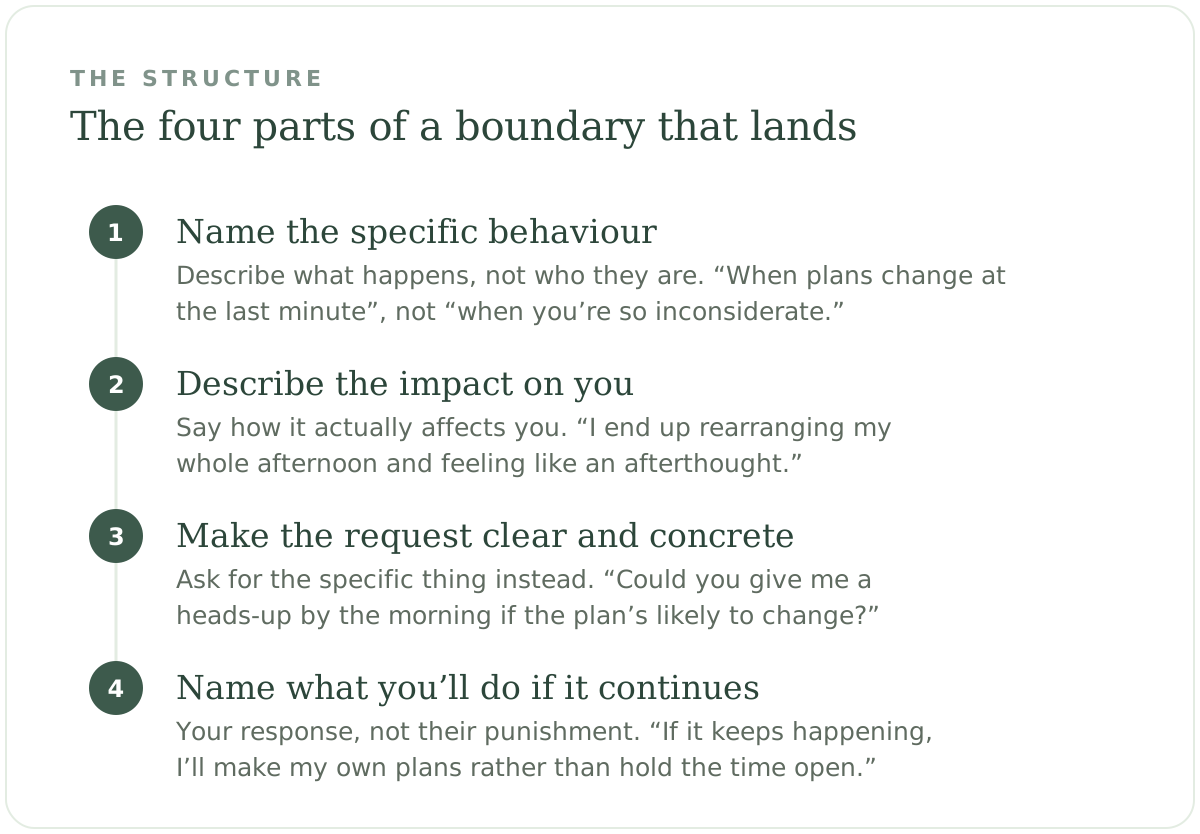
1. Name the specific behaviour, not the person. Describe what happens, not who they are. “When plans change at the last minute” is workable. “When you’re so inconsiderate” is a character attack, and it starts a fight. This is the same principle behind I-statements versus you-statements: describe the situation, not the flaw.
2. Describe the impact on you. Say how it actually affects you, in plain terms. “I end up rearranging my whole afternoon and feeling like an afterthought.” This is the part that helps the other person understand there’s a real cost, rather than an arbitrary rule.
3. Make the request clear and concrete. Ask for the specific thing you’d like instead. “Could you give me a heads-up by the morning if the plan’s likely to change?” A request the other person can picture is a request they can actually meet.
4. Name what you’ll do if it continues. This is the boundary itself, and it’s about your response, not their punishment. “If it keeps happening without notice, I’m going to start making my own plans rather than holding the time open.” Said calmly, this is information, not a threat. It tells them what to expect, which is fair to everyone.
Notice what this structure avoids: blame, ultimatums, and vagueness. It’s a description of reality, delivered in a way that leaves the relationship intact.
Boundaries versus consequences versus threats
People often worry that the fourth step, naming what you’ll do, makes them the aggressor. The difference between a healthy consequence and a threat comes down to intent and tone.
A threat is designed to control the other person through fear: “If you do that again, you’ll regret it.” It’s about power, it’s usually disproportionate, and it’s delivered with heat.
A consequence is simply the natural result of you protecting your own wellbeing: “If that happens, I’ll leave and we can talk tomorrow.” It’s proportionate, it’s within your control, and it can be said calmly, even kindly. The Australian Psychological Society frames assertive communication this way: clear about your needs, respectful of the other person, and free of aggression or manipulation.
The test is simple. If your “boundary” only works because the other person is afraid of you, it’s a threat. If it works because it’s a fair and predictable response you’re willing to follow through on, it’s a boundary.
What to do when a boundary is tested
Setting the boundary is the easy part. Holding it when someone pushes back is where it counts, and pushback is normal, especially the first few times. People who benefited from the old arrangement rarely welcome the new one immediately.
A few things help:
Expect the pushback and don’t take it as evidence you were wrong. Resistance to a new boundary usually means it was overdue, not that it was unreasonable.
Repeat, don’t escalate. You don’t need a new argument each time. Calmly restating the same boundary in the same words is more effective than defending it with a longer speech. “I understand you’re frustrated. I’m still going to step away if it turns into shouting.”
Follow through, once. The first time you actually keep the boundary, calmly and without drama, is what makes every future statement of it credible. Following through is not a punishment; it’s you keeping a promise to yourself.
Stay warm where you can. A boundary held with warmth (“I care about this relationship, which is exactly why I’m being clear”) is far more durable than one held with coldness. The goal is a better relationship, not a colder one. For more on keeping your own temperature down when a boundary conversation heats up, see our guide to de-escalation techniques.
Where FairTalk fits in
Boundaries are hardest to hold in the moment, when emotions are high and the other person is pushing back. That’s where having a calmer, structured setting helps. In a FairTalk session, both people talk the issue through in one conversation while the AI listens impartially, and the analysis that follows lays out each person’s perspective, where you align, where you differ, and what each of you actually needs.
That structure makes boundary conversations easier in two ways. Talking it through with a neutral record means a boundary is heard as a genuine need rather than an accusation, and the documented summary gives both people the same clear account of what was agreed, so a boundary set in one conversation doesn’t quietly dissolve by the next. Over time, FairTalk is also designed to surface the patterns in how you communicate, which is often where the same boundary keeps needing to be reset.
Frequently asked questions
What’s the difference between a boundary and being controlling?
A boundary governs your own behaviour: what you’ll accept and how you’ll respond. Controlling behaviour tries to govern someone else’s: dictating what they can do, say, or feel. “I’ll leave if the shouting continues” is a boundary. “You’re not allowed to see those friends” is control. If your line only works by restricting the other person’s freedom rather than describing your own response, it has crossed from boundary into control.
How do I set a boundary without feeling guilty?
Guilt is common, especially if you were raised to equate keeping the peace with being good. It helps to remember that a boundary usually protects the relationship rather than threatens it: the alternative is often silent resentment that damages things more slowly but more permanently. The guilt tends to fade with practice and with evidence that most people respect a boundary that’s set clearly and kindly. If guilt is stopping you from stating needs at all, that’s worth exploring, sometimes with professional support.
What if the other person reacts badly?
Some pushback is normal and not a sign you did it wrong. Restate the boundary calmly rather than arguing it, and follow through on your stated response. If someone reacts to a reasonable, calmly stated boundary with sustained anger, contempt, or attempts to punish you, that reaction is itself useful information about the relationship. Persistent hostility toward basic boundaries can be a sign of a genuinely unhealthy dynamic, which may need a counsellor or relevant support service rather than another conversation.
Can you set boundaries over text or do they need to be in person?
Straightforward, low-stakes boundaries can be fine over text, and text has the advantage of letting you word things carefully. But emotionally charged boundaries usually land better in person or in a real conversation, because tone carries so much of the meaning, and text strips it out, leaving room for the other person to read hostility that wasn’t there. For anything significant, a live conversation, or a structured one, tends to work better than a message.
How many boundaries is too many?
There’s no fixed number, but if you find yourself needing constant, escalating boundaries with the same person, the issue may be less about the individual boundaries and more about the overall health of the relationship. Boundaries are a tool for maintaining a fundamentally workable relationship. When almost every interaction requires one, that’s worth reflecting on, and often worth discussing directly. Our guide to improving communication skills covers the broader habits that reduce how often a hard boundary is needed in the first place.