Almost every relationship problem is, at some level, a communication problem. The argument that went nowhere, the request that landed as an attack, the silence that got read as indifference: none of these usually reflect what either person actually meant. They reflect the gap between what was meant and what was communicated.
The good news is that communication is not a personality trait. It is a set of skills, and skills respond to practice. This guide covers how to improve communication skills in a practical, buildable order: the foundation each skill rests on, what to practise, and how to know it’s working.
Why communication skills matter more than intentions
Most people in conflict have reasonable intentions. What they lack is technique. Research from the Gottman Institute across four decades of studying couples reaches a consistent conclusion: how people communicate, especially during disagreement, predicts relationship outcomes far more reliably than how much they love each other or how compatible they are.
The same holds outside romantic relationships. Communication skills in relationships of every kind, whether family, friendships or colleagues, determine whether friction turns into understanding or into distance. And because each skill tends to trigger a matching response in the other person, one person improving their communication usually improves the whole exchange. This is why communication is really the foundation of building healthier connections of every kind.
The four core skills, in the order to build them
Effective communication rests on a stack of skills, and the order matters: each one depends on the ones below it.
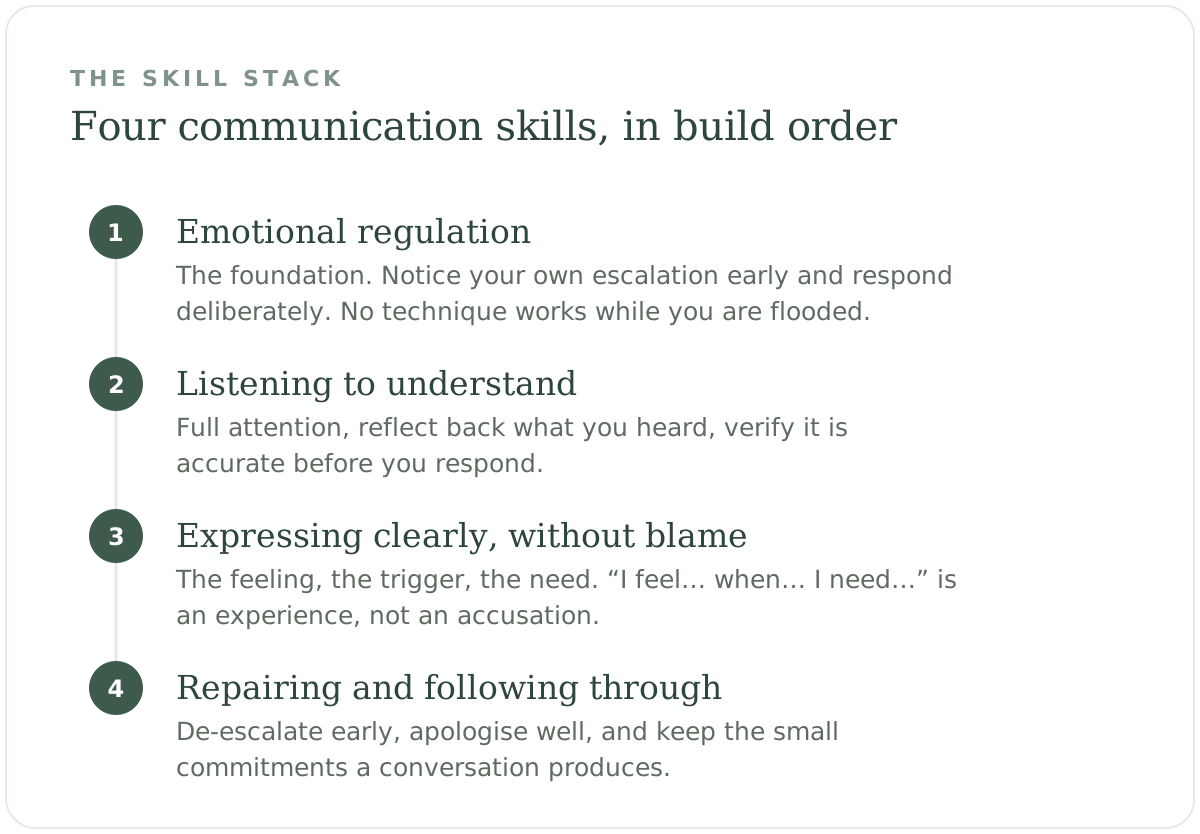
1. Emotional regulation: the foundation
No communication technique works while you are flooded. When a conversation gets heated enough, the nervous system shifts into a defensive state and the capacity for empathy and rational processing drops sharply. Everything else in this guide fails in that state.
The skill is noticing your own escalation early (racing heart, rising voice, the urge to interrupt) and responding to it deliberately: slowing down, breathing, or calling a short break with a specific time to return. The American Psychological Association’s research on emotion regulation shows that even naming your emotional state (“I’m getting frustrated”) measurably reduces its intensity, a process known as affect labelling. This capacity for self-awareness sits at the core of emotional intelligence in relationships.
Practise: once a day, name what you’re feeling with a specific word: not “fine” or “stressed” but “disappointed,” “anxious,” “resentful.” Specific labels regulate better than vague ones.
2. Listening to understand
Most people listen to respond: while the other person talks, they build their reply. Genuine listening means giving full attention, reflecting back what you understood, and checking it’s accurate before you answer. That verification step, letting the other person correct your summary, is the one almost everyone skips, and it does most of the work.
This is the single highest-leverage communication skill, because every other skill depends on responding to what was actually said rather than what you assumed. Our guide to active listening in relationships covers it in depth, with exercises.
Practise: in your next disagreement, summarise the other person’s point to their satisfaction before making your own. One week of this habit changes most conversations.
3. Expressing yourself clearly, without blame
Being a good listener is half the job. The other half is saying what you actually mean in a way the other person can hear. The most reliable technique here is the I-statement: reporting your own experience (“I’ve been feeling unheard lately”) rather than attributing behaviour or motive (“You never listen”).
The structure that works combines three parts: the specific feeling, the specific trigger, and what you need. “I feel dismissed when the conversation moves on before I’ve finished. I need to know what I’m saying matters to you.” It is harder to argue with an experience than an accusation, which is exactly why it works. See I-statements vs you-statements for the science and the common mistakes, and how to set healthy boundaries for stating a need clearly when the answer needs to be a firm one.
Practise: notice each time you’re about to say “you always” or “you never,” and rewrite it internally as an “I feel… when… I need…” sentence, even if you don’t say it aloud.
4. Repairing and following through
Even skilled communicators have bad conversations. What distinguishes healthy relationships is repair: the apology, the softened tone, the “I don’t want to fight with you” that interrupts a negative spiral, offered early and accepted generously.
Follow-through is repair’s quieter sibling. Saying the right thing and then not doing it erodes trust faster than saying the wrong thing. Effective communication includes keeping the small commitments a conversation produces, because that is what makes the next conversation safe.
Practise: after any significant conversation, note one concrete thing you agreed to do, and do it visibly.
Communication exercises for couples
A few structured communication exercises couples can use to build these skills outside of conflict, when practice is cheap:
The daily debrief (10 minutes). Each person gets five uninterrupted minutes to talk about their day while the other only listens and reflects back. No advice, no fixing. This builds the listening habit in low-stakes conditions.
The appreciation habit. Once a day, name one specific thing the other person did that you appreciated. Vague gratitude (“you’re great”) does little; specific gratitude (“thanks for handling dinner when I was flat out”) builds the goodwill that makes repair work during real conflict.
The rewrite game. Take a complaint you have (a real one) and phrase it three ways: as a you-statement, as an I-statement, and as a request. Notice how differently each one would land. This builds the expression skill before an argument makes it necessary.
The pattern spot. After a disagreement (not during), each person names one pattern they noticed in themselves: defensiveness, interrupting, withdrawing. Naming your own pattern, rather than the other person’s, keeps the exercise safe. For the patterns worth watching for, see the five patterns that predict relationship breakdown.
The common mistakes that undo good communication
Knowing what to practise is half the picture. The other half is recognising the habits that quietly sabotage otherwise well-intentioned conversations.
Mind-reading. With people we know well, we assume we already know what they mean, and what they’re about to say. That assumption closes down the curiosity that listening requires, and it is wrong more often than anyone expects. Treat familiarity as a reason to check, not a licence to skip checking.
Kitchen-sinking. Raising one issue, then attaching every related grievance from the past six months. The conversation now has no answerable question, and the other person is defending on five fronts at once. One conversation, one topic. If naming a single topic feels impossible, that itself is useful information about how much has gone unaddressed.
Bad timing. Starting a hard conversation when one of you is exhausted, distracted, or already activated. The identical words land completely differently at 9pm on a Sunday than mid-argument or on the way out the door. Asking “is now a good time to talk about something?” costs five seconds and changes outcomes.
Scorekeeping. Framing the conversation as a ledger of who has done more, conceded more, or apologised last. Ledgers invite audits, and audits invite counter-claims. The alternative framing that works: not “who owes whom” but “what do we each need for this to feel fair going forward?”
Each of these mistakes has the same root: treating the conversation as something to win rather than something to get right together.
How long does it take?
Honest answer: the first improvements show up within a week or two of deliberate practice; most people notice that a single conversation goes differently. Making the new habits automatic under pressure takes longer; research on habit formation suggests 60 to 90 days of consistency. The awkward middle stage, where the techniques feel scripted and unnatural, is normal and passes. Verywell Mind has a useful library of plain-English explainers on the individual skills if you want to go deeper on any of them.
The trajectory matters more than the speed. Communication skills compound: better listening leads to less defensiveness, which leads to more honesty, which makes every future conversation easier.
Where FairTalk fits in
Skills built in calm moments still have to survive real conflict, and that is where structure helps. In a FairTalk session, both of you talk the issue through in one conversation while the AI listens impartially, and the analysis that follows shows you what actually happened: each person’s perspective, where you aligned, where you talked past each other, and what each of you needs.
Beyond individual sessions, FairTalk is designed to help you understand the patterns in how you engage over time and build healthier ways to express yourself, so the skills in this guide get reinforced by evidence from your own conversations, not just good intentions.
Frequently asked questions
What is the most important communication skill to learn first?
Emotional regulation, because nothing else works without it. If you can stay calm enough to think during a hard conversation, every other technique becomes available. If you can’t, no technique survives contact with a real argument. Listening is the close second, and the two reinforce each other: genuinely listening is itself calming, for both people.
Can one person improve a relationship’s communication alone?
To a meaningful degree, yes. Communication patterns are loops: criticism triggers defensiveness, which triggers more criticism. When one person breaks their half of the loop by listening instead of rebutting, or describing instead of accusing, the other person’s behaviour usually shifts in response, even without conscious effort on their part. You can’t control the outcome, but you can reliably change the dynamic.
How do I communicate better with someone who won’t engage?
Shutting down is usually overwhelm rather than indifference. Pushing harder makes it worse. What helps: lower the intensity (softer opening, one topic, no audience), make engaging safe (genuine listening without ambush), and agree on timing rather than demanding the conversation now. If the disengagement is chronic, structured support, whether a mediated conversation or professional help, beats another attempt at the same approach.
Why do we communicate worst with the people we’re closest to?
Partly because the stakes are higher, with more history, more vulnerability and more to lose, and partly because familiarity breeds shortcuts. We drop the care we’d extend to a colleague, assume we know what our partner means, and let years of accumulated context colour every new disagreement. The fix isn’t to care less; it’s to bring the same deliberateness home: check your understanding, pick your timing, and say what you mean instead of expecting it to be inferred.
Are communication skills different at work than at home?
The fundamentals are identical: regulation, listening, clear non-blaming expression, follow-through. What changes is register: at work you lean more on specific requests and documented agreements, and less on emotional disclosure. The skills transfer in both directions, which is why building them in one part of your life tends to improve the others.