Most of us were never taught how to have a difficult conversation. We learned, by absorption, to argue: to defend, to score points, to make our case and pick holes in theirs. It works about as well as you would expect. There is, however, a more deliberate alternative, and it has been refined over decades into something you can actually learn and use.
It is called Nonviolent Communication, or NVC (sometimes written non violent communication): a framework developed by psychologist Marshall Rosenberg that works in four steps. You describe what happened as a neutral observation, name the feeling it brings up, identify the need behind that feeling, and make a specific request. Despite the slightly earnest name, it does not ask you to be passive or to pretend everything is fine. It asks you to say what is true for you in a way the other person can actually hear, and that changes almost everything about how a hard conversation goes.
What Nonviolent Communication Actually Is
In the plainest terms, nonviolent communication is a way of speaking that swaps blame for honesty. Instead of telling someone what is wrong with them, you tell them four simple things: what happened, how you feel about it, what you need, and what you would like them to do. The name is a little misleading, since it has nothing to do with physical violence. It refers to taking the “violence” out of everyday language: the blaming, labelling, and pressure that quietly turn a conversation into a fight. Strip those out, say what is true for you plainly, and the other person can finally hear you instead of bracing against you.
Nonviolent communication was developed by the psychologist Marshall Rosenberg, whose work is now carried on by the Center for Nonviolent Communication. Rosenberg’s central insight was that most conflict is not really a clash of interests but a failure to express and hear needs. Underneath every complaint, criticism, or demand is a human need, and underneath every unmet need is a feeling. When people communicate at the level of blame and judgement, those needs stay hidden and the conflict has nothing to resolve around. When they communicate at the level of feelings and needs, the same disagreement becomes solvable.
“Nonviolent” here does not mean merely avoiding aggression. It means communicating without the subtle violence of blame, labelling, and coercion that most ordinary arguments are built from. It is a way of being honest and direct that does not require making the other person wrong.
The Four Components
NVC is usually taught as four components that build on each other. The framework is simple to describe and genuinely hard to do, which is why it rewards practice.
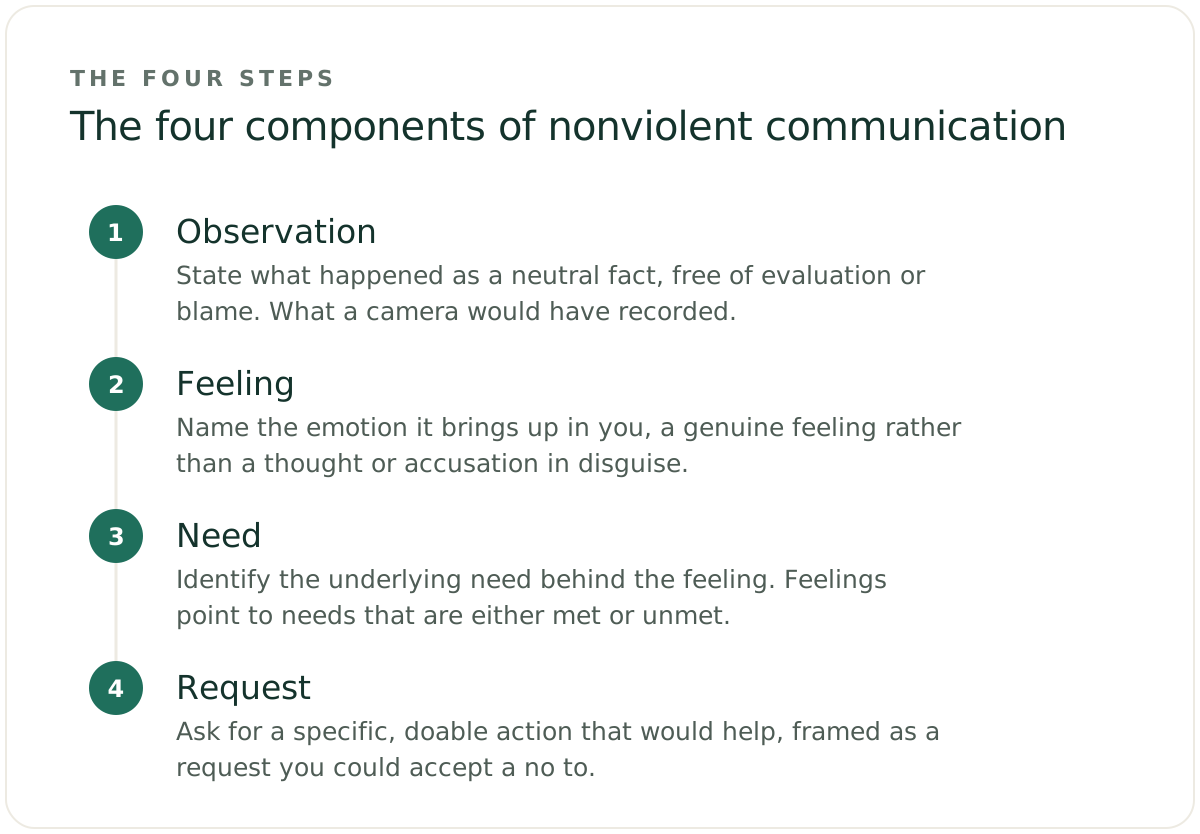
Observation. You start by stating what actually happened, as a neutral fact, stripped of evaluation. The test is whether a camera would agree with you. “You’ve left the dishes in the sink three nights this week” is an observation. “You’re so lazy” is a judgement. Mixing the two is the most common way NVC goes wrong, because the moment the other person hears a judgement, they stop listening and start defending.
Feeling. Next you name the emotion the situation brings up in you. This has to be a genuine feeling, not a thought in disguise. “I feel frustrated” is a feeling. “I feel like you don’t care” is an evaluation of the other person wearing the costume of a feeling, and it will land as an accusation. Real feelings, hurt, anxious, lonely, tired, disappointed, are much harder to argue with than disguised judgements.
Need. This is the heart of the framework. Behind every feeling is a need that is either met or unmet. Frustration about the dishes might point to a need for fairness or for support. Naming the need moves the conversation from the surface complaint to the thing that actually matters. Needs are universal, we all share them, which is why naming yours tends to invite empathy rather than defensiveness.
Request. Finally, you ask for something specific and doable that would help meet the need. The distinction that matters here is between a request and a demand. A request can be declined without punishment; a demand cannot. “Would you be willing to sort the kitchen before bed on the nights you cook?” is a request. Its honesty depends on you genuinely being able to hear a no.
Putting It Together
Strung together, the four components produce a sentence that is honest, specific, and remarkably difficult to fight with. Compare the two versions of the same moment:
The ordinary version: “You never help around here. You’re so selfish.”
The NVC version: “When I come home to the dishes still in the sink after a long day (observation), I feel worn out and a bit resentful (feeling), because I need to feel like we’re sharing the load (need). Would you be willing to take the kitchen on the nights you cook (request)?”
The content is the same. The second version says everything the first one wanted to, but it opens a conversation instead of a fight, because there is nothing in it to defend against. You are not being told you are a bad person; you are being told how someone feels and what they need. Most people, hearing that, want to help.
The Mistakes That Undo It
NVC fails most often not because the framework is wrong but because it gets used incorrectly, usually in one of a few predictable ways.
Smuggling judgement into the observation. “When you’re being inconsiderate” is not an observation; it is a verdict with an NVC costume on. If there is an evaluation in your first sentence, the rest will not save it.
Faux feelings. Any sentence of the form “I feel that you…” or “I feel like you…” is expressing a thought, not a feeling, and almost always contains a hidden accusation. Genuine feelings are single words about your internal state.
Turning requests into demands. If you deliver a request but visibly punish a no, with the silent treatment, or by escalating, it was a demand all along. The other person will feel the coercion regardless of the polite phrasing.
Using it as a formula. Delivered mechanically, NVC sounds stilted and can feel manipulative, like a technique being done to someone. The framework is scaffolding for genuine honesty, not a script to extract a result. The words matter far less than whether you actually mean them.
Nonviolent Communication in the Middle of Conflict
The version above assumes you are the one raising an issue calmly. Real conflict is rarely that tidy. The deeper power of NVC shows up in how it lets you receive difficult communication, not just send it.
When someone is attacking or criticising you, NVC offers a different move than defending or counter-attacking: listen for the feeling and need underneath their words. Someone shouting “you never listen to me” is, in NVC terms, expressing a painful feeling and an unmet need to be heard. If you can respond to that need, “it sounds like you’re feeling really unheard right now, and that matters to you”, rather than to the accusation, the entire temperature of the exchange changes. You are not agreeing you never listen. You are hearing the person underneath the complaint.
This is closely related to the skill of active listening: both are ways of getting past the surface content to the thing that actually needs addressing. NVC just gives you a specific map, feelings and needs, of what to listen for, and it sits comfortably alongside the other conflict resolution strategies that work on the same principle of describing rather than accusing.
How to Practise It
Like any real skill, NVC develops through deliberate practice rather than understanding.
Build a feelings and needs vocabulary. Most people can name only a handful of emotions and almost no needs. The Center for Nonviolent Communication publishes lists of both; spending time with them makes the raw material available when you need it.
Translate silently before you speak. In a low-stakes moment of irritation, practise running the four steps in your head without saying them aloud. What is the observation? The feeling? The need? The request? This builds the pathway before an argument demands it.
Start with the easy conversations. Use NVC when the stakes are low and it does not much matter, so that the structure is familiar by the time a real conflict arrives. It is far too hard to learn for the first time mid-argument.
The shift NVC represents, from “you” statements that accuse to statements about your own experience, is the same one at the heart of our guide to I-statements versus you-statements. NVC is, in a sense, the fully worked-out version of that idea.
Where FairTalk Fits In
Nonviolent communication is built on translating positions into the feelings and needs underneath them, and that translation is exactly what a neutral third party is good at, and what most of us struggle to do for ourselves in the heat of a disagreement. FairTalk’s after-session analysis works on the same needs-based logic: rather than judging who was right, it surfaces what each person was actually feeling and what they needed, which is often the first time both people see the real shape of the disagreement.
FairTalk also identifies the specific communication skills each person could work on, and its Knowledge Hub offers self-paced guidance on the underlying communication skills, so a difficult conversation becomes a chance to build the very capability that would make the next one easier. It does not replace learning NVC yourself, but it gives you a fair, structured place to work through your own disagreements.
Frequently Asked Questions
Isn’t nonviolent communication just a nicer way of getting what you want?
Not if it is done genuinely. The framework only works when the request is a real request, one you can accept a no to, and when you are honestly trying to understand the other person’s needs as well as express your own. Used as a technique to manipulate someone into compliance, it stops being nonviolent communication and becomes exactly the kind of coercion it was designed to replace. The honesty is the point, not the phrasing.
Does NVC actually work in a heated argument?
It can, but it is hardest precisely when it matters most, because naming feelings and needs requires a degree of self-regulation that intense conflict strips away. In practice, NVC works best when at least one person can stay regulated enough to use it, and when it has been practised beforehand in calmer moments. In a genuinely flooded argument, the most nonviolent move is often to pause and return to it once both people have settled.
What if the other person has never heard of NVC?
They do not need to have. NVC changes the dynamic even when only one person uses it, because expressing your own feelings and needs clearly, and listening for theirs, alters how the whole exchange unfolds regardless of whether they know the framework. You are not asking them to follow rules; you are simply communicating differently, and people tend to respond to that in kind.
How long does it take to learn?
The concepts can be grasped in an afternoon, but using them fluently under pressure takes months of practice, because it means overriding communication habits built over a lifetime. Most people find it feels awkward and mechanical at first and gradually becomes more natural. The awkward stage is normal and worth pushing through, since the fluency is where the real benefit lives.