The most effective conflict resolution strategies are simple: address issues early, calm down before you talk, listen until the other person feels understood, describe your experience instead of blaming, look for the need beneath each position, and finish with a specific agreement. Those, plus a few supporting techniques below, work with partners, family, friends and colleagues alike.
Conflict is one of the few genuinely universal human experiences. It shows up in marriages and friendships, in workplaces and families, between neighbours and housemates. And yet almost no one is taught how to handle it, so we navigate one of the hardest interpersonal skills there is with no training at all, then feel surprised when the same arguments keep repeating.
The good news is that conflict resolution is a skill, not a personality trait. The people who seem naturally good at defusing tension are usually applying a small set of strategies, consciously or not, and those strategies can be learned. This guide brings them together: the goal worth aiming for, the core skills underneath every technique, ten strategies with everyday examples, and how to adapt them for relationships and for work.
How to resolve conflict, step by step
If you take only one thing from this guide, take the sequence. Most conflicts that get resolved follow roughly this order:
- Calm down first. No strategy works while either of you is flooded.
- Listen until the other person feels understood. Summarise their view before giving yours.
- Describe your experience instead of blaming. “I felt…” rather than “you always…”.
- Find the need beneath each position. What someone demands is rarely the whole story.
- Agree something specific. Who will do what, by when, and when you will check in.
The strategies below expand on each of these, with a few more that make the sequence easier to run.
The goal: resolution, not winning
Conflict resolution is often mistaken for winning: proving your point, getting the other person to admit they were wrong, or reaching a compromise where everyone gives something up. None of those is the real goal.
Genuine resolution means reaching an outcome both people can live with while preserving, or even strengthening, the relationship. A resolution that leaves one person quietly resentful has not resolved anything; it has postponed the next argument. The aim is not to eliminate disagreement but to address the real issue underneath it, so it stops resurfacing. For a plain-English explanation of what conflict resolution is, including the difference between resolving a conflict and managing one, start there.
That reframe changes how you approach a conflict. You stop trying to win and start trying to understand, because understanding is what makes a resolution last.
The conflict resolution skills underneath every strategy
Every technique in this guide rests on three skills. Build these and most of the strategies become close to automatic. Our guide to improving your communication skills covers the everyday habits behind them in more depth.
Regulating your own emotion
You cannot resolve a conflict while flooded. When your heart is racing and you are bracing to attack or flee, the part of your brain that solves problems is running at a fraction of its capacity. Learning to notice that state, and to pause before you act on it, is what makes the other skills usable when it counts. Our guide to de-escalation techniques covers how to bring the temperature down before a conversation boils over.
Listening to understand
The most underrated conflict skill is the ability to genuinely hear the other person: not waiting for your turn, but understanding their meaning and the feeling beneath it. Active listening lowers defensiveness faster than almost anything else, because most people calm down the moment they feel understood.
Speaking without blame
How you raise an issue largely determines how it is received. Leading with an accusation (“you always…”) invites defence. Describing your own experience (“I felt… when…”) invites a conversation. This is the shift from you-statements to I-statements, and Nonviolent Communication builds a complete four-step framework on the same idea.
10 conflict resolution strategies, with everyday examples
These strategies work across almost any kind of disagreement. Each comes with an example from a different kind of relationship, because the principle stays the same even when the setting changes.
1. Address it early, while it is still small
Small issues are easy to resolve. The same issue left to compound becomes tangled with resentment and much harder to undo, and as we cover in the real cost of unresolved conflict, avoided conversations rarely stay small.
Example, with a colleague: rather than stewing for a month about meetings booked over your focus time, mention it in the first week: “Could we keep Tuesday mornings free of meetings? I lose my best working hours otherwise.”
2. Calm down before you talk
A flooded nervous system cannot problem-solve. If either of you is past the point of useful conversation, pause for at least twenty minutes, which is roughly how long the body takes to settle, and agree when you will come back to it.
Example, with a partner: halfway through an argument about money, one partner says, “I’m too wound up to be fair right now. Can we pick this up after dinner?” Then they both do.
3. Listen until they feel understood
Before you make your case, summarise theirs and check you have it right. It feels slow, and that is exactly why it works: people stop repeating themselves, and stop escalating, once they know they have been heard.
Example, with a friend: “So you felt left out when you saw the photos from the weekend, because nobody had mentioned it to you. Is that right?“
4. Describe your experience instead of blaming
Say what happened and how it affected you, rather than what the other person is. A description of your own experience is much harder to argue with than a verdict on someone’s character.
Example, with family: instead of “You never ask about my life,” try “I feel a bit invisible when our calls are only about family news. I’d love you to ask how work is going.”
5. Attack the problem, not the person
Frame the conflict as a shared problem you are solving together rather than a contest between you. This single shift turns an opponent into a collaborator.
Example, with a partner: “We’re both exhausted and the house is chaos. How do we split things so neither of us is carrying it alone?“
6. Find the shared ground first
Almost every conflict contains more agreement than it feels like in the moment. Naming what you both want gives the conversation a foundation before you tackle where you differ.
Example, with siblings: two siblings arguing about care for an ageing parent start from what they agree on: “We both want Mum safe and happy at home for as long as possible.”
7. Separate positions from needs
People arrive with positions (“we’re doing it my way”) that hide underlying needs (“I need to know my time is respected”). Positions clash; needs can often both be met once they are on the table. The question that gets you there is simple: “What matters most to you about this?” Our guide on how to compromise in a relationship applies the same idea to everyday negotiations with partners, friends, family and colleagues.
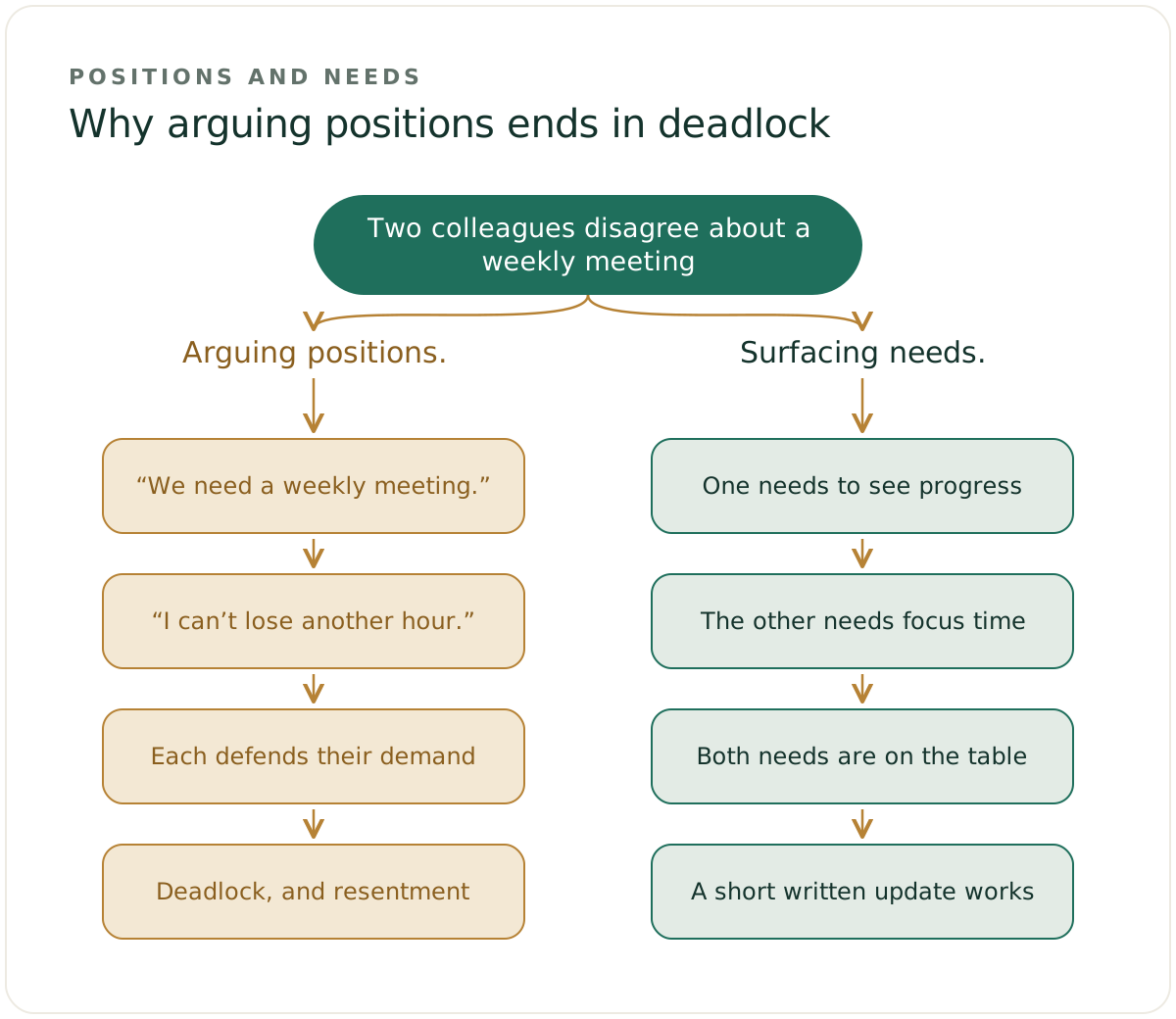
Example, with a colleague: one colleague insists on a weekly status meeting and the other refuses to attend another one. Underneath, one needs visibility of progress and the other needs uninterrupted time, and a short written update each Friday meets both.
8. Take one issue at a time
Bringing every grievance into one argument, sometimes called kitchen-sinking, makes a conflict impossible to solve. Agree the one thing you are sorting out today, and give the others their own conversation.
Example, with a partner: “Can we just talk about the holiday plans tonight? The stuff with your parents matters too, but let’s give it its own time.”
9. Own your part
Acknowledging even a small share of the problem lowers the other person’s defences more than anything else you can do. It signals that you are there to fix things, not to win. Our guide to how to apologise properly covers what makes an acknowledgement land.
Example, with a friend: “I did go quiet on you for a few weeks, and I can see how that looked. I’m sorry.”
10. End with something specific, and follow up
A resolution is not real until it is specific. Vague promises to “do better” fade by the next morning; clear agreements about who will do what, by when, change behaviour. A quick check-in a week or two later stops it from quietly lapsing.
Example, with a parent: “I’ll call on Sunday evenings, and you’ll text if something big comes up in between. Let’s see how it feels in a month.”
Using these strategies with a partner or family
In close relationships, conflict is rarely about the surface topic, such as the dishes, the money or the plans. It is usually about something underneath: feeling unappreciated, unheard or not prioritised. Decades of research from the Gottman Institute point the same way: it is not how often couples argue that predicts whether a relationship lasts, but how they argue.
That is why the relationship-specific work focuses on the pattern, not the topic: calling out recurring cycles, taking breaks before things escalate, and repairing quickly afterwards. Our guide on how to stop fighting with your partner breaks these techniques down in detail, and how to resolve a family dispute covers the extra history and roles that family conflict carries. For the principles that apply across every personal relationship, see how to resolve personal conflict.
Using these strategies at work
Workplace conflict uses the same core skills but adds constraints that personal conflict does not: power dynamics, professional reputation, and relationships you cannot simply walk away from. The strategies shift accordingly. Lead with impact rather than accusation, bring proposals rather than just problems, and know when a disagreement is better handled directly and when it needs a manager or HR. Our guide to workplace conflict resolution covers the professional side in full.
What makes a resolution actually last
Plenty of conflicts get “resolved” in the sense that the argument stops, and then the same issue returns a month later. The difference between a temporary truce and a lasting resolution usually comes down to four things:
- The real issue was addressed, not just the surface symptom.
- Both people felt heard, so neither walked away quietly resenting the outcome.
- The agreement was specific, so there is a shared understanding of what changes.
- There is a way to follow up, because resolution is often a direction rather than a single moment.
When those conditions are met, the conflict does not just end; it stops recurring, which is the real test of whether it was resolved. Making it stick often means agreeing what changes going forward, which is where setting healthy boundaries turns a one-off resolution into a lasting one.
Where structured tools and AI mediation help
The hardest part of conflict resolution is not knowing the strategies. It is applying them while you are upset, because in the heat of a disagreement you are rarely a calm, neutral party. That is the gap structured tools are designed to fill.
A neutral framework keeps a heated conversation on track: making sure both sides are heard, surfacing the shared ground, and turning a vague argument into specific next steps. This is where AI conflict resolution is increasingly useful. It offers structure and impartiality at the moments people struggle to provide either for themselves, and it is available when the conflict actually happens rather than only during business hours.
How FairTalk helps
FairTalk puts these strategies into practice at the moment you need them. It brings an impartial third party into the conversation: both of you talk the issue through together while FairTalk listens without taking sides, and afterwards you both get a fair picture of each other’s perspective and specific next steps you have shaped together, so “we’ll communicate better” becomes something you can actually do.
If the other person is not ready to take part, you can still work through your own side on your own. For the idea behind it, see how FairTalk works.
FairTalk is not right for every situation. Where there is abuse, coercion or a significant power imbalance, structured self-guided tools are not appropriate and human professionals are.
Frequently asked questions
What are the most effective conflict resolution strategies?
The most reliable are addressing conflict early, calming down before you talk, listening until the other person feels understood, describing your experience instead of blaming, separating positions from needs, and ending with a specific, agreed next step. Underneath all of them sit three core skills: regulating your own emotions, active listening, and speaking without blame.
How do you resolve conflict with your partner?
Pick a calm moment, take turns explaining how the issue affects each of you, and listen until each person feels understood before looking for solutions. Keep to one issue, look for the need underneath each position, and finish by agreeing something specific that each of you will do. If things get heated, pause and agree when you will come back to it.
What is the difference between conflict resolution and compromise?
Compromise is one possible outcome, where each side gives up something to meet in the middle. Resolution is broader: it means addressing the real issue so it stops recurring, and preserving the relationship in the process. Sometimes that involves compromise, but often a better solution emerges once both people’s underlying needs are understood, one where neither has to simply concede.
Can conflict resolution skills really be learned?
Yes. People who handle conflict well are usually applying a learnable set of skills and strategies, not expressing a fixed personality. Like any skill, it improves with understanding and practice, especially practising the calm-moment habits of listening and making clear requests, so they are available when a conversation heats up.
What if the other person refuses to resolve the conflict?
Focus on your own side, which is more powerful than it sounds. Genuinely listening and lowering your own defensiveness often shifts the other person’s stance over time. If repeated good-faith attempts fail and the issue still matters, it may be time for a third party: a mediator, a structured tool, or in serious cases a professional such as a counsellor or HR.