
We tend to treat a bad argument as a failure of character. If only you had stayed calmer, chosen better words, been the bigger person. That framing misses something important: much of what goes wrong in a heated conflict is not a failure of willpower at all. It is biology. The moment a disagreement starts to feel like a threat, your brain begins running a survival programme that is millions of years old, and that programme is very good at keeping you alive and very bad at helping you finish a sentence.
Understanding the psychology of arguing, and what your brain is actually doing while you do it, changes how you handle conflict. It stops you blaming yourself, or the other person, for reactions that are largely automatic, and it points you toward conflict resolution techniques that work with your nervous system rather than against it. This is the science of conflict: why we argue, what happens in the brain when we do, and how to stay in the conversation rather than being hijacked out of it.
Your brain has two operating modes
A useful simplification is that you have a thinking brain and a survival brain, and they do not always cooperate.
The thinking brain is centred on the prefrontal cortex, the region behind your forehead responsible for reasoning, planning, empathy, impulse control and language. It is the part of you that can see the other person’s point of view, weigh consequences and choose a measured response. It is also, in evolutionary terms, relatively new and comparatively slow.
The survival brain is older and faster. Its command centre is the amygdala, a small almond-shaped structure that acts as the brain’s threat detector. Its entire job is to scan for danger and, when it finds any, to trigger an immediate protective response before the thinking brain has even finished processing what happened. In a genuine emergency, that speed saves your life. In an argument with someone you love, it is often the problem.
The amygdala hijack
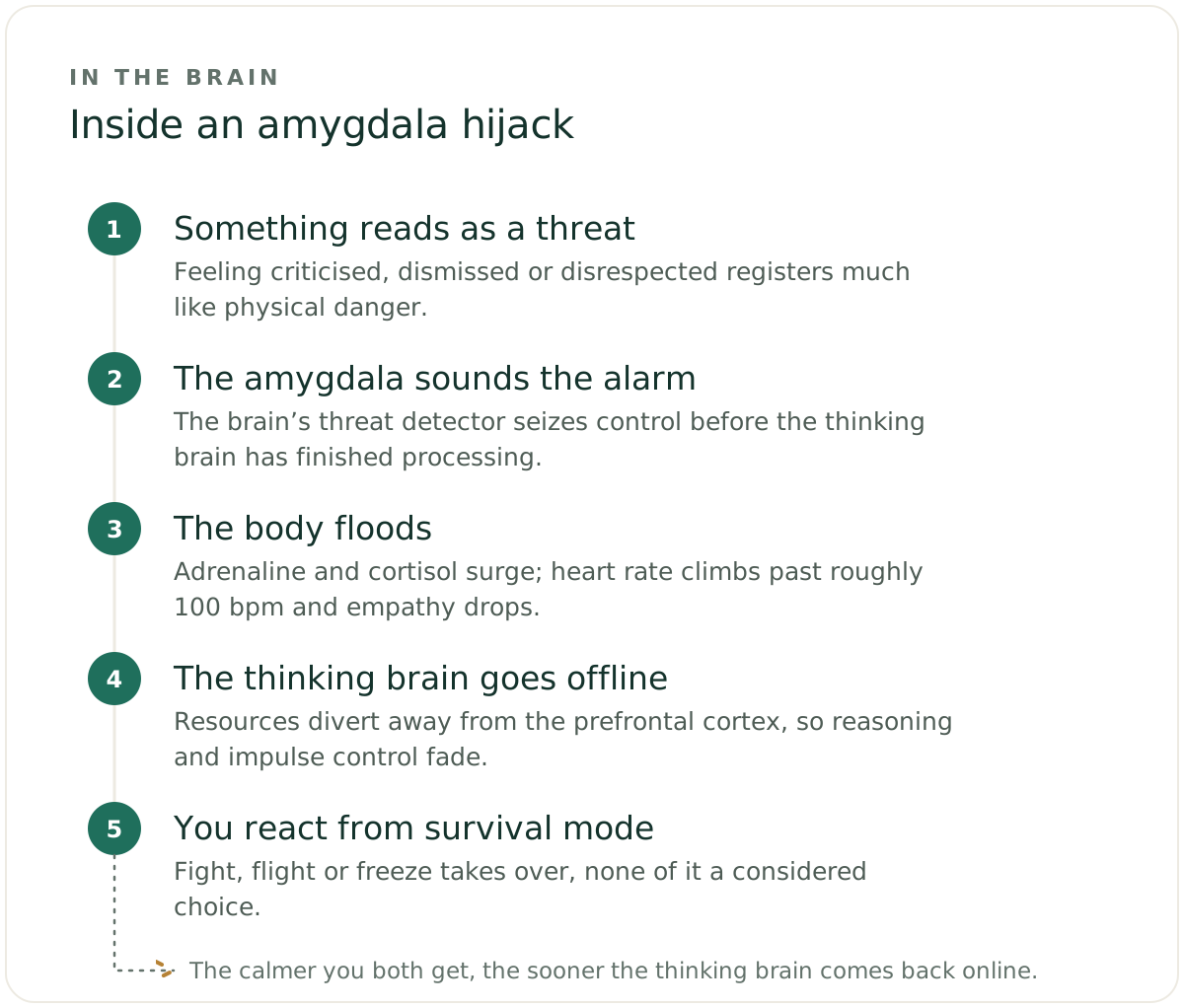
The psychologist Daniel Goleman popularised the term “amygdala hijack” for what happens next. When the amygdala perceives a threat, and social threats such as feeling criticised, dismissed, or disrespected register in much the same way as physical ones, it effectively seizes control. It floods the body with stress hormones, adrenaline and cortisol, and diverts resources toward immediate survival.
Research from the Gottman Institute, which has studied couples in conflict for decades, describes the tipping point as emotional flooding. Once heart rate climbs past roughly 100 beats per minute, the capacity for empathy, listening and rational thought drops sharply. You are, quite literally, no longer able to access your best thinking. This is why the arguments you most regret tend to happen when you are most activated, and why they so rarely get resolved in the moment.
Why you literally cannot think straight mid-argument
Here is the part that surprises people. During an amygdala hijack, blood flow and neural activity are redirected away from the prefrontal cortex. The thinking brain does not just get overruled; it goes partially offline. This is not a metaphor for being upset. It is a measurable shift in which parts of your brain are running the show.
That is why, in the heat of an argument, you cannot find the reasonable point you made so easily an hour earlier, why you say things you do not mean, and why the perfect calm response only arrives at 2am when it is far too late to use it. You were not being weak or stupid. The equipment you needed for a calm, rational conversation was temporarily unavailable.
Psychologists sometimes describe this using the idea of a “window of tolerance”: the zone of arousal in which you can stay present, think clearly and engage. Inside the window, you can handle difficult feelings and still function. Pushed above it, into fight or flight, you become reactive and overwhelmed. Effective conflict is largely about keeping both people inside that window, or getting back into it when one of you has tipped out.
Fight, flight, and freeze
The survival brain has more than one setting. When it takes over, it reaches for one of three ancient responses, and recognising which one you and the other person default to explains a great deal about how your arguments go.
- Fight. Raised voice, sharper words, going on the attack. This is the response we most associate with arguing, and the most visible.
- Flight. Changing the subject, physically leaving, or refusing to engage in order to escape the discomfort.
- Freeze. Going quiet, blank, or unresponsive, not out of indifference but because the nervous system has become so overwhelmed it shuts down. This is often mistaken for stonewalling or not caring, when it is closer to the opposite. We cover it in depth in why people shut down in arguments.
None of these is a considered choice. They are automatic threat responses, which is why “just calm down” is such useless advice. You cannot reason your way out of a reaction that has bypassed the reasoning part of your brain.
Why it feels so personal, even when it is not
Two more quirks of the brain explain why small disagreements escalate so fast. The first is negativity bias: the brain is wired to weigh threats and criticisms more heavily than praise or neutral information, because historically, missing a threat was far more costly than missing a compliment. A single sharp remark can outweigh an hour of warmth.
The second is that the brain is a relentless storyteller. Faced with an ambiguous comment, it fills the gap with an interpretation, and under threat that interpretation skews negative. “You forgot to call” becomes “you don’t care about me.” The story feels like fact, and you end up arguing with the version of the other person your own brain has constructed. Learning to separate the observable behaviour from the story you have wrapped around it is one of the most powerful shifts in conflict, and it sits at the heart of emotional intelligence in relationships.
Working with your brain, not against it
Once you understand the mechanism, the practical techniques stop feeling like clichés and start making biological sense.
Notice the early signs. The racing heart, the heat in your chest, the urge to interrupt: these are the amygdala warming up. Catching them early, before you are fully flooded, is the single most useful skill, because it is far easier to stay inside your window of tolerance than to climb back into it.
Take a real break. The research points to at least twenty minutes for an activated nervous system to return to baseline. A genuine pause is not avoidance; it is giving your prefrontal cortex time to come back online. The key is to name when you will return, so the break is a reset rather than an abandonment.
Lower the intensity deliberately. Softening your voice and slowing your pace does more than sound nicer. Calm is contagious between nervous systems, and lowering your own signals to the other person’s threat detector that there is nothing to brace against. Our guide to de-escalation techniques covers how to do this in the moment.
Come back when you can think again. Resolution belongs to the thinking brain, so the productive conversation is the one you have once both of you are back inside your window, not the one you force while flooded. This is also, incidentally, why arguments feel so normal and yet so hard to finish well, a tension explored in are arguments normal in a relationship.
Where FairTalk fits in
Most arguments go wrong not because the people are unreasonable, but because the conversation outruns their nervous systems before anything gets resolved. FairTalk is designed with that reality in mind. Because a session is one structured conversation rather than a free-for-all, and because either person can pause it the moment they feel themselves flooding, there is a built-in way to step back before an amygdala hijack takes hold.
Just as importantly, the analysis comes after the session, not in the heat of it. That means each person gets to see the other’s perspective laid out calmly, once their thinking brain is back online and actually able to take it in, which is often exactly when understanding becomes possible. For anything involving abuse, coercion, or a mental health condition underlying the conflict, a qualified professional remains the right support rather than a self-guided tool.
Frequently asked questions
Why do people argue, according to psychology?
At the simplest level, we argue because the brain reads certain social experiences, feeling criticised, dismissed, or disrespected, as threats, and responds with the same fight-or-flight machinery it would use for physical danger. Add negativity bias, which makes the brain weigh criticism more heavily than warmth, and its habit of filling ambiguous moments with negative stories, and small disagreements escalate quickly. Arguing is less a sign that something is broken than a predictable result of how the human threat-detection system works.
What is an amygdala hijack?
An amygdala hijack is what happens when the brain’s threat detector, the amygdala, takes over in response to a perceived danger and floods the body with stress hormones before the thinking brain can weigh in. During a hijack, the prefrontal cortex, responsible for reasoning and empathy, goes partially offline, which is why you cannot think clearly, say things you regret, and only find the calm response long after the moment has passed. It is a fast, automatic survival response, not a failure of self-control.
Why can’t I think clearly during an argument?
Because the parts of your brain you need for clear thinking are temporarily running at reduced capacity. When a conflict tips into fight or flight, neural resources are diverted away from the prefrontal cortex toward immediate survival. Once your heart rate passes roughly 100 beats per minute, the capacity for empathy and rational thought drops sharply. You are not being weak; the equipment for a calm conversation has genuinely, if briefly, gone offline. The fix is not to try harder in the moment but to pause and let your system settle.
How do I calm down in the middle of an argument?
Start by catching the early physical signs, the racing heart or the urge to interrupt, before you are fully flooded. Then take a genuine break of at least twenty minutes, naming when you will come back so it reads as a reset rather than walking out. Lowering your voice and slowing your pace helps regulate both your nervous system and the other person’s. The aim is to get both of you back inside your window of tolerance, because the conversation that actually resolves things is the one you have after you have calmed down, not during.