
Conflict coaching is one-to-one help for one person to handle a specific conflict better. A coach works with you alone, not with the other person, to understand what is going on, decide what you want, and plan and practise how to raise it. The aim is a better conversation, and better skills for next time.
It sits in a gap most people do not know is there. Mediation needs both people to agree to sit down together. Counselling looks at your wellbeing more broadly. Conflict coaching is narrower and more practical: one person, one conflict, and a plan for what to do about it. This guide covers what it involves, how it compares with the other options, when it suits, and how to use the same approach on your own.
What conflict coaching is
In their book Conflict Coaching: Conflict Management Strategies and Skills for the Individual (SAGE, 2008), Tricia S. Jones and Ross Brinkert set out the practice as conflict help aimed at the individual rather than the pair. The coach does not take your side against the other person, and does not pass messages between you. Their job is to help you think clearly about a conflict you are in, and to get better at handling it yourself.
The field is younger than mediation or counselling. A 2016 review by Ross Brinkert in Conflict Resolution Quarterly traces how conflict coaching grew between 2005 and 2015, across theory, practice and research, and sets out propositions for where it should go next. It is most established in workplaces, universities and dispute resolution services, but the same approach works for conflict at home, with family or with neighbours.
A typical piece of conflict coaching works on three things:
- The story of the conflict. What happened, what each person likely thinks happened, and where those versions differ.
- What you want. Not just “for them to stop”, but the outcome you would actually accept, and what matters most to you underneath it.
- What you will do. Whether to raise it, when, what to say first, and how to respond if the conversation goes badly.
How conflict coaching differs from mediation and counselling
The easiest way to see what conflict coaching is for is to set it beside the options people usually confuse it with.
| Who takes part | What it focuses on | What you leave with | |
|---|---|---|---|
| Conflict coaching | You and a coach | One specific conflict and your part in handling it | A plan and practised words for the next conversation |
| Mediation | Both people and a neutral mediator | Reaching an agreement between the two of you | An agreement, sometimes written |
| Counselling | You (or a couple) and a counsellor | Your wellbeing, feelings and patterns more broadly | Understanding and support over several sessions |
| Therapy | You and a qualified therapist | Mental health and longer term patterns | Treatment for a condition or a deeper change |
The big practical difference is that conflict coaching does not need the other person’s agreement. That is why it is often the first step when someone will not come to the table, or when you are not ready to raise the issue yet. It can also run alongside mediation: some people get coaching before a mediation so they arrive clear about what they want to say. Whichever route you take, the principles of resolving personal conflict are the same.
Conflict coaching is also not a substitute for counselling or therapy when the conflict is tangled up with depression, anxiety, grief or trauma. If the conflict is affecting your sleep, work or health, talk to your GP.
What happens in conflict coaching
Coaches use different models, but most sessions follow a similar arc.
- Telling the story. You describe the conflict in your own words. A good coach listens for what you emphasise and what you leave out.
- Seeing it from the other side. The coach asks how the other person would tell the same story. This is often the most uncomfortable part, and the most useful.
- Finding what you need. You separate your position (“they have to apologise”) from the need underneath it (“I want to know they understand why it hurt”).
- Choosing a goal. You decide what a good outcome looks like, and what you are prepared to accept.
- Planning and practising. You work out your opening line, likely responses, and what you will do if it escalates. Many coaches role play the conversation with you.
Coaching might be a single session for one conflict, or a few sessions if the conflict is ongoing. Some people come back afterwards to review how the conversation went.
When conflict coaching suits
Conflict coaching is a good fit when:
- The other person is not ready or willing to talk, so mediation is not an option.
- You keep handling the same conflict badly, and want to break the pattern.
- There is a power difference you cannot change, such as a manager, a landlord or an in-law, and you want to raise something carefully.
- You need to keep the relationship, with a colleague, neighbour or family member you will see again.
- You are not sure what you want yet, and need to think before you speak.
At work, it often sits alongside the steps the Fair Work Ombudsman recommends for fixing a workplace problem: check the rules, gather the key information, talk about the problem, and put it in writing if talking does not fix it. Its advice on the conversation itself is the kind of thing coaching helps with: make a time to talk without interruptions, be clear about what the problem is, have some suggestions for how to fix it, and keep an open mind. Our guide to how to deal with conflict at work covers the workplace side in more depth.
It is not the right tool where there is abuse, threats, coercion or a serious imbalance of power that puts you at risk. In that situation the goal is safety, not a better conversation. Contact 1800RESPECT on 1800 737 732 for confidential support, or 000 in an emergency.
How to coach yourself through a conflict
You do not need a professional coach to use the method. The same five steps work on your own, with a notebook and twenty quiet minutes.
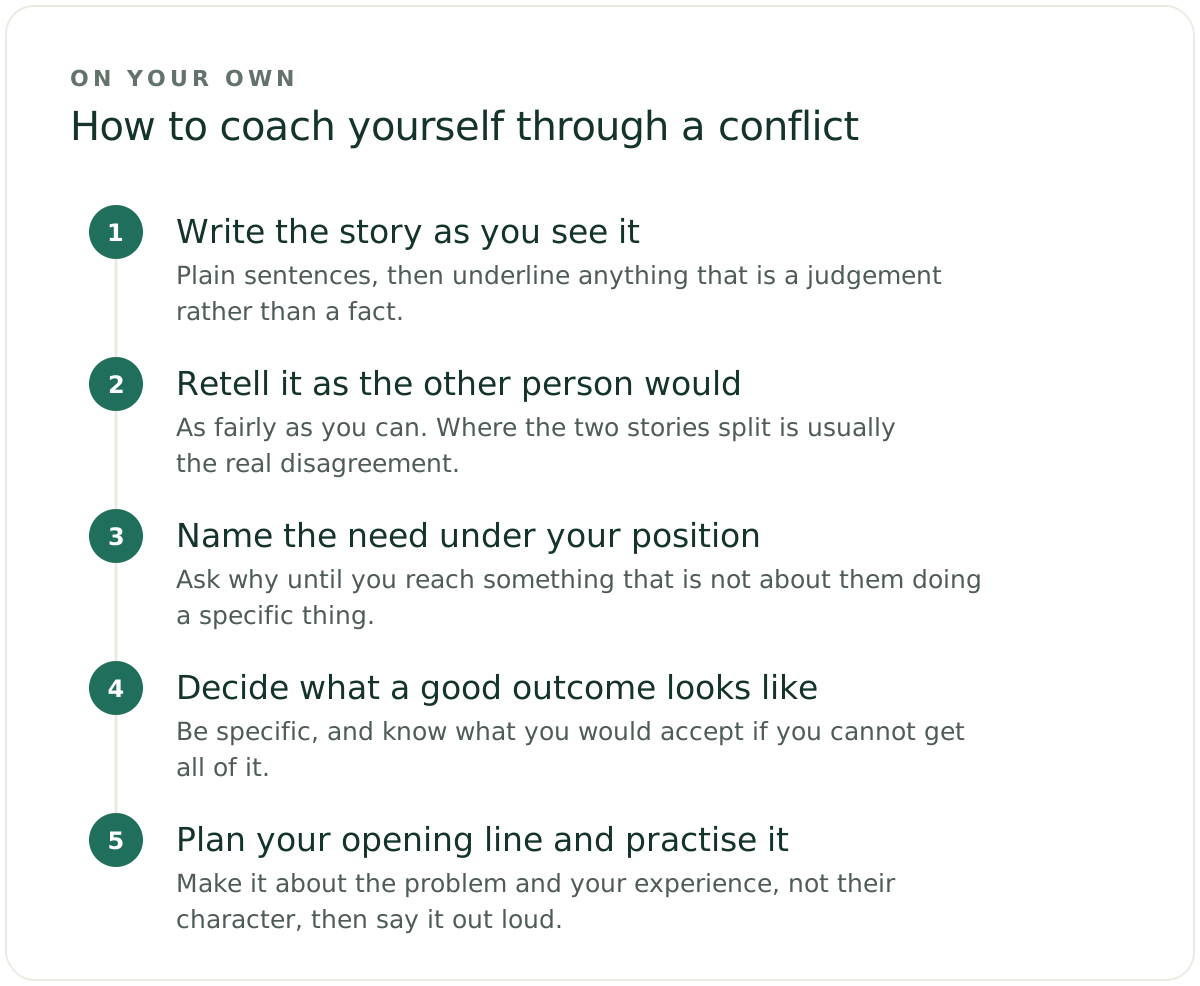
1. Write the story as you see it
Write down what happened, in plain sentences, as if explaining it to a friend. Then underline anything that is a judgement rather than a fact. “She ignored my email” is a fact. “She does not respect me” is a judgement. Both may matter, but they are different things.
2. Retell it as the other person would
Now write the same events from their side, as fairly as you can. What were they dealing with? What might they think you did? You do not have to agree with their version. The point is to find where your two stories split, because that is usually where the real disagreement is.
3. Name the need under your position
Ask yourself what you want, then ask why. Repeat until you reach something that is not about them doing a specific thing. “I want him to stop leaving the dishes” might become “I want to feel that the work at home is shared.” The need is often easier to talk about than the demand.
4. Decide what a good outcome looks like
Be specific. “Things get better” is not an outcome. “We agree who does the dishes on weeknights” is. Also decide what you would accept if you cannot get all of it, and what you will do if the conversation does not happen at all.
5. Plan your opening line and practise it
Most conflicts go wrong in the first thirty seconds. Write your first sentence, and make it about the problem and your experience, not their character:
- Instead of “You always take credit for my work,” try “I want to talk about how the report was presented yesterday, because I came away feeling my part was not visible.”
- Instead of “Your dog barks all day,” try “I wanted to let you know the barking has been going most of the day while you are out, and it is making it hard for me to work from home.”
- Instead of “You never listen,” try “I would like to talk about something that has been bothering me, and I would like to hear how you see it too.”
Then say it out loud, more than once. It sounds strange, but rehearsal is the main thing a coach does with you, and it works for the same reason on your own: the words are ready when you need them. Our guide to how to have a difficult conversation covers what to do once the conversation is under way.
Where FairTalk fits in
FairTalk is not a coach or a therapist, but it is built around the same idea: getting clear on a conflict before trying to fix it, with something impartial in the room.
If the other person is not ready to talk, FairTalk’s solo session feature lets you work through your own side. You talk it through, and afterwards you get a clear picture of your perspective, suggested actions and coaching on the communication skills worth building. It is a structured way to do the self coaching steps above. Our guide to working through a conflict on your own explains that side in more detail.
When you are both willing, FairTalk supports one conversation with both of you present. You talk the issue through together while FairTalk listens without taking sides, and either of you can pause if it gets heated. Afterwards you both get a fair picture of each perspective, a way forward you shape together, and guidance for each person. For how this compares with working with a human coach, see our comparison of an AI relationship coach and couples therapy.
FairTalk is for adults working through everyday disagreements. It is not therapy, and it is not suitable where there is abuse, coercion or a significant power imbalance.
Frequently asked questions
What is conflict coaching?
Conflict coaching is one-to-one help for one person to handle a specific conflict better. A coach works with you alone to understand the conflict, clarify what you want and plan how to raise it. Unlike mediation, the other person does not need to take part.
How is conflict coaching different from mediation?
Conflict coaching works with one person, while mediation brings both people together with a neutral mediator. Coaching helps you prepare and build your own skills; mediation helps the two of you reach an agreement. Some people use coaching first so they go into a mediation clear about what they want to say.
Is conflict coaching the same as counselling?
No. Conflict coaching focuses on one specific conflict and practical next steps, such as what to say and when. Counselling looks more broadly at your wellbeing, feelings and patterns, usually over several sessions. If a conflict is affecting your mental health, counselling or a visit to your GP is the better starting point.
Can I coach myself through a conflict?
Yes. Write the story as you see it, retell it as the other person would, name the need under your position, decide what a good outcome looks like, and plan and practise your opening line. Doing this on paper before the conversation makes it much more likely to go well.
When is conflict coaching not appropriate?
Conflict coaching is not appropriate where there is abuse, threats, coercion or a power imbalance that puts you at risk. In those situations the priority is safety, not a better conversation. Contact 1800RESPECT on 1800 737 732 for confidential support, or 000 in an emergency.