
Conflict at work carries a particular kind of pressure. Unlike a disagreement with a partner or a friend, you often can’t step away from it, you have to keep sitting near this person, collaborating on the same project, seeing them in every meeting, while the tension quietly drains your focus and your goodwill. And because it’s a professional setting, the usual outlets for frustration are off the table. You can’t shout, you can’t sulk, and you certainly can’t storm out.
The good news is that workplace conflict is one of the most learnable forms of conflict to handle well, precisely because the professional context gives you structure to lean on. This guide covers how to approach a dispute with a coworker or manager professionally, how to keep it from escalating, and how to know when it’s time to bring in a third party.
Why workplace conflict is worth addressing early
There’s a tempting logic to letting work conflict slide: it’s just a job, you’ll avoid the person, it’ll blow over. It rarely does. Unresolved workplace tension tends to compound, spreading from the two people involved into the wider team through side-taking, gossip, and the slow erosion of collaboration.
The cost is not abstract. Research consistently links unresolved workplace conflict to lower productivity, higher absenteeism, and increased staff turnover, and the Harvard Business Review has documented how much management time is quietly consumed by disputes that were never properly addressed. The same dynamic we describe in the real cost of unresolved conflict applies at work: the issue doesn’t disappear when it’s ignored, it just goes underground and resurfaces with interest.
Addressing conflict early, while it’s still a specific, solvable disagreement rather than a hardened grudge, is almost always cheaper than the alternative.
Separate the problem from the person
The single most useful shift in any workplace dispute is to treat it as a problem to be solved together rather than a battle to be won. This sounds obvious, but under pressure most people do the opposite: they build a case, gather allies, and frame the other person as the obstacle.
The professional reframe is to locate the conflict in the situation, not the individual. “We’re both under pressure to hit the same deadline with different priorities” is a solvable problem. “She’s impossible to work with” is a verdict, and verdicts don’t have solutions. When you can describe the conflict in terms of competing needs or unclear expectations rather than the other person’s character, you’ve usually found the thing that can actually be fixed.
Most workplace conflict isn’t a clash of bad people. It’s a clash of unclear roles, competing pressures, and assumptions nobody checked.
This is also what keeps the conversation professional. You can be direct about a problem without being personal about a colleague, and that distinction is what lets you keep working together afterwards.
How to have the conversation professionally
When you decide to raise an issue directly, and directly is almost always better than letting it fester or routing it through others, a few principles keep it constructive.
Choose the setting deliberately. Not in front of the team, not over a terse email thread, not in the heat of the moment. A private, low-pressure conversation, in person or on a call, gives the discussion the best chance. Public confrontation forces the other person to defend their reputation as well as their position.
Lead with the specific, not the general. “In yesterday’s meeting, the project timeline got changed without me knowing” is workable. “You always go around me” is an accusation that invites denial. Specific, recent, factual observations are much harder to argue with than sweeping characterisations.
Use the language of your own experience. Framing the issue around your perspective rather than their failings lowers defensiveness immediately. “I felt blindsided when the decision was made without me” lands very differently from “you deliberately cut me out.” This is the workplace application of I-statements versus you-statements, and it’s one of the most reliable tools you have.
Listen for the interest behind their position. The colleague who keeps overriding your decisions might be under pressure you can’t see, worried about a deadline, or acting on an instruction from above. Asking “help me understand what’s driving this from your side” often surfaces a shared problem you can both solve, rather than a personal slight.
Keep your own temperature down. Work conflict escalates the same way any conflict does, and the same tools apply. If a conversation starts heating up, our guide to de-escalation techniques covers how to bring it back down without losing the thread.
Handling conflict with your manager
Conflict with a manager adds a power imbalance that changes the calculation. You can still raise issues, but the approach needs more care.
Lead with shared goals: framing your concern around the work (“I want to make sure I’m delivering what you actually need”) is safer and more effective than framing it around grievance. Be specific and solution-oriented rather than accusatory, and pick your moment, a scheduled one-to-one, not a crowded meeting. And be realistic about the dynamic: a manager who responds to reasonable, professionally raised concerns with retaliation is displaying a problem that may eventually need HR or a formal channel, not another quiet conversation.
When to handle it yourself, and when to escalate
Not every workplace conflict should be handled one-on-one. Knowing the difference is itself a professional skill.
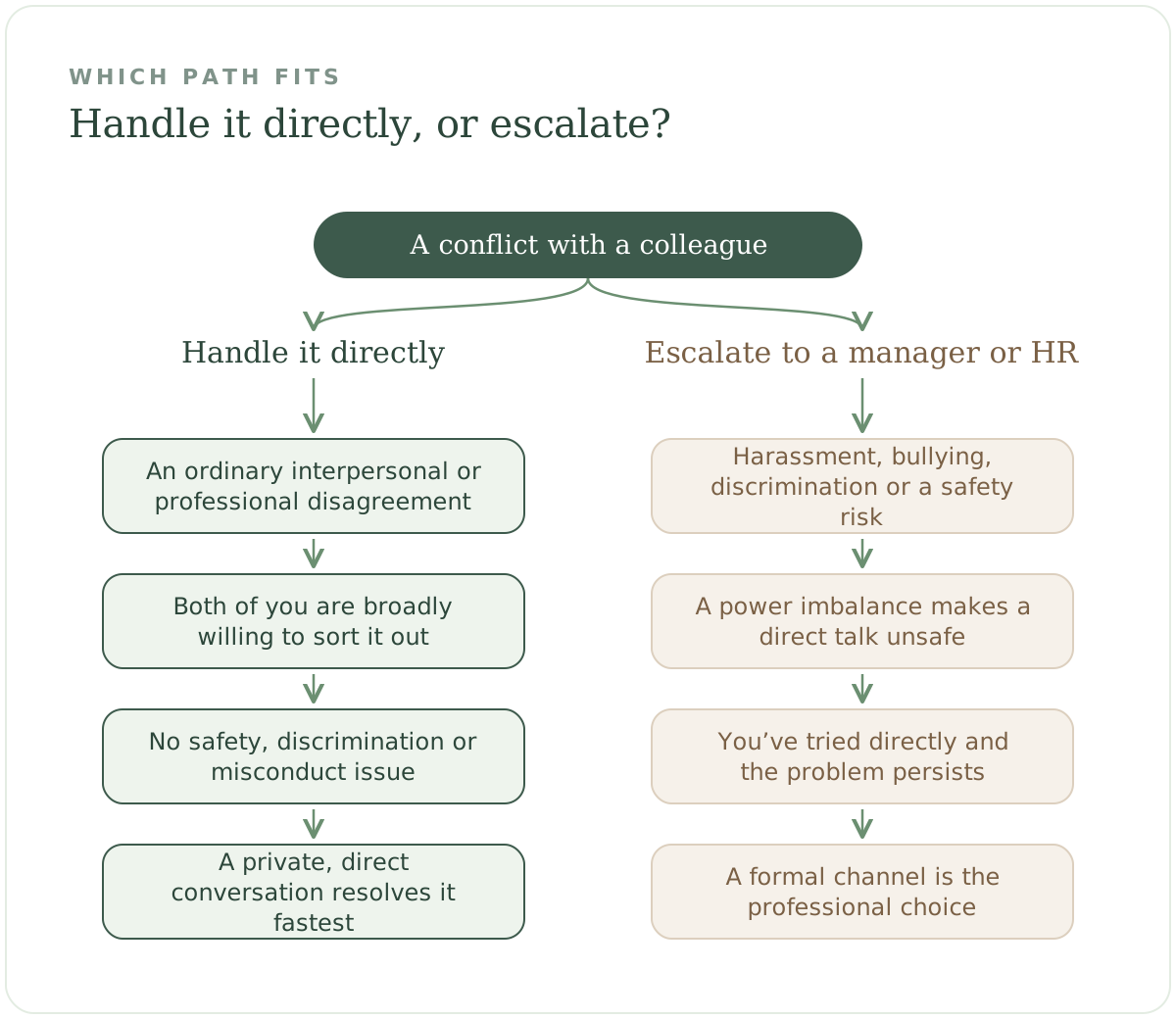
Handle it directly when the conflict is an ordinary interpersonal or professional disagreement, both of you are broadly willing to sort it out, and there’s no issue of safety, discrimination, or serious misconduct. Most day-to-day friction, over workload, communication styles, overlapping responsibilities, or a specific incident, falls into this category, and direct conversation resolves it faster than any formal process.
Escalate to a manager or HR when the behaviour involves harassment, bullying, discrimination, or a safety risk; when you’ve tried to resolve it directly and the problem persists; or when the power imbalance makes a direct conversation unsafe or futile. In Australia, the Fair Work Ombudsman sets out employees’ rights and the appropriate channels for workplace disputes that can’t be resolved informally. Escalating isn’t a failure of professionalism; for serious matters, it’s the professional thing to do.
The key is not to skip straight to formal escalation for problems that a direct conversation would solve, nor to keep quietly enduring behaviour that genuinely warrants a formal response.
Where FairTalk fits in
Most workplace conflict is ultimately interpersonal: two people who need to keep working together and haven’t found a way to talk the problem through. When both colleagues genuinely want to resolve an issue between them and it isn’t a matter for a formal HR process, a structured conversation can do what an awkward corridor chat can’t.
FairTalk provides that structure. Both people talk the issue through in one session while the AI listens impartially, and the analysis afterwards lays out each person’s perspective, where you align, where you differ, and what each of you needs to move forward, with the same documented summary for both of you. For a workplace disagreement that’s more about crossed wires than misconduct, having a neutral account both people trust can be exactly what unsticks it. For anything involving harassment, discrimination, or safety, though, use your organisation’s formal channels rather than a self-directed tool.
Frequently asked questions
How do you resolve conflict with a coworker you can’t avoid?
Address it directly and early, rather than hoping proximity will force it to resolve itself. Ask for a short, private conversation, describe the specific issue in factual terms, and focus on the working relationship you both need going forward rather than relitigating who was right. Because you have to keep collaborating, the goal isn’t to win, it’s to reach a workable arrangement you can both live with. If direct conversation genuinely isn’t possible or hasn’t worked, a manager or HR can help mediate.
Should I go to HR or try to sort it out myself first?
For ordinary interpersonal disagreements, an honest direct conversation usually resolves things faster and with less collateral damage than a formal process, and it’s worth trying first. Go to HR when the issue involves harassment, discrimination, bullying, or a safety concern, when the power imbalance makes a direct approach unsafe, or when you’ve genuinely tried to resolve it and it keeps recurring. Serious misconduct should go to HR without a preliminary “quiet word.”
How do I stay professional when a coworker is being unreasonable?
Keep the conflict located in the problem, not the person, even when they don’t. Stick to specific, factual observations, keep your voice and pace steady, and resist matching their intensity, since staying regulated is what keeps you credible. You can acknowledge their frustration without agreeing with their behaviour. If someone is being genuinely aggressive or abusive rather than just difficult, disengage from the heated exchange and consider whether the situation now warrants a formal channel.
What’s the best way to raise an issue with my boss without damaging the relationship?
Frame it around the work and shared goals rather than personal grievance: “I want to make sure I’m prioritising the right things” invites collaboration, while “you keep changing the plan on me” invites defensiveness. Choose a private, scheduled moment, be specific about the impact, and come with a suggested way forward rather than just a complaint. Most reasonable managers respond well to concerns raised professionally and constructively; how a manager handles being given respectful feedback also tells you something useful about the relationship.
Can better communication skills actually prevent workplace conflict?
They prevent a large share of it. A great deal of workplace conflict comes down to unclear expectations, assumptions that were never checked, and feedback that landed badly because of how it was delivered, all of which are communication problems. Building the underlying skills, clear expression, genuine listening, and checking understanding before reacting, heads off many disputes before they start. Our guide to improving communication skills covers the core habits that apply just as well at work as at home. And for conflict away from the workplace, with a partner, family member, friend or neighbour, see our guide to how to resolve personal conflict.