
Family conflict carries a particular kind of weight that other disputes don’t. You can leave a job over irreconcilable workplace conflict. You generally can’t “leave” a parent, a sibling, or a child, and most people don’t want to, even at the height of the disagreement. The relationship is permanent in a way that raises the stakes on getting the conflict resolution right. Family conflict is one of the harder forms of personal conflict; for the principles that apply across every relationship, see our guide to how to resolve personal conflict.
That’s also why family conflict is the category most likely to be quietly avoided rather than addressed, and the data suggests that avoidance is happening on a larger scale than most people assume.
How Common Is Family Estrangement, Really?
It’s more common than the silence around it suggests. A 2025 YouGov poll found that 38% of American adults report being currently estranged from at least one close relative: a sibling, parent, child, grandparent, or grandchild. Sibling estrangement was the most common category, reported by 24% of respondents, followed by 16% estranged from a parent.
The reasons behind that estrangement are instructive, because they tend to be exactly the kind of dispute that structured mediation is built to address rather than catastrophic, unresolvable breaks. The most common reasons cited for sibling estrangement are personality conflicts (29%), lies or betrayal (29%), and manipulative behaviour (26%). Parents estranged from a child most often point to lies or betrayal (24%), conflicting values or lifestyle (21%), and fallout from divorce (20%).
These are not, in most cases, irreparable circumstances. They’re communication breakdowns and unresolved hurt that calcified into permanent distance because nobody had a structured way back into the conversation.
It’s also worth noting this isn’t necessarily one-sided or final. Among people estranged from a sibling, roughly equal numbers say they were the one who cut off contact (26%) versus their sibling doing so (29%), with 19% describing it as a mutual decision, and researchers studying the phenomenon note that estrangements are not necessarily permanent.
Why Family Conflict Is Harder Than Other Disputes
A few features of family relationships make conflict resolution genuinely more complicated than, say, a workplace disagreement:
The history is longer and more tangled. A dispute with a sibling rarely starts with the thing you’re currently arguing about. It’s usually the latest entry in a pattern that started in childhood, which means both people are often reacting to twenty years of context the other person may not fully share.
Roles complicate the power dynamic. Parent-child conflict, even between two adults, often still carries the residue of the original parent-child hierarchy. Mediation between adult parties needs to account for that without either party feeling infantilised or undermined.
The exit cost is enormous. Because family relationships are harder to walk away from, people often suppress conflict rather than raise it, which, per the research on unresolved conflict and chronic stress, tends to make things worse rather than better over time. The opposite is true of friendship, which is so easy to walk away from that ruptures often go unrepaired; our guide to conflict resolution for friends covers how to mend a falling out before the friendship quietly fades.
Multiple relationships are entangled. A dispute between two siblings rarely stays contained to those two people. Parents, other siblings, and extended family are often pulled in, each with their own version of the history and their own stake in the outcome.
A Structured Approach to How to Resolve Family Conflict
The research on family mediation consistently points towards structure as the variable that makes the difference. One controlled study on parent-led mediation of sibling conflict found that parents trained in formal mediation techniques were more likely to discuss the children’s emotions and less likely to assign blame for past transgressions, and the children involved were correspondingly more likely to propose their own solutions and discuss their own and each other’s emotions. Those effects were still observable months after the training.
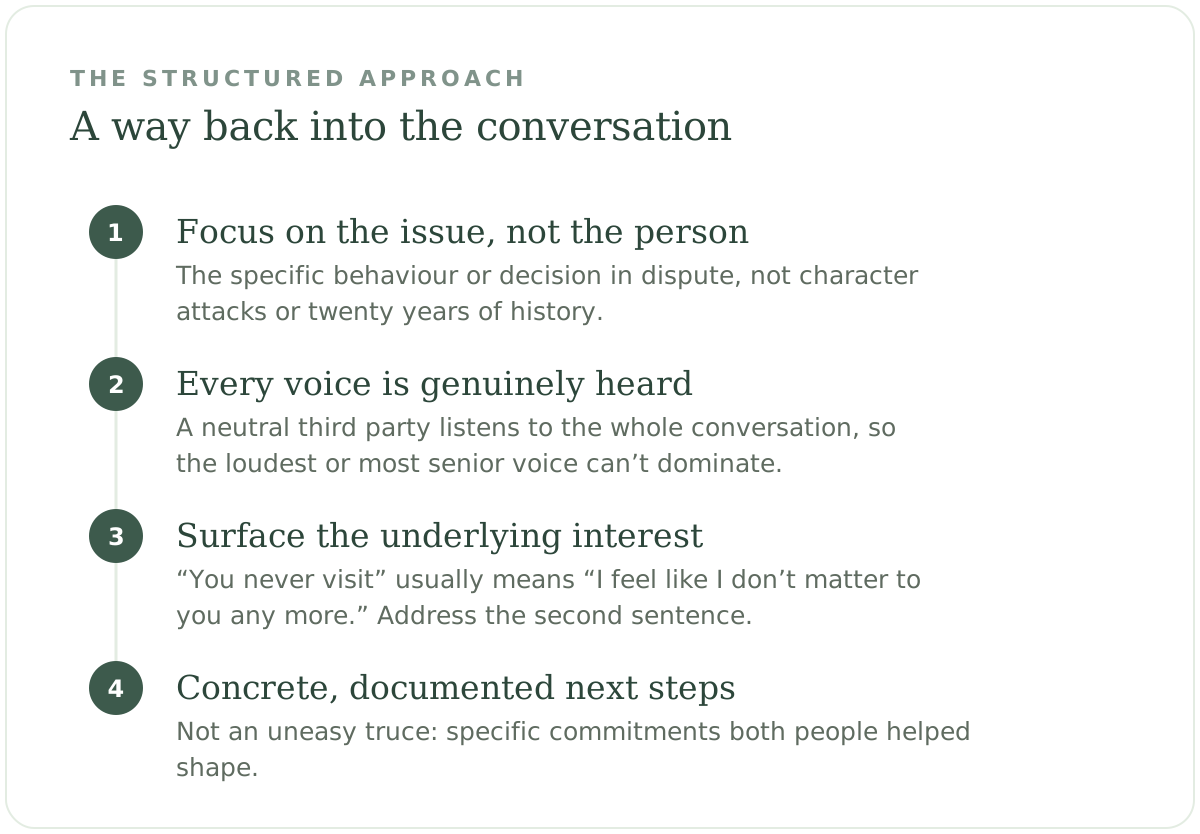
The pattern holds for adult family conflict too. A structured process tends to outperform an unstructured one because it does four things an ordinary argument doesn’t:
-
Separates the person from the position. Family conflict frequently collapses into character attacks (such as “you’re so selfish”) rather than addressing the specific behaviour or decision in dispute. Structure forces the conversation back to the actual issue.
-
Makes sure every voice is genuinely heard. Particularly with multi-generational disputes, an unstructured argument often means the loudest or most senior voice dominates. A neutral third party listening to the whole conversation means each person’s actual position is captured and reflected back accurately, not just the most forceful one.
-
Surfaces the underlying interest, not just the stated complaint. “You never visit” is often a stand-in for “I feel like I don’t matter to you any more.” Structured mediation is built to get to the second sentence, not just respond to the first.
-
Produces something concrete at the end. Family arguments often end in an uneasy truce with nothing actually agreed. A structured process closes with specific, documented next steps both parties have had a hand in shaping.
When to Get Outside Help
Not every family dispute needs a third party, but several signs suggest one would help: the same argument keeps recurring without resolution, one or both people have started avoiding contact altogether, or the conflict has started pulling in other family members as proxies. Options range from professional family dispute resolution services to tools that offer family mediation online. If the friction is specifically between a parent and a teenager, parent and teen communication covers that dynamic in depth.
Some disputes do require professional human support rather than a self-guided tool. Situations involving abuse, coercion, or significant power imbalance should go to a qualified counsellor or relevant support service, not a self-directed mediation process. In Australia, Relationships Australia provides family dispute resolution and counselling services nationally.
For the much larger category of everyday family friction (recurring arguments, communication breakdowns, unresolved hurt that’s calcified into distance), FairTalk mediates between a parent and adult child, siblings, or extended family members using the same structured, two-sided approach: one conversation between the two of you, with the AI listening impartially and producing a structured analysis of both perspectives and a shared path forward. If the conflict pattern you’re seeing in your family looks similar to what’s playing out in a romantic relationship, How to Stop Fighting With Your Partner covers the same de-escalation principles applied to couples, and Active Listening in Relationships covers the single skill that helps most across every family dynamic.
Frequently Asked Questions
Is family mediation different from couples mediation?
The underlying structure is similar (a conversation between both parties, with a neutral analysis of each perspective), but family mediation needs to account for generational roles, longer relationship history, and often a wider circle of people affected by the outcome.
What if the other family member won’t participate?
This is common, particularly in long-running disputes. Mediation needs both people at the table, but you can still prepare on your own: getting clear on what happened, how it affected you, and what you actually need makes the conversation far more productive if and when the other party is willing.
Can family mediation repair an estrangement that’s gone on for years?
It’s possible, but outcomes vary significantly depending on the specific history and the willingness of both parties. Long-standing estrangement often benefits from professional human support alongside any structured tool, particularly where the original cause involved a serious breach of trust.
Is this a replacement for family therapy?
No. Family therapy with a qualified clinician is the appropriate option where there’s a deeper pattern of dysfunction, a mental health condition involved, or a history of abuse. Structured mediation is best suited to discrete disputes and communication breakdowns rather than long-term therapeutic work.
If you or someone you know is affected by family violence or abuse, please contact a qualified professional or relevant support service. This article does not constitute legal, clinical, or psychological advice.