
Political differences in relationships are common, and most couples, families and friendships can survive them. What usually does the damage is not the disagreement itself but how it is handled: contempt, point scoring and the sense that the other person is a bad human being for voting differently. Handled with curiosity and a few agreed limits, a political difference can sit inside a close relationship.
It is a live question right now. The United States has just been through its midterm elections, and in Australia the pressure of rent, groceries and power bills has made the performance of government a dinner table topic in a way it often is not. When the news is loud, the people closest to us are where it lands. This guide is about keeping those relationships intact, and about the quieter strain of loving someone whose views you find hard to sit with.
Why politics feels so personal
Most disagreements are about a decision: where to live, how to spend money, whose turn it is. Political disagreements feel different because they are rarely about the policy alone. Underneath them sit values (fairness, security, freedom, loyalty, compassion) and, often, identity: the family you grew up in, the community you belong to, the people you trust.
So when someone you love says something you strongly disagree with, it can feel less like “we see this issue differently” and more like “you do not see me”, or even “you are not who I thought you were”. That is why a conversation about tax policy can end with one person in tears and the other slamming a door.
A few other things make politics especially hard:
- The stakes feel real. For many people, policy is not abstract. It touches their job, their rent, their health care, their safety or the safety of people they love. Telling someone to “not take it personally” misses that, for them, it may be personal.
- The news cycle keeps it hot. Commentary and social media feeds are built to provoke, and a steady diet of outrage makes the other side look worse than the person sitting across from you actually is.
- Each side expects to be judged. Research from the Pew Research Center has repeatedly found that people in the United States see those on the other side of politics in increasingly negative terms. When you expect to be looked down on, you arrive at the conversation already defensive.
Elections add pressure of their own. The American Psychological Association’s Stress in America surveys have found that election seasons and the future of the country are a significant source of stress for many adults. It is reasonable to expect your household to be a little more on edge at a time like this.
The internal side: when you disagree with someone you love
Not all of the conflict is spoken. Plenty of people never argue about politics with their partner or parents at all; they carry it instead. You might find yourself replaying something your father said at lunch, wondering whether you can respect someone who voted the way they did, or biting your tongue so often that you feel like a stranger in your own family.
That inner tug of war usually comes from two true things pulling against each other: “I love this person” and “I cannot accept what they believe”. Neither cancels the other out. Some ways to hold both:
- Separate the person from the position. Ask what your partner or friend is actually worried about. A vote is a blunt instrument; the fear or hope behind it is usually more human, and often closer to your own than the label suggests.
- Notice what the view costs you. There is a difference between a view you find frustrating and one that touches something central to your life, your livelihood or how you see yourself. Be honest with yourself about which this is. It shapes what you need from the relationship.
- Decide what you can live with. You do not have to agree to stay close, but you do get to decide where your limits are. Our guide on how to find peace with unresolved conflict covers how to settle a disagreement inside yourself when the other person is never going to change their mind.
If you notice the strain spilling into everything (dreading visits, lying awake rehearsing arguments, feeling low for days after a family gathering), that is worth taking seriously. Beyond Blue has support for stress and low mood if it is weighing on you.
How to talk about politics with your partner, family or friends without fighting
If the subject cannot be avoided, or you would rather not avoid it, a few habits make a calmer conversation far more likely.
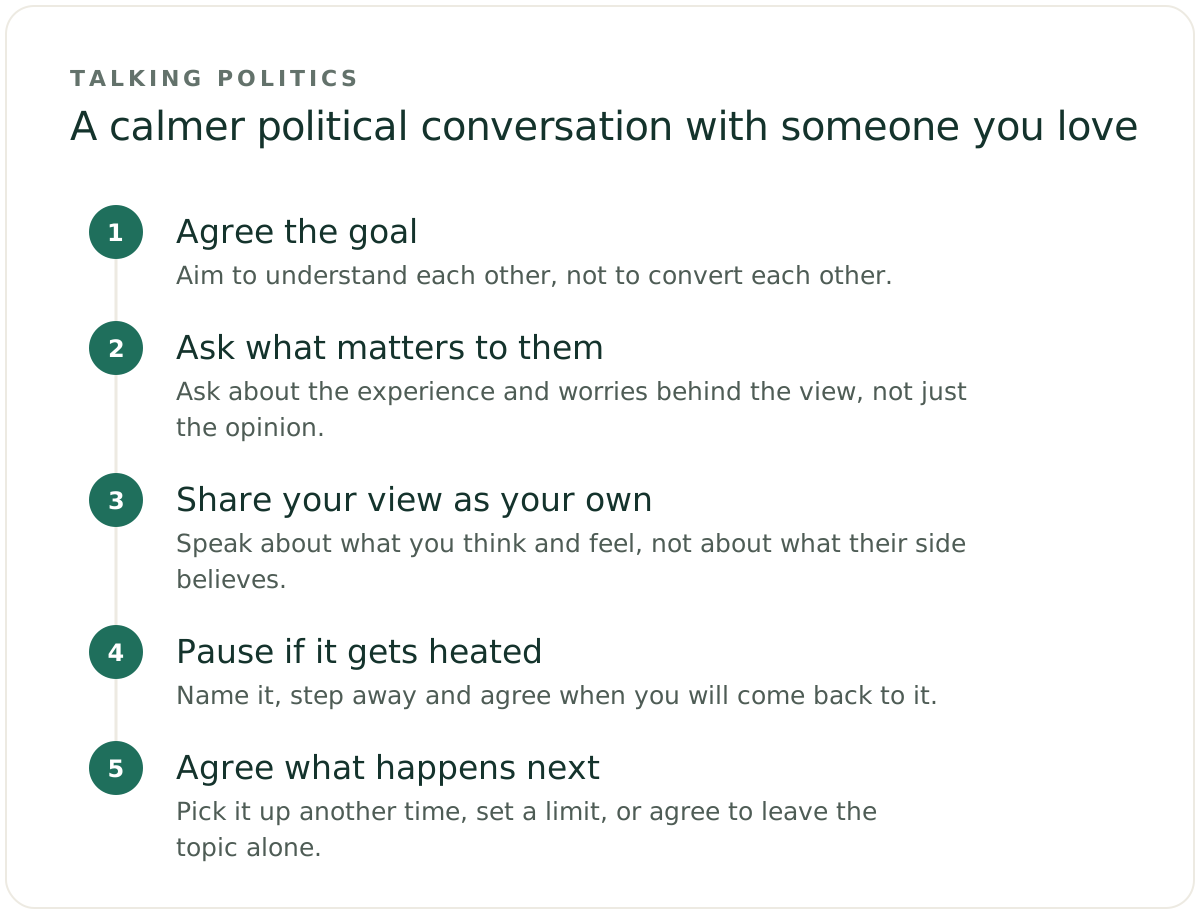
Agree on the goal before the topic
Most political arguments go wrong because each person is trying to convert the other. Decide together what the conversation is for. “I want to understand why this matters so much to you” is a goal you can actually reach. “I want you to admit you were wrong” is not.
Ask about experience, not just opinion
“What made you start caring about this?” or “What worries you most about it?” will tell you far more than “How can you possibly support that?” People can argue against a statistic all day. It is much harder to argue against someone’s lived experience, and much easier to feel for it.
Speak for yourself
Talk about what you think and feel, not about what “people like you” believe. “I am worried about what this means for my sister’s job” lands very differently from “People like you never think about anyone else”. The difference between I-statements and you-statements matters more in politics than almost anywhere else.
Watch for contempt
Eye rolling, mocking a politician the other person supports, or calling their view stupid are all forms of contempt, which the Gottman Institute identifies as one of the strongest predictors of a relationship breaking down. You can strongly reject an idea without sneering at the person who holds it. Contempt is one of Gottman’s Four Horsemen for a reason.
Know when to pause
If voices are rising or someone is getting flooded, stop. Name it and agree when you will come back: “This is getting heated. Can we leave it for tonight and pick it up on Sunday?” Then actually come back to it, or agree not to.
Setting limits around politics
Sometimes the healthiest move is not a better conversation but fewer of them. That is not avoidance if you both agree to it. Some limits that work for couples and families:
- A topic pause at certain times. No politics at family dinners, on holidays, or in front of the grandparents. Agree it in advance, not in the middle of an argument.
- A time limit. “Let’s give this twenty minutes, then talk about something else.”
- A news boundary at home. Agree not to read out the latest outrage to each other, or to keep the television news out of the bedroom.
- No ambushes. Nobody raises a charged topic in front of others to embarrass the other person, at work events, family gatherings or online.
Limits only hold when both people choose them. If you need more help putting one in place, our guide on how to set healthy boundaries walks through what to say. And when the tension involves a wider family, with siblings taking sides and gatherings to plan around, how to resolve family conflict is a good next read.
When political differences in a relationship become something more
Most political disagreements are differences of opinion between equals. Some are not, and it is important to know the difference.
When it is about values that cannot be bridged. Occasionally the gap reflects something deeper about how each of you wants to live, raise a family or treat other people. That is not a failure of communication, and no technique will close it. If you suspect that is where you are, our article on incompatibility in relationships can help you think it through honestly.
When it is about control. Political disagreement should never be used to belittle, frighten or isolate someone. Warning signs include being mocked or punished for how you vote, being told how to vote, having your phone or social media checked, being cut off from friends because of their views, or feeling afraid to say what you think at home. Those are not political differences. They are signs of coercive or abusive behaviour, and they need human support, not better conversation skills.
If any of that sounds familiar, or you feel unsafe, contact 1800RESPECT on 1800 737 732, any time of day or night. In an emergency, call 000.
Where FairTalk fits in
Political disagreements tend to go round in circles because each person is so busy defending their side that neither feels heard. An impartial third party can help, and that is the gap FairTalk is designed to fill for everyday disagreements between two adults.
You and the other person sit down together for one conversation, with FairTalk listening. Either of you can pause the session if it gets heated. It does not interrupt, take sides or decide who is right about the policy. Afterwards, the AI gives both of you a fair picture of each perspective, where you agree and where you differ, a shared way forward, and guidance for each person on how to communicate. With politics, that often reveals more common ground than either of you expected: shared worries about the cost of living, family or the future, even when you would vote differently. For a fuller picture, see how FairTalk works.
If the other person is not ready to talk, the solo session feature lets you work through your own side and come away with a clearer view of what you need and what you could do next.
There are limits. FairTalk is not therapy, and it is not suitable where there is abuse, coercion or a significant power imbalance, which includes the controlling behaviour described above. It is best suited to two adults who disagree, respect each other, and want to stop the same argument from damaging the relationship.
Frequently asked questions
Can a relationship work with different political views?
Yes, many relationships work well with different political views. What matters most is whether you share core values such as respect, honesty and care for each other, and whether you can disagree without contempt. Couples who struggle are usually those where the disagreement has turned into scorn for the other person.
How do you deal with family members with different political views?
Decide what you want from the relationship first, then set limits that protect it. That might mean agreeing to avoid politics at gatherings, asking about their experience rather than debating their opinion, and stepping away when a conversation gets heated. You do not have to win the argument to keep the relationship.
Should couples talk about politics?
Yes, as long as the aim is understanding rather than persuasion. Talking about the values and worries behind your views can bring you closer, while trying to convert each other usually drives you apart. If every conversation ends in a fight, it is reasonable to agree a pause on the subject for a while.
Why do political arguments get so heated?
Political arguments get heated because they are rarely just about policy. They touch values, identity and fears about the future, so a disagreement can feel like a judgement on who you are. A constant stream of outrage in the news and on social media makes it even easier to see the other person as an opponent.
When does a political disagreement need professional help?
A political disagreement needs professional help when it is being used to control, belittle or frighten someone, or when it is causing distress you cannot manage on your own. Being told how to vote, punished for your views, cut off from friends or afraid to speak at home are signs of coercive behaviour, not a difference of opinion. In Australia, 1800RESPECT on 1800 737 732 can help, and you should call 000 in an emergency.