
Few relationships test a parent’s patience quite like the one with a teenager. A child who once told you everything now answers in one word. A reasonable request about homework becomes a slammed door. Conversations that used to be easy turn into a negotiation, and it can feel as though the person you knew has been replaced by someone who finds you faintly ridiculous. Parent and teenager conflict is one of the trickier forms of personal conflict; for the approach that underpins all of them, see our guide to how to resolve personal conflict.
This is one of the most emotionally charged conflicts there is, precisely because the stakes feel so high and the relationship matters so much. The encouraging news is that most parent and teen conflict is a sign that something is going right, developmentally. What helps most is simple to say and harder to do: stay calm yourself, lead with curiosity rather than interrogation, criticise the behaviour rather than the person, offer autonomy within clear limits, and repair after a blow-up.
Why Conflict With a Teenager Feels So Different
Arguing with a teenager is not like arguing with a younger child or another adult, and understanding why makes it far less personal.
Adolescence is a period of intense neurological change. The parts of the brain responsible for emotion and reward mature earlier than the prefrontal cortex, which governs planning, impulse control, and weighing consequences, and that latter region keeps developing into the mid-twenties. The result is a young person who feels everything powerfully but is still building the machinery to regulate it. When a teenager reacts to a small request as though it were a major injustice, that mismatch is often what you are seeing.
At the same time, the core developmental task of adolescence is to become a separate, autonomous person. Pushing against parents is part of how that happens. Australia’s Raising Children Network describes this drive for independence as a normal and healthy part of development, even when it is exhausting to live with. A teenager testing limits is not rejecting you. They are practising being themselves.
The Most Common Flashpoints
Parent-teen conflict tends to cluster around a handful of predictable themes, and nearly all of them are really about the same underlying issue: autonomy.
Independence and control. Curfews, going out, who they spend time with. The specific rule is rarely the real argument. The real argument is how much freedom is reasonable at this age.
Privacy. Phones, bedrooms, and what they choose to share. Teenagers experience privacy as a marker of being trusted and treated as a person, so a request that feels like reasonable oversight to you can feel like surveillance to them.
Screens and technology. A near-universal battleground, and one where the line between healthy limits and control is genuinely hard to find.
Respect and tone. Often the flashpoint that stings the most, because it feels personal. It helps to remember that a teenager’s sharp tone is usually poor emotional regulation rather than genuine contempt.
Naming which of these a particular argument is really about is often the first step to defusing it.
How to Communicate Across the Gap
The goal is not to win the argument or to eliminate conflict altogether. It is to stay connected while holding the boundaries that matter. A few principles make that possible.
-
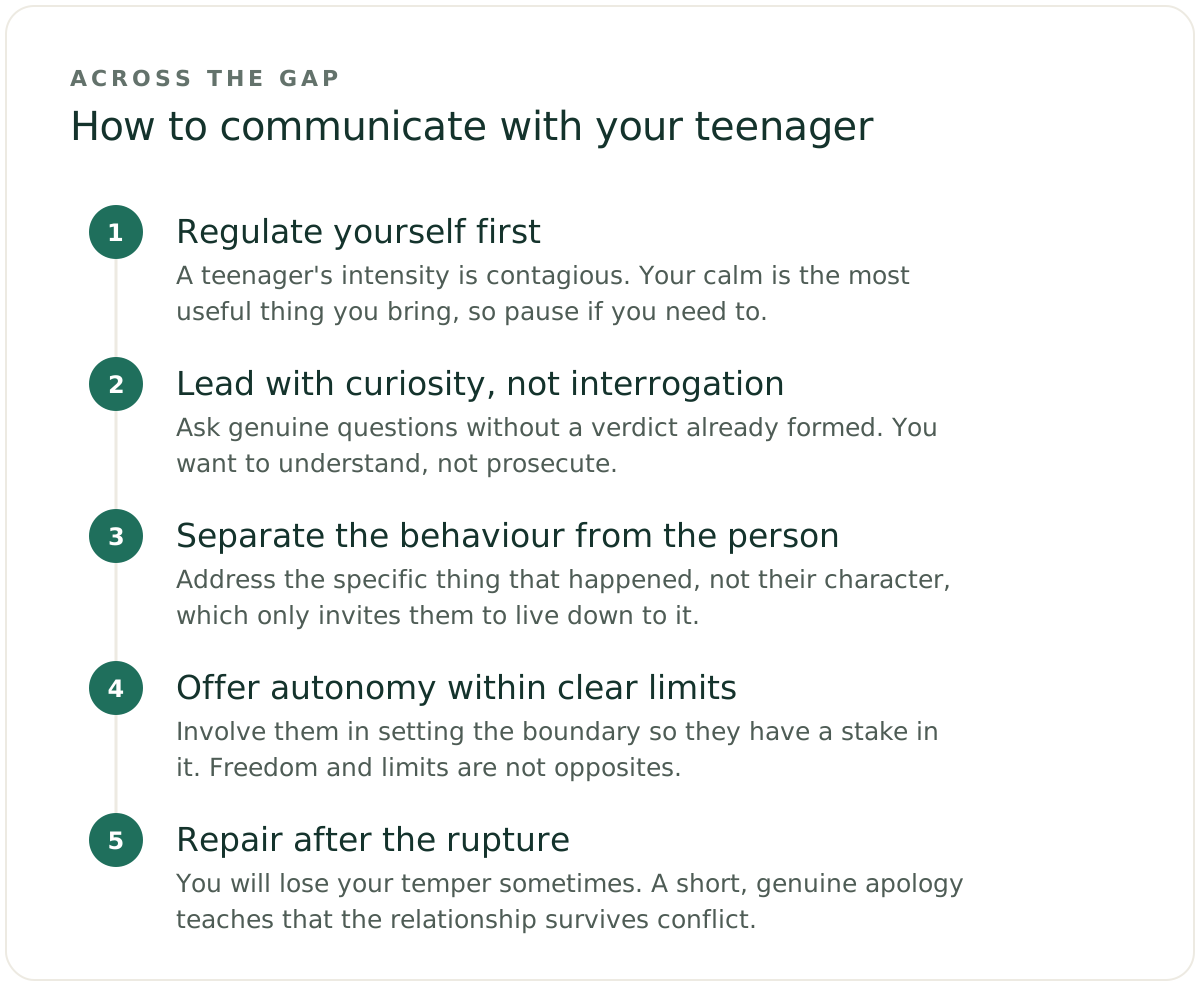
Regulate yourself first. A teenager’s dysregulation is contagious, and the moment you match their intensity, the conversation is lost. Your calm is the single most useful thing you bring. If you feel yourself heating up, it is entirely reasonable to pause and return to the conversation later, which also models exactly the self-regulation you want them to learn.
-
Lead with curiosity, not interrogation. “What’s going on for you?” opens a door that “Why would you do that?” slams shut. Genuine questions, asked without a verdict already formed, signal that you want to understand rather than prosecute. This is the same active listening skill that works in every relationship, and teenagers are unusually quick to detect when it is missing.
-
Separate the behaviour from the person. “I’m frustrated that the curfew wasn’t kept” keeps the door open. “You’re so irresponsible” attacks their character and invites them to live down to it. Address the specific thing that happened, not who they are.
-
Offer autonomy within clear limits. Teenagers push hardest against rules that feel arbitrary. Involving them in setting the boundary (“what feels like a fair time to be home, and what will we do if it slips?”) gives them ownership without abandoning the limit. Boundaries and freedom are not opposites, a point our guide to setting healthy boundaries covers in more depth.
-
Repair after the rupture. You will lose your temper sometimes. What matters more than never rupturing is repairing afterwards: a short, genuine “I’m sorry I raised my voice earlier, let’s try that again.” Repair teaches a teenager that relationships can survive conflict, which may be the most valuable lesson of all.
When It Is More Than Ordinary Conflict
Most parent-teen conflict is normal, but not all of it. It is worth paying closer attention when the changes look less like typical adolescence and more like distress: a persistent withdrawal from friends and activities they used to enjoy, marked changes in sleep or eating, talk of hopelessness, or any sign of self-harm.
In those situations, the issue is no longer communication technique, and the right step is professional support rather than another conversation about boundaries. A general practitioner, a school counsellor, or a psychologist is the appropriate place to start, and organisations listed by the Australian Psychological Society can help you find one. Research summarised by the American Psychological Association is clear that early support for adolescent mental health makes a meaningful difference, so raising a concern sooner is always better than waiting.
Where FairTalk Fits In
An honest note on this one: FairTalk is designed for adults, so it is not a mediation tool to use directly with a teenager who is still a minor. For the day-to-day work of communicating with a teenager at home, the strategies above, applied consistently and calmly by you, are what actually move things.
Where FairTalk can help is at the edges of this stage. Once a child reaches adulthood, FairTalk can mediate a conversation between a parent and their adult child, using the same structured approach it applies to any family dispute: one conversation with both people present, an impartial analysis afterwards of each perspective, and a shared summary both keep. And where two co-parents disagree about how to handle a teenager, it offers a neutral space for those two adults to work that disagreement through between themselves. For the wider dynamics of family conflict, our guide to resolving a family dispute covers the same principles across every family relationship.
Frequently Asked Questions
Is it normal to argue this much with my teenager?
In most cases, yes. Increased conflict is a well-documented feature of adolescence, driven by the normal developmental push for independence and by a brain that feels emotion intensely while still building the capacity to regulate it. Frequent friction is not usually a sign of a damaged relationship. What matters is that the conflict is handled with enough repair and warmth around it that the underlying connection stays intact.
Why does my teenager shut down instead of talking?
Withdrawal is often a teenager’s way of managing feeling overwhelmed, judged, or controlled, rather than a refusal to engage. Pushing harder tends to make it worse. Lowering the pressure usually works better: choose a low-stakes moment, sit alongside an activity rather than facing them across a table, and ask an open question without an agenda. If the withdrawal is persistent and paired with other changes in mood or behaviour, it is worth speaking to a professional.
How do I set boundaries without constant fighting?
Involve your teenager in the boundary rather than imposing it whole. When they help decide what a fair limit is and what happens if it slips, they have a stake in keeping it, and the rule feels less arbitrary. Keep the boundary itself firm and consistent while staying warm about it. The aim is clear limits held kindly, not either rigid control or giving up.
When should I get professional help?
Seek support when the signs point to distress rather than ordinary conflict: prolonged withdrawal, significant changes in sleep, eating, or mood, talk of hopelessness, or any indication of self-harm. In those cases a general practitioner, school counsellor, or psychologist is the right resource. Reaching out early is always preferable to waiting to see whether it passes.