
Incompatibility in a relationship means two people want fundamentally different things on matters neither of them can give up, such as whether to have children, where to build a life, or what commitment means. Most differences that feel like incompatibility are not. They are ordinary differences in personality and habits that couples learn to live with.
Telling the two apart matters, because they need very different responses. A real incompatibility calls for an honest decision. An ordinary difference calls for a better conversation. This guide covers what incompatibility actually looks like, the differences that are often mistaken for it, a few questions that help you tell which one you are facing, and how to talk about a big difference without it turning into the same fight again.
What does incompatibility mean in a relationship?
Every couple is made up of two people with different histories, temperaments and hopes, so some difference is guaranteed. Incompatibility is narrower than that. It is when a difference touches something central to who one or both of you are, and there is no version of the relationship where both of you get what you need.
It is also a common worry. Relationships Australia found that people seeking help with a relationship reported fundamental differences in values, beliefs and expectations at much higher rates than the general population. In other words, by the time people look for help, “we are just too different” is often how the problem feels.
That feeling is worth taking seriously, but it is not always accurate. Arguments that repeat for months can make two people feel incompatible when what has really broken down is how they talk about the difference.
Differences that feel like incompatibility, but usually are not
The Gottman Institute describes most relationship conflict, sixty-nine percent in its research, as perpetual problems: fundamental differences in personality or lifestyle needs that a couple will return to again and again, and it says all couples have them. Common examples include:
- Tidiness. One of you notices the mess, the other genuinely does not.
- Social energy. One recharges with people, the other with time alone.
- Money style. One saves for security, the other spends to enjoy life now.
- Time. One is always early, the other runs on a looser clock.
- Conflict style. One wants to talk it through immediately, the other needs space first.
- Affection. One wants more physical closeness or reassurance than the other naturally gives.
None of these is a sign that you are wrong for each other. They are the normal friction of two different people sharing a life. According to the Gottman Institute, what matters is not solving perpetual problems but whether a couple can keep up a dialogue about them, ideally with some acceptance, affection and even humour. Our guide to common relationship problems covers how to talk about the everyday ones.
Signs of real incompatibility
Real incompatibility tends to involve choices that shape a whole life, where meeting in the middle is not possible or would leave one person giving up something essential:
- Children. One of you wants them and the other is certain they do not. There is no halfway point.
- Where and how to live. One person’s life is rooted somewhere the other cannot or will not stay, or your plans for the future point in opposite directions.
- Commitment. You want different things from the relationship itself, such as marriage, exclusivity or a shared home.
- Core values. Deep differences in faith, honesty, or how to raise children, where each of you experiences the other’s view as a line you cannot cross. Politics can sit here too, although most political differences in relationships are easier to live with than they feel in the moment.
- One person can only be happy if the other stops being themselves. If staying together means one of you shrinking a central part of who you are, the cost is likely to grow over time.
Some things are not incompatibility at all. Contempt, disrespect, or one person controlling or frightening the other are not a mismatch of personalities. If you feel afraid of your partner, or they control your money, contacts or decisions, contact 1800RESPECT on 1800 737 732 for confidential support, or 000 in an emergency.
Is it a difference or a dealbreaker? Five questions to ask
When a disagreement feels too big to get past, these questions help you see what you are dealing with:
- Could either of us give ground without losing something central? If one of you could flex and still be yourself, it is a difference to negotiate.
- Are we arguing about the issue, or about how we argue? Many “incompatible” couples are really stuck in criticism and defensiveness about a manageable topic.
- Do I understand why it matters so much to them? If you cannot explain your partner’s position in a way they would agree with, you may not yet know whether you are incompatible.
- Has it always been this big? A difference that has grown with each argument is often gridlock. A difference that was always fundamental, such as children, is more likely real.
- Would a compromise leave us both okay? If every middle ground leaves one of you quietly grieving, take that seriously.
When a difference turns into gridlock
The Gottman Institute describes a gridlocked problem as a perpetual difference that has been handled badly for so long that discussing it feels like spinning your wheels. It says gridlocked discussions lead only to painful exchanges or icy silence, that hidden agendas tend to sit underneath, and that gridlock eventually leads to emotional disengagement.
Gridlock is one of the main reasons couples conclude they are incompatible. After the fortieth round of the same argument, it is hard to remember that the original difference was ordinary. The way out is usually not to settle the issue, but to change how you talk about it: keeping out the criticism, contempt, defensiveness and stonewalling that Gottman calls the Four Horsemen, and getting curious about what sits underneath each position.
How to talk about a big difference
A conversation about a fundamental difference goes better with some structure, especially if it has been gridlocked for a while.
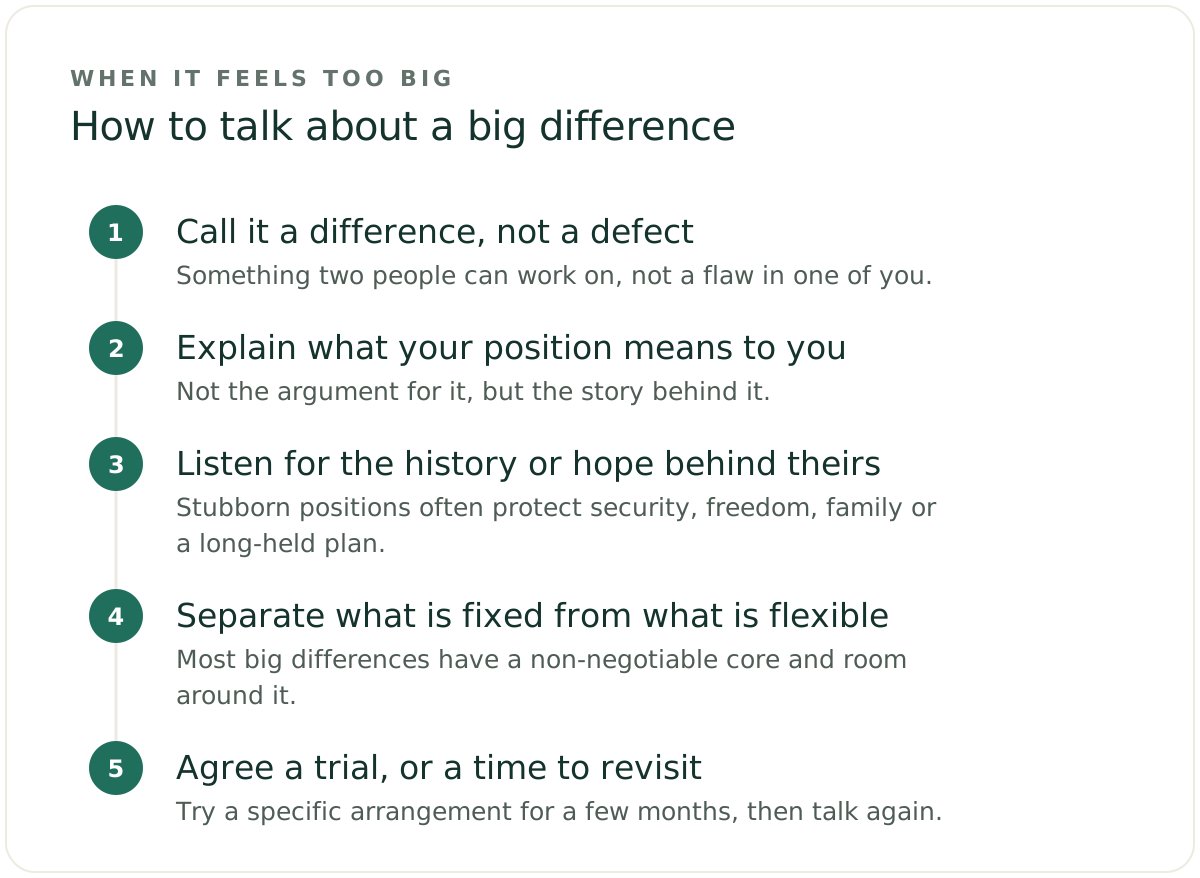
- Call it a difference, not a defect. “We see weekends really differently” is something two people can work on. “You’re antisocial” is not.
- Each explain what your position means to you. Not the argument for it, but the story behind it: “I grew up never knowing if there would be enough money, so savings make me feel safe.”
- Listen for the history or hope behind theirs. Positions that look stubborn often protect something important, such as security, freedom, family or a long-held plan.
- Separate what is fixed from what is flexible. Most big differences have a non-negotiable core and a lot of room around it. Be honest about which is which.
- Agree a trial, or a time to revisit. Try a specific arrangement for a few months, then talk again. Our guide to negotiation and compromise covers how to find a middle ground both of you can live with.
If you are genuinely incompatible
Sometimes two decent people who care about each other want lives that cannot fit together. That is not a failure on either side, and it is not something better communication can fix. What good communication can do is help you reach that conclusion honestly and treat each other well along the way.
If you are unsure, or one of you sees the difference as fixable and the other does not, a couples counsellor can help you work out what you each want before you decide anything. Our guide to what couples therapy is explains what that involves.
Where FairTalk fits in
Big differences are hard to talk about well, because each conversation carries the weight of every earlier one. You talk the issue through together while FairTalk listens without taking sides, and either of you can pause if it gets heated. Afterwards, you both get a fair picture of each other’s perspective and a way forward you have shaped together, along with guidance on the communication skills each of you could build.
Seeing both positions laid out fairly can make it clearer whether you are facing a difference you can manage or a choice you need to make. If your partner is not ready to talk yet, the solo session feature lets you work through your own side first. FairTalk is not therapy, and it is not suitable where there is abuse, coercion or a power imbalance.
Frequently asked questions
What is incompatibility in a relationship?
Incompatibility in a relationship is when two people want fundamentally different things on matters neither can give up, such as children, where to live, commitment or core values. It is different from ordinary differences in personality and habits, which every couple has and most learn to manage. The test is whether a middle ground exists that leaves both people okay.
Can incompatible couples make it work?
It depends on what the incompatibility is about. Differences in personality, habits and lifestyle, such as tidiness or social energy, are common and manageable with good communication. Differences on life-shaping choices, such as one person wanting children and the other not, usually cannot be compromised without one person giving up something essential.
How do I know if we are incompatible or just going through a rough patch?
Ask whether the difference has always been fundamental or has grown with each argument. Differences that feel bigger over time are often gridlock, where the way you argue has become the problem. Stress, exhaustion and life changes can also make ordinary differences feel impossible for a while.
What are the signs of incompatibility?
The clearest signs are fixed, opposing positions on children, where to live, commitment or core values, where every compromise leaves one person giving up something central. Another sign is when one person can only be happy if the other stops being themselves. Frequent arguments on their own are not a sign of incompatibility.
Is it normal for couples to have differences they never resolve?
Yes. The Gottman Institute’s research found that most relationship conflict is about perpetual problems, lasting differences in personality or lifestyle needs that couples manage rather than solve. What matters is whether you can keep talking about them with acceptance rather than letting them become gridlocked.