Pre-marriage counselling is a short series of sessions, or a course, that helps a couple prepare for marriage by talking through the topics that most often cause friction later: money, family, children, roles, intimacy and how you handle conflict. In Australia it is also called pre-marriage education or premarital counselling, and it is usually done before problems start.
That last part is what makes it different from most relationship help. Nobody is in trouble. You go while things are good, so that the hard conversations happen calmly and early, instead of years later in the middle of an argument. This guide covers what pre-marriage counselling involves, who offers it in Australia, what the research says about whether it helps, and the conversations worth having whether or not you book anything.
What pre-marriage counselling is
The phrase covers a few different things, and it helps to know which one you are looking at.
- Pre-marriage education. A course or workshop, often in a small group of couples, that teaches skills such as communicating clearly, solving problems together and managing conflict. It is closer to a class than to therapy.
- Pre-marriage counselling. Private sessions for the two of you with a counsellor, focused on your own relationship, your plans and any worries either of you has.
- Questionnaire-based programmes. Each of you completes a questionnaire separately, and a trained facilitator then goes through the results with you both, showing where you see things the same way and where you differ. Relationships Australia NSW, for example, offers its Prepare and Enrich service as an online assessment followed by three sessions with a counsellor, online or face to face.
Many churches and faith communities also run their own marriage preparation, sometimes as a condition of marrying in that community. Those courses usually blend the same practical topics with the faith’s teaching on marriage.
Why your celebrant mentions it
If you are marrying in Australia, you will probably first hear about pre-marriage education from your celebrant. Once you lodge your Notice of Intended Marriage, your celebrant gives you a brochure from the Attorney-General’s Department called Happily ever… before and after. It outlines the obligations and consequences of marriage and tells you that marriage education and counselling services are available.
It is information, not a requirement. Whether you take up pre-marriage education is your decision.
What pre-marriage counselling covers
Every programme differs, but most come back to the same handful of topics, because these are the subjects couples most often find they had never fully discussed:
- Money. Earning, spending, saving, debt, and whether your finances will be joint, separate or a mix.
- Family. How involved each family will be, holidays, expectations from parents, and what happens when a family member disagrees with a decision you have made together.
- Children. Whether you want them, how many, when, and how you would each like to parent.
- Roles and housework. Who does what at home, and what feels fair to each of you.
- Intimacy and affection. What each of you needs to feel close, and how you will raise it when something is not working.
- Values, faith and culture. What matters most to each of you, and how you will handle differences.
- Conflict. How each of you argues, what you do when you are upset, and how you repair afterwards. The conflict resolution strategies that work in any disagreement are worth knowing before your first big one.
Relationships Australia NSW describes the aims of its programme in similar terms: identifying shared goals and values, naming sources of stress, learning to resolve conflict with compassion and respect, negotiating commitments and boundaries, and strengthening communication and listening.
The point is not to settle every question before the wedding. It is to find out where your expectations differ while it is still easy to talk about. Many of these topics are also the common relationship problems that married couples report years later.
Does pre-marriage education work?
The research is encouraging, with some honest limits.
The largest review is a 2008 meta-analysis in the Journal of Consulting and Clinical Psychology, which pooled 117 studies of marriage and relationship education. It found that these programmes improved both relationship quality and communication skills, and that programmes of moderate length had larger effects than very short ones. The authors also noted the gaps: most samples lacked racial and economic diversity, and few studies measured long-term outcomes such as whether couples stayed together.
A 2006 study in the Journal of Family Psychology took a different approach, surveying a large random sample of households across four American states. People who had taken part in premarital education reported higher satisfaction and commitment in their marriages, less conflict, and lower odds of divorce, and those links held across income, education and race. Because it was a survey rather than an experiment, it cannot prove the education caused the difference. Couples who choose to do a course may already differ from those who do not.
Taken together: pre-marriage education is not a guarantee, but there is good evidence that learning these skills before marriage helps, and that a course with some substance does more than a single short session.
The conversations to have before marriage
You do not need a counsellor to start. These are the conversations most programmes are designed to prompt, with questions you can actually ask.
Before you begin, agree how you will talk, because the way you discuss a topic matters as much as the answer. One approach that works:
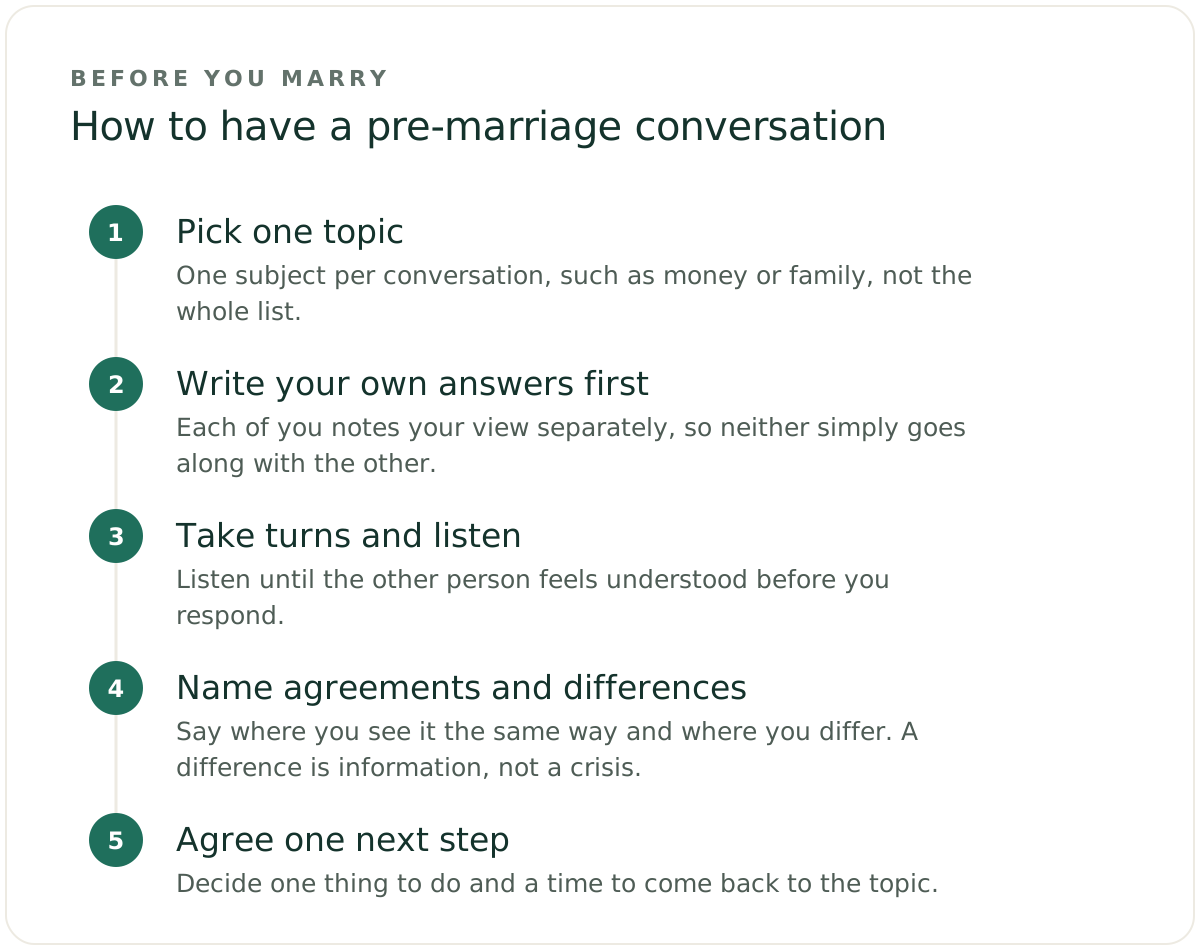
- Pick one topic per conversation, not the whole list.
- Each write down your own answers first, so neither of you simply goes along with the other.
- Take turns, and listen until the other person feels understood before you respond.
- Name where you agree and where you differ. A difference is information, not a crisis.
- Agree one next step and a time to come back to it.
Money
“What does financial security look like to you?” “Do you have any debts I don’t know about?” “Should our money be joint, separate, or both?” “How much could either of us spend without checking with the other?”
Family
“How often do you expect to see your family?” “Where will we spend Christmas?” “If your parents disagree with a decision we make, what will you do?”
Children
“Do you want children, and roughly when?” “How were you disciplined, and would you do it the same way?” “What happens if we can’t have children, or one of us changes our mind?”
Home and roles
“What did housework look like in the home you grew up in?” “What would feel unfair to you?” “Who will manage the bills, the calendar and the birthdays?”
How you argue
“What do you do when you’re upset with me?” “What do I do that makes an argument worse?” “How do you like to make up?” If this is the conversation that worries you most, agreeing a few fair fighting rules now is one of the most useful things you can do before marriage.
Not every difference needs to be resolved. Some will stay with you for life, and that is normal. What matters is that you can talk about them without it turning into a fight.
How to choose a course or counsellor
A few questions help narrow it down:
- Group or private? A group course is usually cheaper and less intense. Private sessions focus entirely on your relationship.
- Faith-based or not? If you are marrying in a church, ask whether it runs or requires its own course. If you would rather a secular programme, say so when you enquire.
- Who runs it? Look for a counsellor with membership of a professional body, or a psychologist registered with Ahpra, or an established not-for-profit such as a Relationships Australia branch.
- Does it fit your relationship? Programmes increasingly welcome couples from all backgrounds, including same-sex couples and couples who already live together. Ask if you are unsure.
- Online or in person? Many providers offer both. Our guide to online couples counselling covers how video sessions work and how to check a practitioner.
Fees vary widely between providers and formats, and some services set fees by income. Our guide to couples counselling cost sets out typical session fees in Australia and the lower cost options.
When it is not the right step
Pre-marriage counselling assumes two people who both want to be there and who can speak freely. If either of you feels pressured into the marriage, or there is fear, control, threats or violence in the relationship, a joint session is not the right place to raise it and may not be safe. Contact 1800RESPECT on 1800 737 732 for confidential support, or 000 in an emergency.
Where FairTalk fits in
FairTalk is not pre-marriage counselling, and it is not a substitute for it. It is a practical tool for the everyday disagreements that tend to surface in the months before and after a wedding: the guest list, the budget, whose family gets which holiday, how the housework will be shared.
You talk the issue through together while FairTalk listens without taking sides, and either of you can pause if it starts to get heated. Afterwards, you both get a fair picture of each other’s perspective, where you agree and where you differ, and a way forward you have shaped together, along with guidance on the communication skills each of you could build. If one of you is not ready to take part, the solo session feature lets you work through your own side first.
Professional services serving the same purpose are in the vicinity of ten times more expensive than the app subscription. Many couples use both: a course or counsellor to prepare for marriage, and FairTalk for the day-to-day disagreements that follow.
Frequently asked questions
What is pre-marriage counselling?
Pre-marriage counselling is a short series of sessions or a course that helps a couple prepare for marriage by discussing topics such as money, family, children, roles and conflict. It is also called pre-marriage education or premarital counselling. Most couples do it while the relationship is going well, to talk through differences early.
Is pre-marriage counselling compulsory in Australia?
No. When you lodge your Notice of Intended Marriage, your celebrant must give you a government brochure that explains the obligations of marriage and tells you marriage education and counselling are available. Taking it up is your choice, although some churches require their own marriage preparation course.
How many sessions does pre-marriage counselling take?
Usually a few sessions or a short course. Questionnaire-based programmes often involve an online assessment followed by around three sessions with a counsellor, while group courses may run over a weekend or several evenings. Research suggests programmes of moderate length do more than a single short session.
Does premarital counselling actually work?
The evidence suggests it helps. A 2008 meta-analysis of 117 studies found that marriage and relationship education improved relationship quality and communication skills, and a large 2006 survey linked premarital education with higher satisfaction, less conflict and lower odds of divorce. It is not a guarantee, and couples who choose it may already differ from those who do not.
Can we do pre-marriage counselling if we already live together?
Yes. Many programmes welcome couples at any stage before marriage, including those who already live together or share finances. Some services also offer the same kind of programme to couples who are not planning to marry but want to strengthen their relationship.
What should we talk about before getting married?
The topics that most often cause friction later: money and debt, family involvement, whether and when to have children, how housework and roles will be shared, intimacy, values and faith, and how each of you handles conflict. Take one topic at a time, write down your own answers first, and agree a next step at the end of each conversation.