Self-care affects conflict because a tired, hungry, stressed or overwhelmed person has less patience, less empathy and less self-control to bring to a disagreement. Looking after your sleep, food, stress and time to recharge is not selfish. It is part of how you show up for hard conversations, and research links it directly to how arguments go.
Most advice on resolving personal conflict focuses on what to say. This guide looks at the state you are in when you say it. It covers what self-care actually means in a relationship, what the research shows about sleep, hunger and stress in arguments, the signs that your own depletion is driving a fight, a quick self-check before a difficult conversation, and the line between self-care and avoiding the issue.
What self-care actually means in a relationship
Self-care has picked up an image of bubble baths and treats. In the context of conflict, it is much more basic: the things that keep you steady enough to listen, think and choose your words.
- Sleep, enough and regular enough that you are not running on fumes.
- Food, so you are not trying to have a hard conversation on an empty stomach.
- Stress relief, whether that is exercise, time outside, or a proper break from work.
- Time to recharge, alone or with friends, depending on what refills you.
- Support, people other than your partner you can talk to.
- Limits, so one part of life does not swallow all your energy.
Beyond Blue offers a free Self-Care Check, a short self-assessment to help you see where your wellbeing could use attention. It is a useful starting point if you are not sure where you are running low.
How self-care affects conflict: what the research says
Several lines of research point the same way: the state you are in shapes the argument you have.
Sleep. A study published in Social Psychological and Personality Science, The Role of Sleep in Interpersonal Conflict, found that people reported more conflict in their romantic relationships after poor nights of sleep. In the laboratory, when one partner had slept badly, both partners were less accurate at reading each other’s feelings during a conflict conversation, and conflicts were most likely to be resolved when both people were well rested.
Hunger. In a study of 107 married couples published in the Proceedings of the National Academy of Sciences, Low glucose relates to greater aggression in married couples, researchers measured blood glucose for 21 days. The lower a person’s glucose level, the more angry impulses they showed towards their spouse. “Hangry” turns out to be more than a joke.
Stress. A review in Clinical Psychology Review, The role of stress on close relationships and marital satisfaction, summarised evidence that stress is a threat to relationship satisfaction and to how long relationships last. Stress from work, money or health tends to spill over into how partners treat each other at home. Our guide to how burnout affects relationships looks at the most extreme version of that spillover.
The common thread is capacity. Patience, empathy and self-control all draw on reserves, and when those reserves are low, small disagreements become big ones.
Signs your own depletion is driving the argument
It is hard to notice your own state in the middle of a disagreement, but some patterns are a giveaway:
- Small things feel enormous, and you know it even as you react.
- You snap, then regret it within minutes.
- You cannot hold the other person’s point of view in your head at all.
- Everything they say lands as criticism.
- You care more about winning, or ending it, than about sorting it out.
- The same argument would not have bothered you on a good day.
None of this means your concerns are not real. It means that right now may not be the moment to resolve them.
A self-check before a difficult conversation
Before you raise something important, take thirty seconds to check your own state.
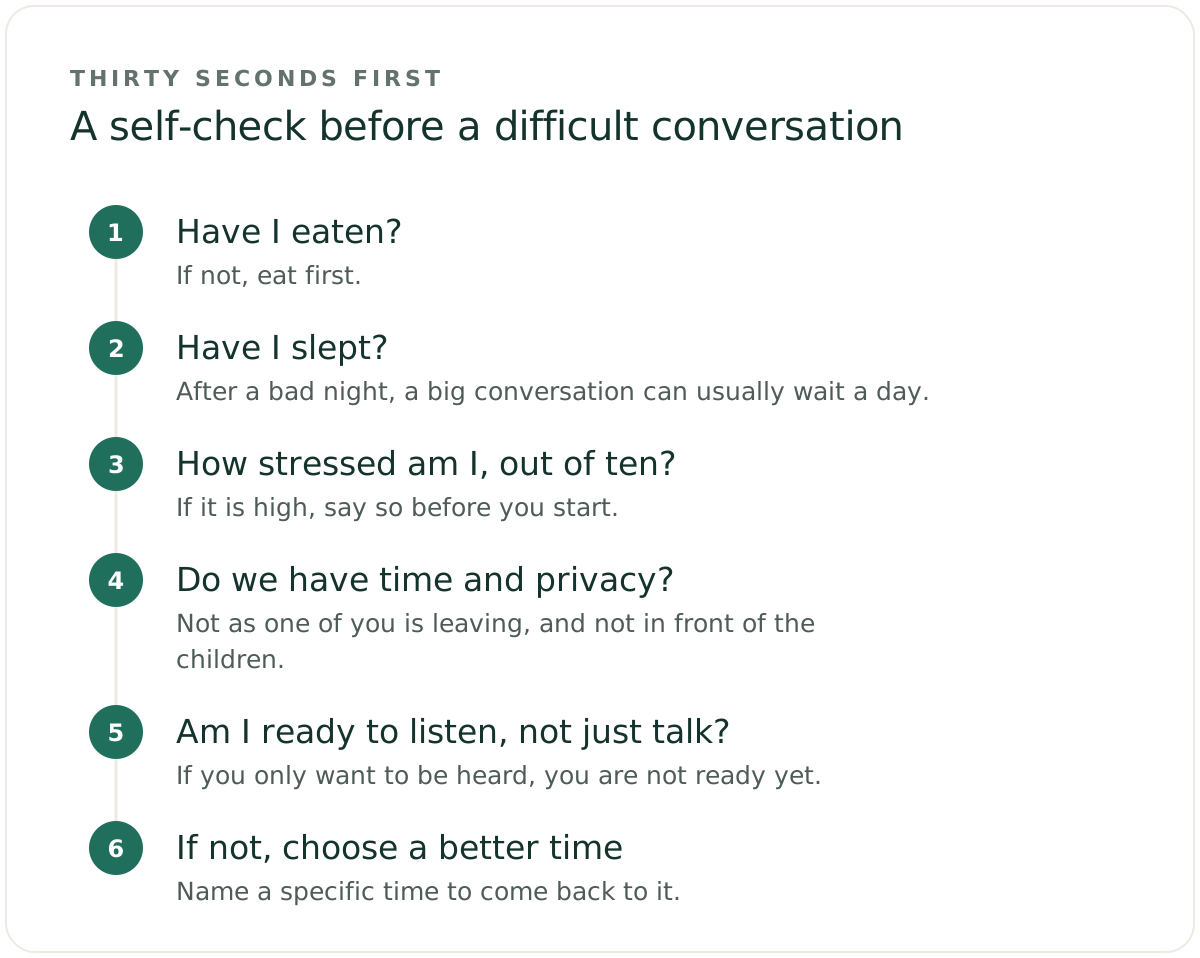
- Have I eaten? If not, eat first.
- Have I slept? After a bad night, a big conversation can usually wait a day.
- How stressed am I, out of ten? If the answer is high, name it: “I’ve had a rough day, so I might be shorter than I mean to be.”
- Do we have time and privacy? Not as one of you is leaving, and not in front of the children.
- Am I ready to listen, not just talk? If you only want to be heard, you are not ready for a conversation yet.
- If not, choose a better time. “I want to talk about this properly, and I’m running on empty. Can we do it tomorrow after breakfast?”
Postponing in this way is not dodging. It is choosing a time when the conversation has a real chance of going well, and the same idea sits behind several of our fair fighting rules.
Self-care during an argument
Sometimes you only notice you are depleted once things are already heated. A few things help in the moment:
- Pause before you are flooded. Say you need a break, and agree when you will come back to it.
- Look after your body during the break. Get some water, eat something, step outside, breathe slowly.
- Do not spend the break rehearsing. Replaying the argument keeps your body in fight mode.
- Come back when you said you would. A pause only works if the other person can trust it ends.
Self-care is not the same as avoidance
Self-care can be misused. “I need to protect my peace” can turn into never raising anything, or walking away whenever a topic gets uncomfortable. The difference is whether you come back.
A break with a return time is self-care. Shutting the conversation down with no plan to return is closer to stonewalling, and it usually makes the other person push harder. Looking after yourself should make difficult conversations more possible, not less.
Self-care is also not a reason to put up with being harmed. If you feel afraid of your partner, or they control your money, contacts or decisions, contact 1800RESPECT on 1800 737 732 for confidential support, or 000 in an emergency.
Looking after each other
Couples can make self-care a shared project rather than a solo effort. Researchers call the way partners handle stress together dyadic coping, and in everyday terms it looks like this:
- Notice each other’s state. “You look wiped out. Shall we leave this till the weekend?”
- Protect each other’s sleep and breaks, especially during busy seasons.
- Trade cover. “You take the morning routine, I’ll take the evening.”
- Agree that either of you can call a pause without it being taken as a rejection.
When it is more than self-care
Sometimes low reserves are a sign of something more than a busy patch. If you are exhausted for weeks, have lost interest in things you used to enjoy, or feel constantly on edge, talk to your GP. Lifeline is available on 13 11 14 any time for crisis support.
Where FairTalk fits in
Timing and state matter in any hard conversation. You talk the issue through together while FairTalk listens without taking sides, and either of you can pause if it gets heated. Afterwards, you both get a fair picture of each other’s perspective and a way forward you have shaped together, along with guidance on the communication skills each of you could build.
Because you choose when to have the conversation, you can pick a time when you are both rested and fed rather than squeezing it into the end of a long day. If the other person is not ready to talk yet, the solo session feature lets you work through your own side first, at your own pace. FairTalk is not therapy, and it is not suitable where there is abuse, coercion or a power imbalance.
Frequently asked questions
How does self-care affect relationships?
Self-care affects relationships by changing how much patience, empathy and self-control you bring to them. Research links poor sleep to more relationship conflict and less understanding during disagreements, low blood sugar to more angry impulses towards a spouse, and stress to lower relationship satisfaction. Looking after the basics makes it easier to handle disagreements well.
Can lack of sleep cause arguments in a relationship?
Yes, it can make them more likely and harder to resolve. A study of couples found that people reported more conflict after poor nights of sleep, and that when one partner had slept badly, both partners were less accurate at reading each other’s feelings. Conflicts were most likely to be resolved when both were well rested.
Is self-care selfish in a relationship?
No. Looking after your sleep, food, stress and time to recharge is part of what lets you show up well for your partner, especially in hard conversations. It becomes a problem only when “self-care” is used to avoid every difficult topic rather than to prepare for it.
How do I practise self-care during an argument?
Notice the signs that you are running low, call a pause before you are overwhelmed, and agree a time to come back. Use the break to look after your body, with water, food, fresh air or slow breathing, rather than rehearsing the argument. Then return when you said you would.
What is the difference between self-care and avoiding conflict?
The difference is whether you come back to the issue. Self-care means choosing a better time or taking a break with a clear return, so the conversation can go well. Avoidance means shutting the conversation down with no plan to return, which usually leaves the problem growing and the other person feeling shut out.