
The magic ratio is the Gottman Institute’s finding that, during conflict, stable and happy couples have about five positive interactions for every negative one. When the balance in an argument falls to one to one or lower, Gottman’s research treats it as a warning sign that a relationship is at serious risk.
It is one of the most quoted ideas in relationship research, and one of the most misunderstood. It does not mean you need five compliments ready for every complaint, or that couples who argue are failing. It means something more useful: that how an argument feels between the hard moments matters as much as the hard moments themselves.
Where the magic ratio comes from
In the 1970s, John Gottman and Robert Levenson began long-term studies of couples. Couples were asked to work on a real conflict for 15 minutes while the researchers watched and recorded. Following up nine years later, the Gottman Institute reports, they could predict which couples would stay together and which would divorce with over 90 percent accuracy.
The difference between the couples who lasted and those who did not was not whether they argued. It was the balance of positive and negative during the argument. Stable couples kept roughly five positives for every negative. The Gottman Institute describes couples whose conflict ran at one to one or worse as close to the edge of divorce.
Outside of conflict, the gap was even wider. The Gottman Institute reports that successful couples had a positive to negative ratio of about 20 to 1 in their everyday interactions.
The detail most people miss: it was measured in time, not points
The ratio is usually described as five positive interactions for every negative one, as if couples were keeping score. The original finding was subtler. According to the Gottman Institute, in conflict conversations successful couples spent about five seconds in a positive or neutral emotional state for every one second in a negative state. The “five interactions” version came later, as a simpler way to explain it.
That changes how you use it in three ways:
- Neutral counts. You do not have to be warm and funny all the way through a hard conversation. Calm, ordinary, even slightly awkward is fine. What tips the balance is how much of the conversation is spent in genuinely negative territory.
- It is about the whole conversation. One sharp comment does not doom an argument. A conversation that keeps sliding back into criticism and defensiveness does.
- It is not a tally to use against each other. The ratio describes a pattern researchers observed across many couples. It is a mirror for your own habits, not a scorecard for your partner’s.
Why one negative moment weighs so much
Negative moments carry more emotional weight than positive ones. A single eye roll, a cutting remark or a contemptuous sigh can undo several minutes of goodwill, which is why it takes several positives to balance one negative.
Not every hard feeling counts as negative in this sense. Anger on its own is a normal part of conflict, and Gottman’s work suggests it is not necessarily damaging. It becomes damaging when it arrives with criticism, contempt or defensiveness, the patterns known as Gottman’s Four Horsemen.
What counts as negative during an argument
The Gottman Institute’s examples of interactions that push a conversation into negative territory include:
- criticism, contempt, defensiveness and stonewalling
- opening the conversation harshly (“You always…” or “You never…”)
- raising your voice, or lashing out when you are flooded instead of taking a break
- not listening while your partner is speaking
- being dismissive or invalidating (“You’re overreacting”)
- rejecting your partner’s attempt to repair the moment, such as an apology or a joke to ease the tension
- dismissive body language, such as eye rolling or turning away
None of these makes someone a bad partner. Everyone does some of them some of the time. The question is how often, and how quickly they are repaired.
The magic ratio in practice: how to tip the balance in an argument
You cannot remove every negative moment from a disagreement, and you do not need to. What you can do is add more positive and neutral moments around them. The Gottman Institute’s list of what stable couples do during conflict translates into concrete things you can say and do.
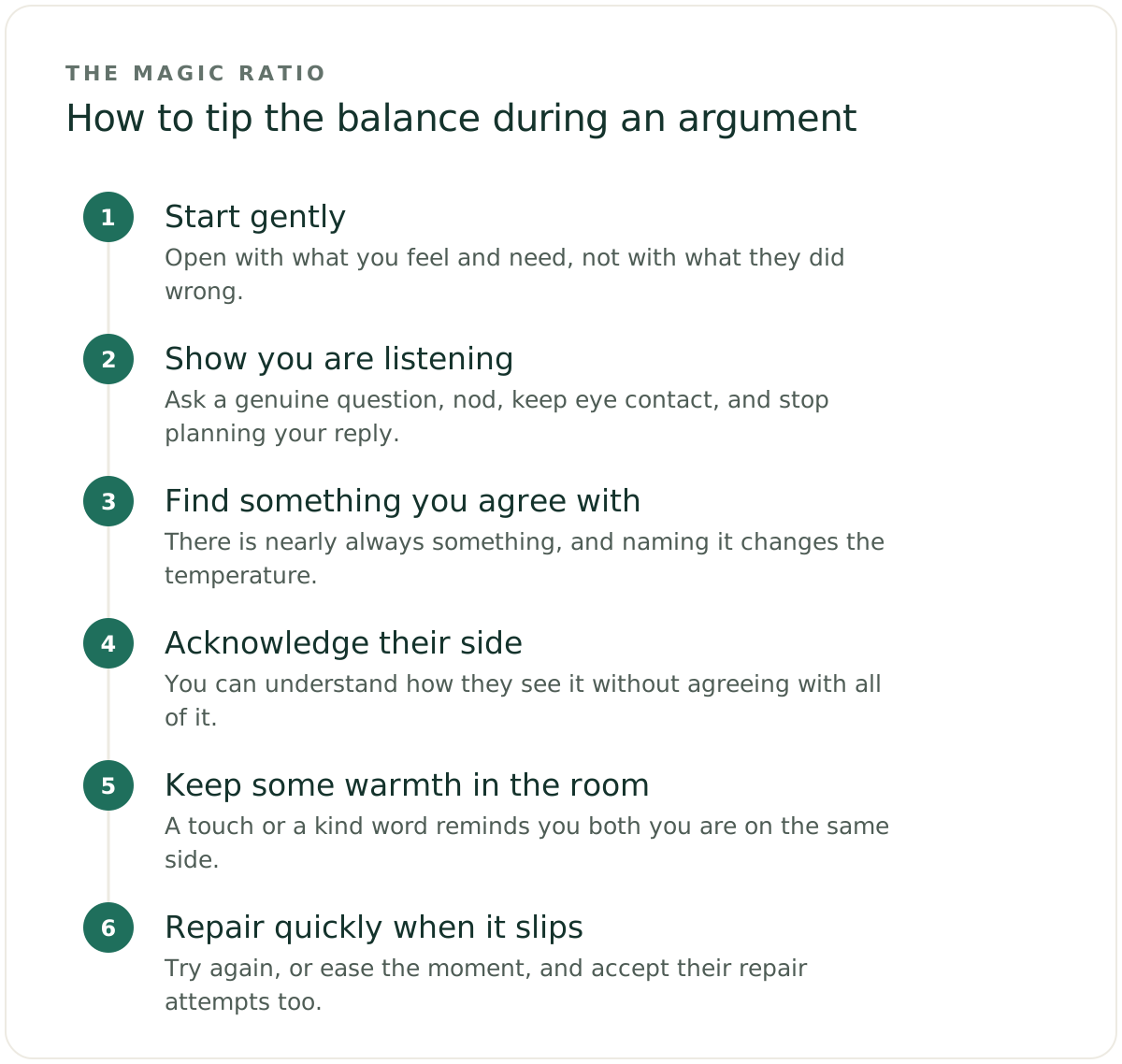
- Start gently. Open with what you feel and need rather than what they did wrong. “I’ve been feeling stretched thin with the house lately and I’d like us to look at it together” lands very differently from “You never help.”
- Show you are listening. Ask a genuine question (“What’s making this so frustrating for you?”), nod, keep eye contact, and resist planning your reply while they talk.
- Find something you agree with. There is nearly always something. “You’re right that I said I’d do it and didn’t” costs you nothing and changes the temperature.
- Acknowledge their side. You do not have to agree to say “That makes sense, given how your week has been.” Feeling understood is one of the strongest positives there is.
- Keep some warmth in the room. A hand on an arm, or “This is hard to talk about, but I want us to sort it out,” reminds you both you are on the same side.
- Repair quickly when it slips. “That came out wrong, let me try again” or a well-timed, gentle bit of humour can pull a conversation back before it spirals. Accepting your partner’s repair attempts matters just as much as making your own.
If a conversation has gone past the point where any of this is possible, stop. A short, agreed break, with a time to come back, is better than adding more negatives. Our guide to how to stop fighting with your partner covers taking a break that actually works.
Building positivity in a relationship, not just in arguments
The 20 to 1 ratio outside conflict is the part that makes the 5 to 1 inside conflict possible. Couples who are generous with small positive moments day to day go into disagreements with goodwill in reserve, so an occasional sharp word does less damage and repairs land more easily.
The Gottmans call this “small things often”, and the small things really are small:
- noticing and responding when your partner reaches for your attention, even with a passing comment
- saying thank you for something specific
- asking about their day and listening to the answer
- remembering what is going on for them this week
- a moment of affection that is not leading anywhere
These habits are covered in more depth in our guide to healthier connections. They are also the most reliable way to raise the ratio, because it is far easier to stay positive in an argument with someone you have felt close to all week.
How to use the ratio without turning it into a scorecard
The ratio is most useful as a private check on your own habits. The Gottman Institute suggests a simple exercise: for a few days, note your interactions with your partner, paying particular attention to any disagreements, and look at the overall pattern rather than any single moment.
A few principles keep that exercise healthy:
- Look at your side first. Count your own negatives and positives, not your partner’s.
- Talk about the pattern, not the score. “I’ve noticed I get defensive fast when we talk about money” is a useful conversation. “You were negative eleven times yesterday” is not.
- Do not chase perfection. Stable couples still have negative moments. They just repair them and surround them with enough positive and neutral time that they do not take over.
If your arguments have felt mostly negative for a long time, despite real effort from both of you, that is a good reason to talk to a qualified couples counsellor. And if arguments involve fear, threats or control, the ratio is not the issue. Contact 1800RESPECT on 1800 737 732, or 000 in an emergency.
Where FairTalk fits in
A disagreement that keeps sliding into negative territory often needs more structure than goodwill alone can give it. In a FairTalk session, you talk the issue through together while FairTalk listens without taking sides, and either of you can pause if it starts to get heated. Afterwards, you both get a fair picture of each other’s perspective and a way forward you have shaped together, along with guidance on the communication skills each of you could build. Seeing your partner’s side laid out calmly is often what makes it easier to acknowledge it next time, which is exactly the kind of positive moment the magic ratio is about.
Frequently asked questions
What is the magic ratio in relationships?
The magic ratio is the Gottman Institute’s finding that stable, happy couples have about five positive interactions for every negative one during conflict. Couples whose arguments run at one to one or worse are, in Gottman’s research, at serious risk of breaking up. Outside of conflict, successful couples showed an even higher ratio of about 20 to 1.
Does the magic ratio mean I need five compliments for every complaint?
No. The original finding measured time: successful couples spent about five seconds in a positive or neutral emotional state for every one second in a negative state during conflict. Calm, neutral moments count, so the goal is to keep the conversation mostly out of negative territory, not to keep score.
What counts as a negative interaction?
Negative interactions include criticism, contempt, defensiveness and stonewalling, along with a harsh opening, raising your voice, not listening, being dismissive, and eye rolling or turning away. Rejecting your partner’s attempt to repair the moment also counts. Anger on its own is not necessarily damaging; it becomes harmful when it comes with criticism, contempt or defensiveness.
How do you increase positivity in a relationship?
Increase positivity through small, frequent moments: responding when your partner reaches for your attention, thanking them for something specific, asking about their day and showing affection. During arguments, start gently, show you are listening, find something to agree with and repair quickly when things slip. These small habits build the goodwill that makes disagreements easier.
Is the magic ratio scientifically proven?
The magic ratio comes from long-term observational research by John Gottman and Robert Levenson, who studied couples discussing real conflicts and followed them for years. It is one of the best known findings in relationship research, but it describes a pattern seen across many couples rather than a rule every relationship must hit exactly. Use it as a guide to your own habits, not as a precise target.