
Arguing about money in a relationship is common, and it is rarely only about the money. Underneath most money fights sit different histories, fears and hopes: security for one person, freedom for the other. You argue less by talking about what money means to each of you first, then agreeing a simple plan together.
Money touches almost everything a couple shares: where you live, how you spend your weekends, what you plan for and what you put off. So it is no surprise that it is one of the common relationship problems couples raise most often. This guide covers why money causes so many arguments, the fights couples tend to have, what is usually going on underneath, how to talk about money without it turning into a fight, and what to do when money is being used to control someone.
Why couples argue about money
On paper, money is simple arithmetic. In a relationship, it rarely feels that way. The Gottman Institute, in its article Arguments About Money Aren’t About Money, argues that money fights are really about our dreams, our fears and our sense of not measuring up, and that personal history shapes how we handle money far more than logic does. It calls the set of beliefs each person brings a “Money Map”.
A few things make money especially easy to fight about:
- Different histories. If money always ran out before payday when you were growing up, a low balance can feel like danger. If your parents saved everything and never took a holiday, saving can feel like a life spent waiting.
- Shared money, separate decisions. Most couples share at least some costs, but each person still makes dozens of small spending choices a week. Every one of them can feel like a decision made for both of you.
- Pressure from outside. Rent, mortgage rates, a job loss or a big bill raise the temperature. A conversation that would be easy in a good month becomes tense in a tight one.
- Unspoken rules. Many people carry private rules they have never said out loud, such as “if we were really saving for a house, you wouldn’t buy that.” The other person breaks the rule without knowing it exists.
The most common money arguments, and what sits underneath
The same handful of arguments come up again and again. The topic on the surface is rarely the whole story.
| The argument | What it can be about underneath |
|---|---|
| Spending versus saving | Security now versus enjoying life now |
| A big purchase made without asking | Being treated as an equal partner |
| Who pays for what when incomes differ | Fairness, and feeling like an equal |
| Debt one person brought into the relationship | Trust, and worry about the future |
| Money given to family | Loyalty, and where your first commitment lies |
| Hidden spending or a secret account | Honesty, and whether you can trust what you are told |
| One person managing everything | A shared load, and having a real say |
Naming the thing underneath changes the conversation. “You spend too much” invites a defence. “I get anxious when there’s nothing put away” invites understanding.
The spender and the saver
The most familiar money argument is between a spender and a saver. It usually sounds like a disagreement about a holiday, a new phone or a dinner out. It is usually a disagreement about what money is for.
Take Mia and Jordan. Mia grew up in a household where the money ran out before payday, and she remembers the stress of it. Jordan’s parents saved every spare dollar and rarely did anything just for fun. Every time Jordan suggests a weekend away, Mia hears risk. Every time Mia says no, Jordan hears a life put on hold.
Their arguments about the weekend away went nowhere until they each said what was underneath it. Mia: “When the account drops low, I feel panicky. It’s not really about the trip. I grew up with nothing to fall back on.” Jordan: “I’m scared we’ll spend our whole lives putting things off.” Neither of them was wrong. Once they could see that, they agreed on a savings amount that stays untouched, and a smaller amount each month for things they enjoy, with no questions asked.
If you are stuck in the same pattern, these questions help you understand each other before you talk numbers:
- What was money like in the house you grew up in?
- What does having money in the bank give you: security, freedom, choice or something else?
- What is one thing you would never want to go without?
- What worries you most about money?
- What would you love to be able to do with money in ten years?
How to talk about money without fighting
The aim is not to win the argument about last month’s spending. It is to agree a way of handling money that you can both live with.
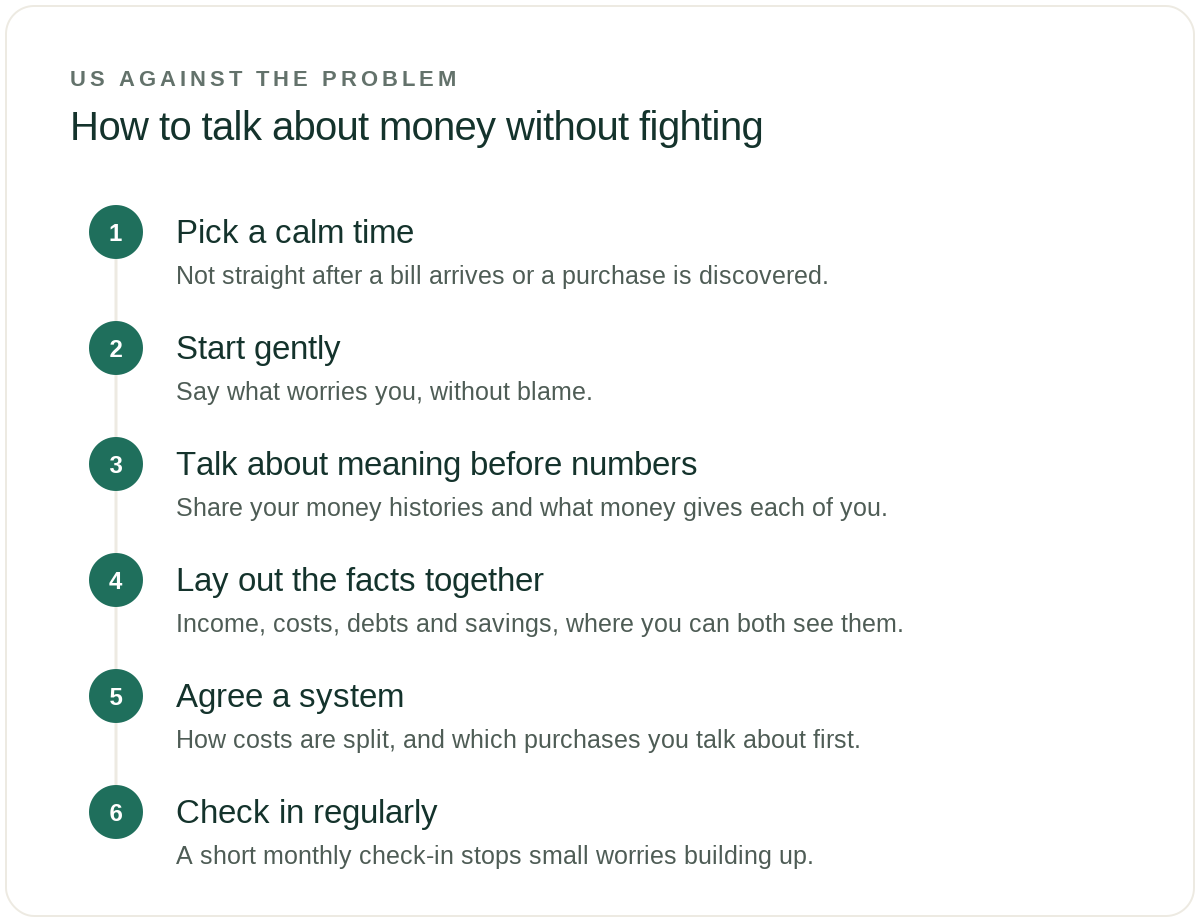
- Pick a calm time. Not straight after a bill arrives or a purchase is discovered. The Gottman Institute’s guide to lower conflict conversations about money suggests planned, regular money talks rather than only talking when something has gone wrong.
- Start gently. “I’d like us to look at our spending together, because I’ve been worried” lands very differently from “You’ve blown the budget again.” Opening with blame is criticism, one of the patterns the Gottman Institute calls the Four Horsemen, and a soft start-up makes a defensive reply far less likely.
- Talk about meaning before numbers. Share your money histories and what money gives each of you. It is much easier to agree a budget with someone whose fears you understand.
- Lay out the facts together. Income, regular costs, debts and savings, written down where you can both see them. No one should be surprised by a number later.
- Agree a system. Decide how shared costs are split, which purchases you will talk about first (anything over an amount you agree on works well), and how much each person can spend without explaining it.
- Check in regularly. A short monthly check-in keeps small worries from building into a big argument. The same Gottman guide describes the goal as moving from “us against each other” to “us against the problem”.
Where you still see it differently, our guide to how to compromise in a relationship covers finding a middle you can both live with.
Joint, separate or both: choosing how to split money
There is no single right way for a couple to organise money. Some pool everything, some keep everything separate, and many do a mix: a shared account for joint costs, and their own accounts for the rest. What matters is that you both chose the system, and that you both understand it.
Moneysmart, the government’s money guidance site, suggests in its guide to relationships and money that couples talk through how they will split rent and bills, how they will cover everyday costs, and what happens if one person earns more or works less. It also suggests understanding the risks before opening a joint account or taking on a loan together, because shared debt is shared responsibility.
When incomes are very different, splitting everything down the middle can feel unfair to the person earning less. Many couples contribute in proportion to what they earn instead. Neither approach is right for everyone. The one you both agree to is the right one for you.
When money becomes a secret
Hidden debt, a secret account or purchases kept quiet can do more damage than the money itself, because the argument becomes about trust. If you have kept something from your partner, the way back starts with telling them everything at once rather than piece by piece, owning it without excuses, and agreeing together what openness will look like from here.
Privacy and secrecy are different things. Having some money of your own that you spend without explaining is privacy, and many couples agree to it. Hiding debts or decisions that affect you both is secrecy.
If debt itself is the problem, the National Debt Helpline on 1800 007 007 offers free advice from financial counsellors.
When it is not a money argument
Sometimes what looks like a money argument is something else. Moneysmart’s guide to financial abuse describes it as a type of family and domestic violence. Signs include restricting someone’s access to bank accounts or cash, pressuring them to ask permission to spend their own money, taking money from a joint account without agreement, pressuring someone to take on debt or act as a guarantor, and controlling their ability to work.
That is not a communication problem to solve with a better conversation. If any of it sounds familiar, or you feel afraid of your partner, contact 1800RESPECT on 1800 737 732 for confidential support, or 000 in an emergency.
Where FairTalk fits in
Money conversations go wrong fastest when one person feels judged and the other feels unheard. FairTalk gives both of you the same space to say what money means to you. You talk the issue through together while FairTalk listens without taking sides, and either of you can pause if it gets heated. Afterwards, you both get a fair picture of each other’s perspective and a clear pathway forward you have shaped together, along with guidance on the communication skills each of you could build.
If you are not ready to raise it together yet, the solo session feature lets you work through your own side first, so you can find what is underneath your worry before you talk. FairTalk is for adults, it is not therapy or financial advice, and it is not suitable where there is abuse, coercion or a power imbalance, including control over money.
Frequently asked questions
Is it normal for couples to argue about money?
Yes. Money is one of the most common things couples disagree about, because it touches almost every shared decision. What matters is not whether you disagree about money, but whether you can talk about it calmly and agree a plan you both understand.
Why do couples fight about money?
Usually because money stands for something deeper. Each person brings their own history, fears and hopes about money, so a disagreement about spending is often really about security, freedom, fairness or trust. Pressure from bills or debt makes those differences harder to talk about calmly.
How do you talk to your partner about money without fighting?
Pick a calm time, start gently, and talk about what money means to each of you before you look at the numbers. Then lay out the facts together, agree a simple system for shared costs and bigger purchases, and check in regularly so small worries do not build up.
Should couples have joint or separate bank accounts?
There is no single right answer. Some couples pool everything, some keep everything separate, and many use a shared account for joint costs alongside their own accounts. The best system is one you both chose, both understand, and both feel is fair.
What is financial infidelity?
Financial infidelity is hiding money decisions from your partner, such as secret debt, a hidden account or purchases you lie about. It damages trust because the problem becomes honesty, not just money. Rebuilding usually starts with full disclosure, owning it without excuses, and agreeing what openness will look like from now on.