
Conflict avoidance is the habit of steering away from disagreements: changing the subject, saying “it’s fine”, or going along with things you do not actually agree with. It feels like keeping the peace, but the problem rarely goes away. More often it grows quietly until it comes out as resentment or a sudden blow-up.
Some avoidance is healthy. Not every difference needs a discussion, and plenty of happy couples let small things go. The trouble starts when avoiding conflict means your needs never get said. This guide covers the signs of conflict avoidance, why people do it, what it costs, and small, practical steps to start raising things without it turning into a fight.
Is avoiding conflict always a bad thing?
No. The Gottman Institute, drawing on decades of research, describes five types of couples, three of them happy and stable. One of those happy types is the conflict-avoiding couple: partners who minimise attempts to persuade each other, emphasise their common ground, and are content to agree to disagree.
The Institute’s guide to conflict styles makes the same point: there are happy, stable couples with all three styles, and many people are a blend. Avoiding conflict works when both people genuinely feel fine about letting a difference sit, and nothing important is being left unsaid.
It stops working when one person is avoiding because they are afraid to speak, when a real need keeps being swallowed, or when the two of you have very different styles and one of you is left chasing a conversation the other keeps dodging.
Signs you avoid conflict
Conflict avoidance can be hard to see in yourself, because it often looks like being easygoing. Common signs include:
- You say “it’s fine” or “whatever you want” when it is not fine.
- You change the subject, make a joke or leave the room when a disagreement starts.
- You rehearse conversations in your head but never have them.
- You agree to things, then feel resentful about them later.
- You would rather do a job yourself than ask someone to do their share.
- Small irritations pile up until you suddenly snap over something minor.
- People are surprised when they find out you were unhappy.
Why people avoid conflict
Most conflict avoidance is a sensible strategy that has outlived its usefulness. Common reasons include:
- Your body floods. The Gottman Institute’s article on flooding and conflict avoidance notes that one common reason people avoid conflict is that they become physically overwhelmed during or even before it, and do not know how to manage that feeling.
- You learned it at home. If disagreement in your family meant shouting, punishment or someone going silent for days, avoiding it may have been the safest choice as a child.
- Fear of the other person’s reaction. Worry about anger, tears, rejection or a relationship ending can make silence feel safer than honesty.
- Wanting to be easy to be around. For people who pride themselves on being agreeable, raising a problem can feel like a threat to who they are.
- It did not work before. If you have raised something and been dismissed, you may have quietly decided it is not worth trying.
Our guide to why conflict is so hard to resolve looks at how family history and personality shape the way each of us handles disagreement.
What avoiding conflict costs
The Gottman Institute puts it bluntly: there is no such thing as truly avoiding conflict. The problem, or the hurt feelings, remain. Over time, avoidance tends to cost you in a few ways:
- Resentment builds. Every swallowed frustration adds to a quiet tally.
- It comes out sideways. Unspoken anger often leaks out as sarcasm, sighs and pointed silences, the pattern our guide to passive-aggressive behaviour describes.
- It explodes. When enough has built up, a small trigger can set off a big argument that seems to come from nowhere.
- Distance grows. If you never share what bothers you, the people closest to you never fully know you.
- Nothing changes. The other person cannot fix a problem they do not know exists.
How to start speaking up
You do not need to become someone who loves an argument. The aim is to be able to raise what matters, calmly and early. Small steps work best.
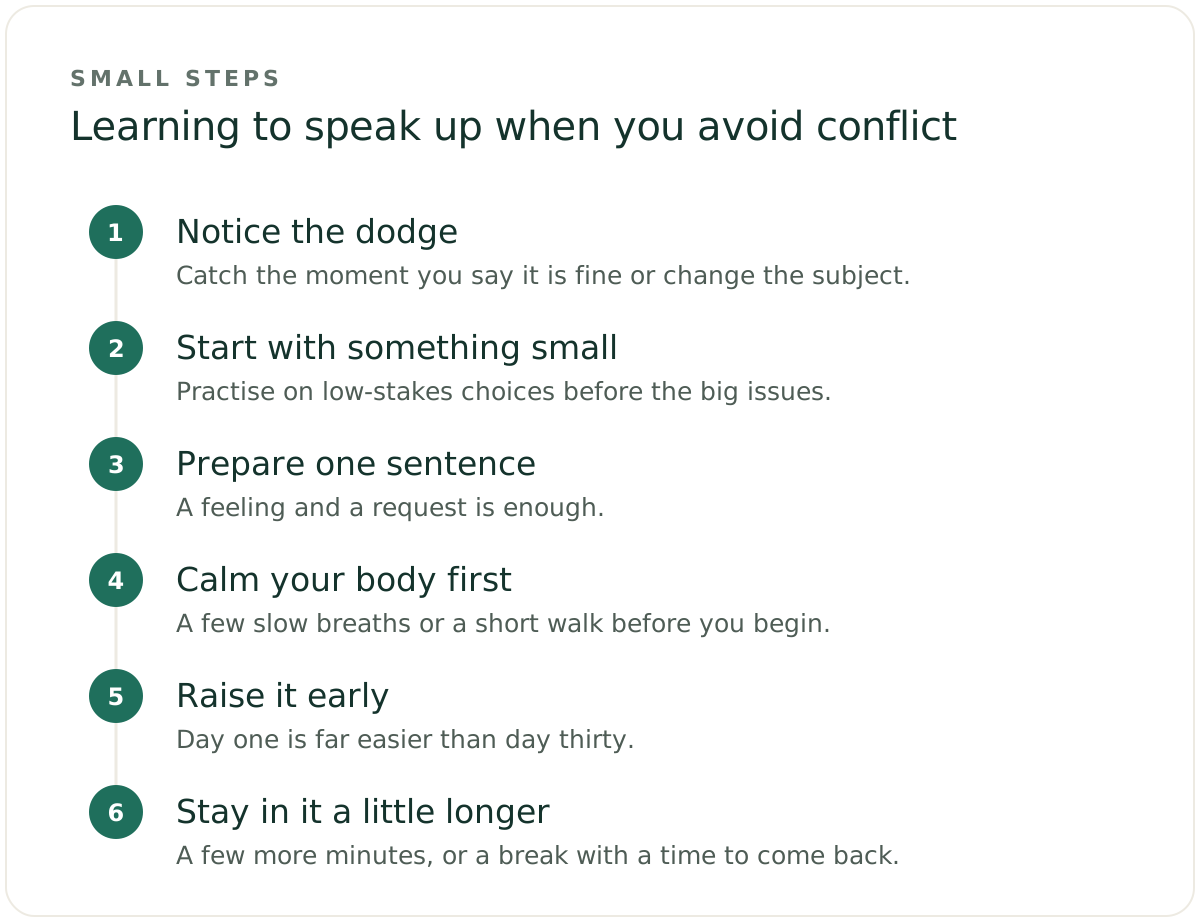
- Notice the dodge. Catch the moment you say “it’s fine” or change the subject. Just noticing it is the first step.
- Start with something small. Practise on low-stakes things, like where to eat or which film to watch, before the big issues.
- Prepare one sentence. A feeling and a request is enough: “I felt left out when the plans changed. Next time, can you check with me first?”
- Calm your body first. If your heart is racing, take a few slow breaths or a short walk before you start. You can say, “I want to talk about something, and I’m a bit nervous about it.”
- Raise it early. A small issue raised on day one is far easier than a big one raised on day thirty.
- Stay in it a little longer. When the conversation gets uncomfortable, try to stay a few minutes more before stepping away. If you do need a break, say when you will come back.
Every conversation that goes reasonably well makes the next one easier. Our guide to resolving personal conflict covers the wider principles.
If your partner is the one who avoids conflict
Pushing harder usually makes an avoider retreat further. It tends to work better to lower the stakes: choose a calm moment, keep it short, make it clear you are not looking for a fight, and accept a smaller conversation than you wanted. Our guide to a reluctant partner has more on inviting someone into a conversation they would rather avoid.
When avoiding conflict is protecting you
Sometimes keeping quiet is not avoidance. It is self-protection. If raising a problem leads to threats, intimidation, put-downs or punishment, or you are afraid of how your partner will react, that is not a communication habit to fix. Contact 1800RESPECT on 1800 737 732 for confidential support, or 000 in an emergency.
Where FairTalk fits in
For people who avoid conflict, the hardest part is often starting the conversation and staying in it. FairTalk gives it a set structure, so neither of you has to carry it alone. You talk the issue through together while FairTalk listens without taking sides, and either of you can pause if it gets heated. Afterwards, you both get a fair picture of each other’s perspective and a clear pathway forward you have shaped together, along with guidance on the communication skills each of you could build.
If you are not ready to raise it with the other person yet, the solo session feature lets you work through your own side first, so you know what you want to say. FairTalk is for adults, it is not therapy, and it is not suitable where there is abuse, coercion or a power imbalance.
Frequently asked questions
Is avoiding conflict a bad thing?
Not always. Gottman Institute research describes conflict-avoiding couples as one of three happy, stable couple types, and letting small differences go is often healthy. Avoidance becomes a problem when important needs are never raised, resentment builds, or one person keeps quiet because they are afraid to speak.
Why do I avoid conflict?
Common reasons are feeling physically overwhelmed when a disagreement starts, growing up in a home where conflict was frightening or punished, fearing the other person’s reaction, wanting to be seen as easygoing, and having been dismissed when you raised things before. Knowing your reason helps you choose what to work on first.
How do I stop being conflict avoidant?
Start small. Notice when you dodge a disagreement, practise raising low-stakes issues, prepare one short sentence with a feeling and a request, calm your body before you begin, and raise things early while they are still small. Each conversation that goes reasonably well makes the next one easier.
Can a relationship work if one person avoids conflict?
Yes, but it usually needs both people to adjust. The person who avoids conflict can practise raising things earlier, and the other person can lower the stakes by choosing calm moments, keeping conversations short and not pushing too hard. Mismatched styles are common and workable.
What does it mean to be conflict avoidant?
Being conflict avoidant means habitually steering away from disagreements, for example by saying everything is fine, changing the subject or going along with things you disagree with. It often comes from fear or discomfort rather than genuinely not minding, which is why the problem underneath usually remains.