
Family arguments at Christmas usually come from pressure more than from the people: high expectations, old family roles, tiredness, alcohol and too many people in one hot room. You keep the peace by planning ahead, agreeing limits with your partner, having a few phrases ready to step out of a tense moment, and saving real issues for a calmer day.
Christmas in Australia often means long days, summer heat, travel, and relatives who only see each other once a year. It is meant to be a celebration, so when tension builds it can feel worse than an ordinary argument. This guide covers why family arguments flare up over the holidays, what to sort out before the day, how to defuse tension when it starts, how to handle in-laws, and what to do if an argument happens anyway.
Why family arguments flare up at Christmas
Beyond Blue points out that there is a lot wrapped up in the holidays: memories, traditions and expectations. That mix is what makes Christmas such fertile ground for arguments:
- Expectations collide. One person pictures a long lunch with everyone, another wants a quiet day at home. Neither expectation is wrong, but they cannot both happen.
- Old roles come back. Adults who get on fine all year can slip straight back into childhood patterns around their parents and siblings: the responsible one, the baby, the one who always gets criticised.
- Logistics and money. Whose family, which day, who hosts, who pays, who cooks. These are the classic Christmas arguments, and they are often settled at the last minute, under pressure.
- Tiredness and heat. Long drives, late nights and a hot kitchen shorten everyone’s fuse.
- Alcohol. It lowers patience and raises volume, and it rarely helps a sensitive conversation.
- Unresolved history. An old hurt that is never discussed during the year can surface the moment everyone is in one room.
None of this means your family is unusual. It means Christmas puts a lot of pressure on relationships at once.
Before the day: plan ahead
Most Christmas arguments can be headed off weeks before anyone sits down to eat.
Agree the plan with your partner first. Whose family, which day, how long you will stay, and who is driving. Settle it between the two of you before you commit to anyone else, so you are not negotiating in the car on the way there. Our guide to negotiation and compromise covers how to find a fair split, such as alternating years.
Decide what is off the table. healthdirect suggests avoiding topics that family members usually argue about. If politics, money, a sibling’s divorce or your parenting always causes trouble, agree in advance that it is not for today.
Set limits on time and effort. Relationships Victoria notes that you can always say no to an event or a request, and suggests limiting how long you stay, or how much you take on in organising, if it feels overwhelming. Our guide to setting healthy boundaries has more on saying no kindly.
Plan your exit. Beyond Blue recommends having an exit plan, and even a “buddy” who can help you out of tricky conversations. Agree a time to leave, or a signal to your partner that means “I need to go”.
Go easy on the drinks. healthdirect notes that using alcohol to manage stress can leave you feeling worse, and that Australian guidelines recommend healthy adults have no more than 10 standard drinks a week and no more than 4 on any one day.
On the day: how to defuse tension
When you feel a conversation starting to heat up, the aim is not to win it. It is to get everyone back to the day.
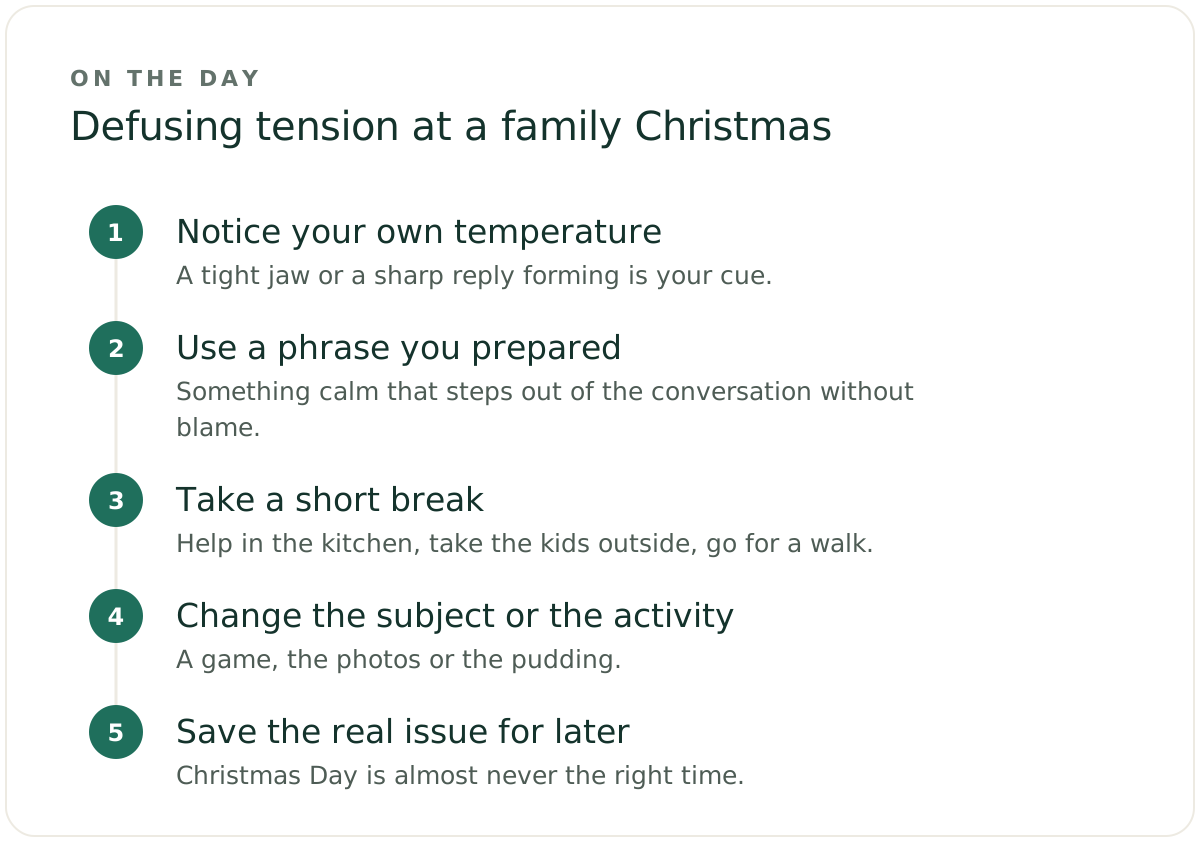
- Notice your own temperature. A tight jaw, a raised voice, a sharp reply forming. That is your cue, before you say the thing you will regret.
- Use a phrase you prepared. Beyond Blue suggests having a few ready, such as “I’d rather not talk about that right now.” Others that work: “Let’s not do this today” or “Can we talk about this another time?”
- Take a short break. Offer to help in the kitchen, take the kids outside, go for a walk, or check on the barbecue. A few minutes away lets everyone cool down.
- Change the subject or the activity. Bring out a game, the photos, or the pudding. A shared activity is often the fastest way out of a tense conversation.
- Save the real issue for later. If something genuinely needs to be said, Christmas Day in front of the whole family is almost never the right time.
These are the same moves our guide to conflict resolution strategies recommends for any heated moment: lower the heat first, then deal with the problem.
If you are hosting
Hosting adds its own pressure, and an exhausted host is often where the first argument starts. A few things help:
- Share the load early. Ask people to bring a dish or a job, and say yes when they offer. Doing everything yourself breeds quiet resentment by mid-afternoon.
- Set a start and finish time. An open-ended day stretches everyone’s patience. “Lunch from twelve, wrapping up around five” gives people a shape to work with.
- Think about the seating. You know which relatives clash. Put a buffer between them, ideally someone easygoing.
- Plan something to do. Backyard cricket, a walk, a game or the pool gives people a reason to move and a break from conversation.
- Make a quiet space. A room where anyone can step away for ten minutes, including you, takes the heat out of a long day.
When it is your partner’s family
In-law tension is one of the most common Christmas flashpoints, and it puts your partner in an awkward spot between you and the people who raised them.
- Each person handles their own family. If your partner’s mother keeps commenting on your cooking, it usually lands better coming from your partner than from you.
- Agree a signal. A word or a look that means “I need backup” or “time to go” saves a scene.
- Back each other in public, discuss in private. Disagree about how to handle a relative later, at home, not at the table.
- Debrief kindly. On the drive home, talk about what was hard without attacking each other’s family.
If an argument happens anyway
Sometimes, despite everyone’s best efforts, voices rise. If it happens:
- Do not try to settle it at the table. Step away, and let things cool down.
- Avoid replaying it in the car. Tired, overfull and upset is not the moment for a post-mortem.
- Repair within a day or two. A short message such as “I’m sorry yesterday got heated. I’d like to talk when we’re both calmer” goes a long way.
- Raise the underlying issue at a better time. If the argument was really about something long-running, plan a calm conversation in the new year. Our guide to family conflict covers how to approach a deeper rift.
When it is better to skip it
Not every family gathering is safe or healthy to attend. If a relative is abusive, frightening or controlling, choosing not to go, or leaving early, is a valid decision, not a failure. If you feel afraid of a partner or family member, contact 1800RESPECT on 1800 737 732 for confidential support, or 000 in an emergency. If the holidays are weighing heavily on you, Lifeline is available on 13 11 14 any time, and Beyond Blue counsellors are available 24/7.
Where FairTalk fits in
Christmas is the wrong time to work through a long-running disagreement, but it often shows you which ones need attention. FairTalk gives those conversations a calmer setting in the weeks before or after the holidays. You talk the issue through together while FairTalk listens without taking sides, and either of you can pause if it gets heated. Afterwards, you both get a fair picture of each other’s perspective and a clear pathway forward you have shaped together, along with guidance on the communication skills each of you could build.
If the other person is not ready to talk yet, the solo session feature lets you work through your own side first, so you know what you want to say before you say it. FairTalk is for adults, it is not therapy, and it is not suitable where there is abuse, coercion or a power imbalance.
Frequently asked questions
Why do families argue at Christmas?
Families argue at Christmas mainly because of pressure: high expectations, old family roles, tiredness, money, alcohol and many people together for a long day. Unresolved issues that are ignored during the year also tend to surface when everyone is in one room. The arguments are usually about the pressure more than the people.
How do you avoid arguments at Christmas?
Plan ahead. Agree the plan with your partner first, decide which topics are off the table, set limits on how long you stay and how much you take on, go easy on alcohol, and have an exit plan. On the day, step away from a tense conversation early and save real issues for a calmer time.
What do you say to stop an argument at a family gathering?
Use a short, calm phrase that steps out of the conversation without blaming anyone, such as “I’d rather not talk about that right now” or “Let’s not do this today.” Then change the subject or the activity, or take a short break. If the issue genuinely matters, offer to talk about it another time.
How do I handle difficult in-laws at Christmas?
Agree a plan with your partner beforehand, and let each person handle their own family. Agree a signal for when you need backup or want to leave, back each other up in public, and discuss any disagreements privately afterwards. Keeping the visit to an agreed length also helps.
Is it okay to skip Christmas with family?
Yes. You can always say no to an event, or limit how long you stay, if it feels overwhelming. If a family member is abusive or frightening, staying away is a valid choice, and 1800RESPECT on 1800 737 732 offers confidential support.