You are a reasonable person. You want the conflict to be over. You have replayed it enough times to know roughly what you would say. And yet the same argument with the same person keeps coming back around, or the tension you have been carrying refuses to resolve no matter how much you think it through. It is tempting to conclude that you are bad at this, or that they are impossible. Usually it is neither. Resolving conflict well is a genuine skill, a demanding one, and almost none of us were ever actually taught it.
This article is about why conflict is so hard to work through on your own, and so often ineffective when you try. Not as an excuse, but because understanding the real reasons, the ones rooted in how you were raised, how your brain behaves under threat, and what you simply cannot see from inside your own head, is the first step to doing something different. It also explains why so many people eventually turn to therapy, and where a tool like FairTalk fits for the everyday conflicts that never quite reach that point.
No one ever taught us how to do this
Think about what school prepared you for. Years of mathematics, grammar, history, and science, and somewhere in all of it, almost nothing on how to handle a disagreement with another human being. How to stay calm when you feel attacked, how to say what you need without blame, how to actually hear someone you disagree with: these are among the most useful skills a person can have, and most of us were left to pick them up by accident, or never picked them up at all.
So when a real conflict arrives, most people are improvising with no training. We would not expect someone to perform surgery or fly a plane by instinct, yet we expect everyone to navigate charged, high-stakes emotional conflict with skills nobody ever gave them. The wonder is not that it goes badly so often; it is that it ever goes well.
Your first lessons came from home
In the absence of formal teaching, your real education in conflict happened at home, long before you could think critically about it. The way the adults around you handled disagreement became your blueprint for what conflict is and what you do with it.
Some people were lucky. They grew up watching disagreements happen openly, get worked through, and end in repair, so they absorbed that conflict is survivable and even useful. Many were not. If what you saw was slammed doors and shouting, you may have learned that conflict is dangerous and to be won at all costs. If what you saw was silence, cold shoulders, and problems that were never spoken of, you may have learned that conflict is something you avoid and bury. And if you never saw a disagreement actually get resolved, you have no working model for what resolution even looks like.
None of this is a character flaw. It is a blueprint you were handed before you had any say in it, and it runs quietly underneath your reactions as an adult. Recognising which one you inherited is often the first genuine insight people have about why they handle conflict the way they do.
Your personality shapes your default setting
On top of upbringing, personality pulls each of us toward a default move under pressure. Some people pursue: they want to talk it out now, press for resolution, and find silence unbearable. Others withdraw: they need space, go quiet, and feel flooded by a head-on approach. Some are conflict-avoidant to the point of agreeing to anything to make the discomfort stop; others are wired to compete and struggle to let a point go.
None of these is wrong, but two people with opposing defaults, a pursuer and a withdrawer, can trigger each other badly, each doing the very thing that most distresses the other. Left unexamined, personality differences that could complement each other instead become the engine of a recurring fight.
Your thinking brain goes offline exactly when you need it
Here is the cruel biological joke at the centre of it all. The moment a conflict feels threatening, your body treats it as danger and floods your system with stress hormones. Your heart rate climbs, and past a certain point the parts of your brain responsible for calm reasoning, perspective-taking, and careful language quite literally lose out to the parts built for fight or flight.
This is why you can be perfectly articulate about an argument the next morning and utterly unable to access any of it in the heat of the moment. It is also why you say things you regret and miss what the other person actually meant. You were not thinking clearly because, for a while, you physiologically could not. This is the same mechanism behind why people shut down in arguments, and understanding the science of why we argue makes it far less mysterious.
You cannot be neutral about your own case
This is the factor that makes resolving conflict on your own so uniquely hard, and it is the one people underestimate most. You are not a neutral observer of your own conflict. You are living inside it, which means you are also subject to every bias that comes with that vantage point.
- You only have your own perspective. You can see your intentions and your hurt in full, and the other person only from the outside. You judge yourself by what you meant and them by what they did, which quietly stacks the deck.
- Your memory is on your side. Recollection is reconstructive, not a recording, and it tends to sharpen the moments that support your version and soften the ones that do not. Both people walk away genuinely remembering different conflicts.
- Your ego is trying to protect you. Admitting you were partly wrong can feel like a threat to your sense of who you are, so the mind reaches for defences, blame, justification, minimising, that protect self-worth at the cost of resolution.
- You are both the participant and the referee. Trying to resolve your own conflict fairly is like trying to umpire a match you are playing in. However honest you are, you cannot fully step outside your own side of it.
None of this means you are dishonest. It means that from inside a conflict, you have blind spots you cannot see precisely because they are blind spots. This is the entire reason a neutral outside perspective is so powerful, and why so little gets solved by thinking harder in circles alone.
The real issue gets buried
Put all of this together and something predictable happens in the heat of a conflict: the actual issue disappears. What started as one specific thing gets buried under old grievances, hurt feelings, defensiveness, and the need to be right. Ten minutes in, you are arguing about the tone of a reply, or something from three years ago, and the original problem, the thing that could actually have been solved, is nowhere to be seen.
Underneath most conflicts is a real, workable core: a need to feel respected, included, trusted, or heard. But that core is exactly what gets lost when emotions are high and skills are low. And an issue that never gets named cannot be resolved.
Why the same conflict keeps coming back
This is why so many people are stuck in prolonged conflict with the same person, having minor variations of the same argument for months or years. It is not that the problem is unsolvable. It is that the underlying skills were never built, the real issue never gets surfaced, and so the same unhelpful patterns run every time, criticism meeting defensiveness, pursuit meeting withdrawal, nobody ever quite feeling heard.
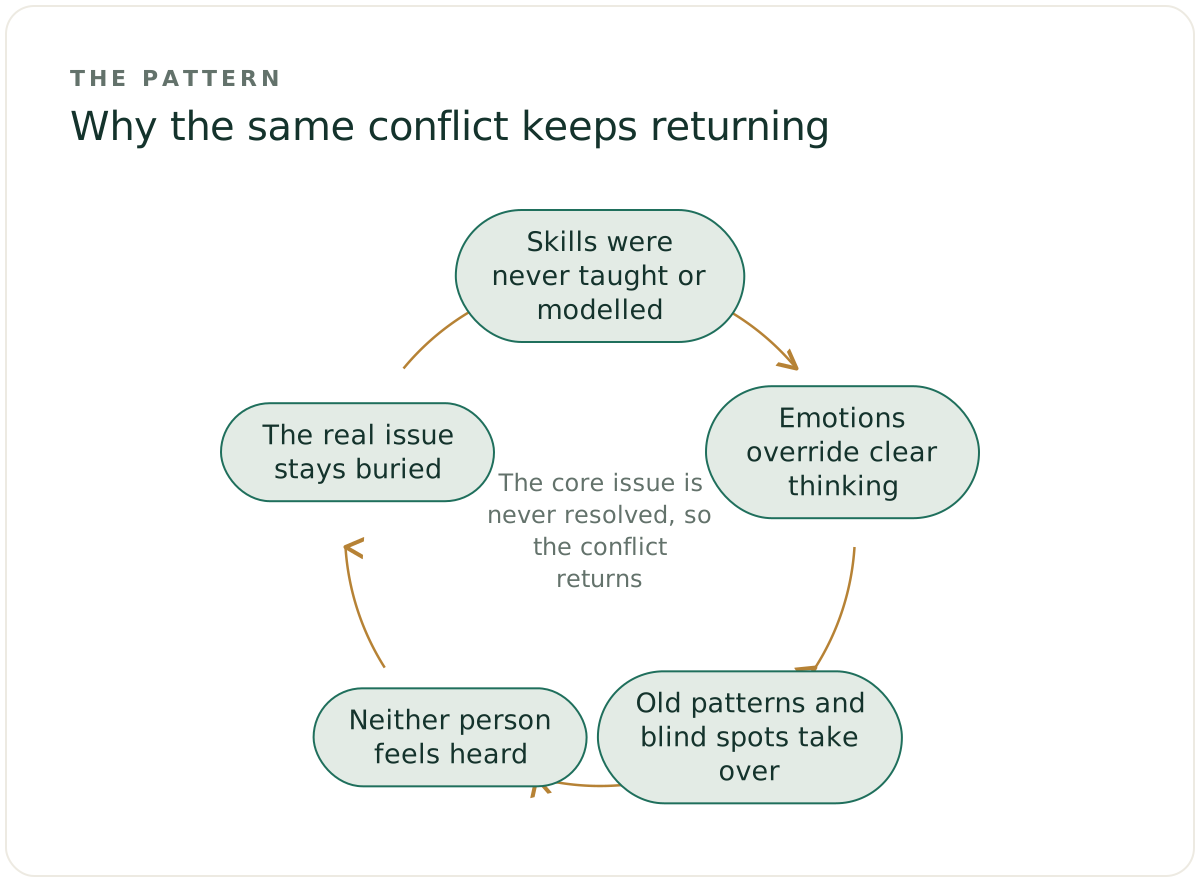
Each loop through the cycle leaves the real issue exactly where it was, so it resurfaces at the next trigger. The pattern does not break on its own, because the very thing that would break it, a way to slow down, get past the blind spots, and name the real issue, is the thing the cycle keeps you from reaching.
Why people turn to therapy
This is precisely why counselling and therapy exist, and why they work. A good therapist provides the things a conflict on its own cannot: a neutral third perspective that is not caught inside your side of it, a calm and structured space that keeps emotions from taking over, and the skills you were never taught, named and practised. They help surface the real issue under the noise and give both people a way to actually be heard.
The catch is access. Therapy is expensive, often involves waiting lists, and tends to be reserved, understandably, for the bigger crises. Most of the conflict in an ordinary life, the recurring argument with a partner, the tension with a sibling, the friend you keep clashing with, never reaches a therapist’s office. It simply gets endured, and repeats.
Where FairTalk fits in
That everyday gap, between struggling alone and booking professional help, is exactly where FairTalk is built to sit. It brings the same core ingredients that make therapy effective to the ordinary conflicts people actually live with, available whenever you need them.
It provides structure, so a conversation that would normally spiral has a shape. It helps de-escalate, giving heated feeling somewhere to go so the thinking brain can come back online. And it works to surface the real issue under the noise and lay out pathways forward, for each person, so you are no longer just looping through the same argument. You can use it together when both people are willing, or on your own when they are not, and it points you to the specific skills worth building through its Knowledge Hub, so the pattern actually changes rather than repeating. For the full picture of how a structured process untangles a conflict, see how to resolve personal conflict.
None of us were taught this properly. The good news is that it can be learned, and you do not have to do it unaided.
When you need more than a tool
Understanding these barriers helps with the ordinary conflicts of life, but some situations call for a person, not a process. If what you are dealing with involves abuse, coercion, or someone with real power over you, or if it is affecting your mental health, that is a moment for professional support rather than working through it alone.
In Australia, Relationships Australia offers counselling and support, and Beyond Blue is there for anyone struggling with their wellbeing. Reaching for that help is a strength, not a failure.
The bottom line
Conflict is hard to resolve on your own for reasons that are not your fault: you were never taught the skills, the home you grew up in shaped your instincts before you could choose them, your personality sets a default you did not pick, your thinking brain goes offline under pressure, and you cannot be a neutral judge of a case you are living inside. That is why the same conflicts repeat, and why people turn to therapy when it finally becomes too much. FairTalk exists for everything before that point: the everyday conflicts that deserve structure, a cooler temperature, and a real way forward, without needing a crisis to justify getting help.
Frequently asked questions
Why is conflict so hard to resolve?
Because resolving conflict well is a skill almost no one was taught. Schools do not cover it, so our instincts come from how conflict was handled at home, which for many people meant avoidance, explosions, or issues that were never resolved at all. On top of that, stress hormones take the calm, reasoning part of the brain offline exactly when a conflict heats up, and from inside your own perspective you have blind spots you cannot see. The result is that the real issue gets buried and the argument repeats, not because you are incapable, but because the underlying skills were never built.
Why do I keep having the same argument with the same person?
Because the underlying issue never actually gets resolved, so it resurfaces at the next trigger. In the heat of the moment the real problem gets buried under old grievances and defensiveness, the same unhelpful patterns run every time, one person pursuing while the other withdraws, criticism meeting defence, and nobody quite feels heard. Since the skills to break that cycle were never learned, the loop simply repeats. Changing it usually requires slowing the conversation down, getting past your own blind spots, and naming the real issue underneath, which is very hard to do unaided in the moment.
Why can’t I stay calm during conflict?
Because your body responds to a threatening conflict as genuine danger and floods you with stress hormones. As your heart rate climbs past a certain point, the parts of your brain responsible for calm reasoning and careful language lose out to the fight-or-flight response. This is a physiological reality, not a lack of willpower, which is why you can be perfectly clear about an argument afterwards but unable to access that clarity in the moment. The most reliable fix is to lower the temperature first, through a pause or a structured process, so your thinking brain can come back online before you try to resolve anything.
Do I need therapy to resolve conflict?
Not for most everyday conflict. Therapy is invaluable for serious or deep-rooted difficulties, and for anything involving abuse, coercion, or your mental health it is the right choice. But a great deal of ordinary conflict, the recurring argument, the persistent tension with someone you care about, sits below that threshold and rarely reaches a therapist’s office. For those, a structured tool like FairTalk brings the same core ingredients, a neutral structure, de-escalation, and a clear way forward, to the everyday conflicts people actually live with, whether you use it together or on your own.