Defensiveness is the reflex to protect yourself when you feel criticised: making excuses, explaining, or turning the complaint back on the other person. It feels like self-defence, but it tells them their concern does not count. You stop being defensive by noticing the reflex, pausing before you reply, and owning even a small part of the problem first.
Everyone gets defensive sometimes. It is one of the most natural reactions there is, and one of the most damaging habits in a relationship, because it turns a solvable complaint into an argument about who is to blame. This guide covers what defensiveness looks like, why it happens, why it makes things worse, and practical ways to respond differently, including what to do when you think the criticism is unfair.
What defensiveness looks like
The Gottman Institute, in its guide to defensiveness, describes it as self-protection in the form of righteous indignation or innocent victimhood, used to ward off a perceived attack. In everyday life it tends to take a few familiar forms:
- Excuses. “I was flat out all day. When was I supposed to do it?”
- The counter-complaint. “Well, you forgot the bins last week.”
- Yes, but. Agreeing for half a sentence, then explaining why it was not really your fault.
- Innocent victim. “I can’t do anything right, can I?”
- Correcting the details. Arguing about whether it was Tuesday or Wednesday instead of hearing the point.
- Repeating yourself louder. Restating your side as if the other person simply has not understood it.
Each of these sends the same message, which the Gottman Institute sums up as “The problem isn’t me, it’s you.”
Why we get defensive
Defensiveness is not a character flaw. It is a protective reflex, and it usually kicks in for a few reasons:
- It feels like an attack. When a concern arrives as criticism, “you never” or “you always”, the natural response is to defend yourself.
- Your body goes into threat mode. A raised voice or a sharp tone can set off the same fight response the body uses for physical danger, which makes careful listening much harder. Our guide to the science of conflict explains why.
- Shame. Being told you have let someone down can feel like being told you are a bad person. Defending yourself keeps that feeling at bay.
- Old experience. If you grew up being blamed for things, any complaint can feel like the start of the same old pattern.
- Fear of being the only one at fault. Admitting your part can feel like accepting all the blame, so it seems safer to admit none.
Why defensiveness makes things worse
The trouble with defensiveness is that it rarely works. The other person does not feel heard, so they push harder, which makes you defend harder. The Gottman Institute counts defensiveness among the Four Horsemen, the patterns its research links most closely to relationships breaking down, and notes that it is almost always present when a relationship is struggling.
Meanwhile, the original issue, the forgotten bill or the late pick-up, never actually gets solved, because the conversation has become about who is to blame instead.
How to stop being defensive
You will not stop feeling the urge to defend yourself. The skill is noticing it and choosing a different first response.
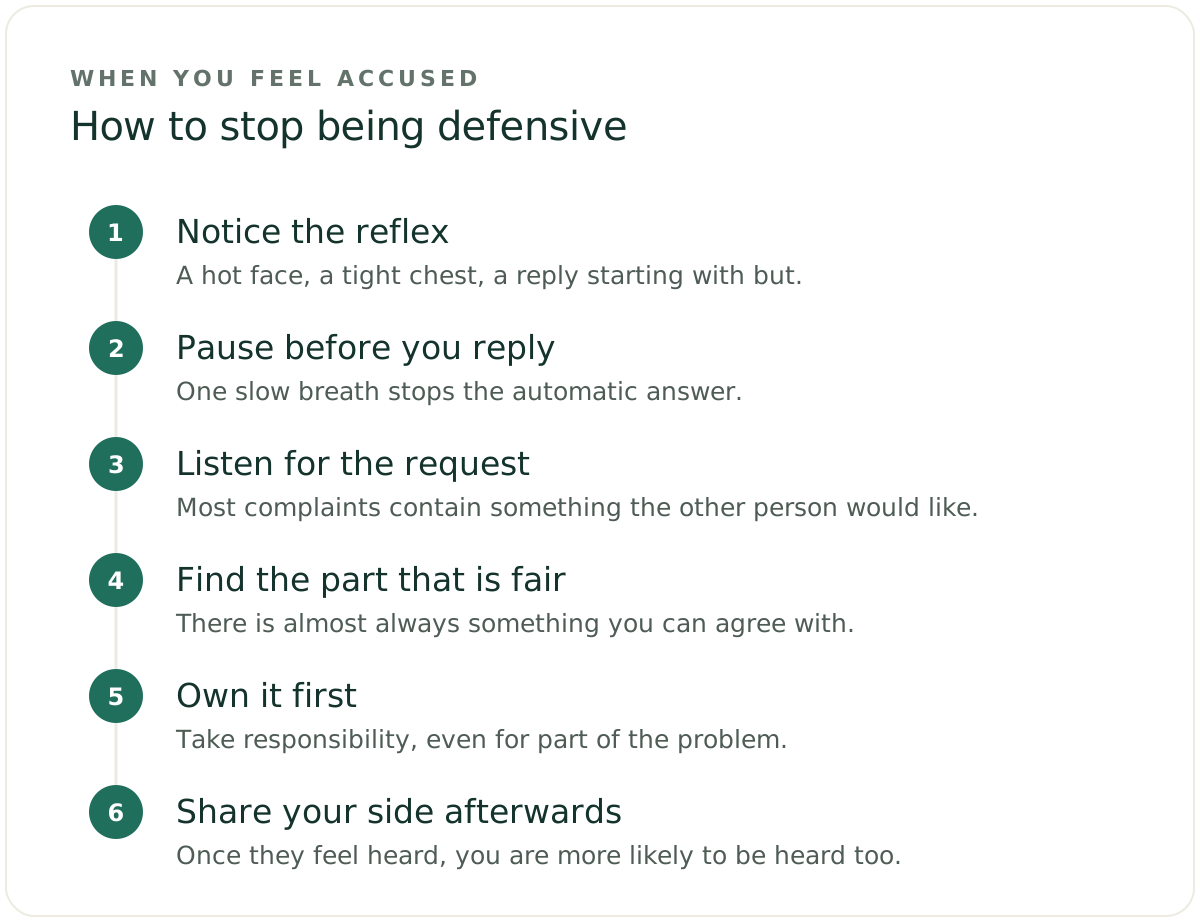
- Notice the reflex. Watch for the tell-tale signs: a hot face, a tight chest, a reply starting with “but” or “that’s not true”.
- Pause before you reply. One slow breath is enough to stop the automatic answer. If you are too worked up, ask for a short break.
- Listen for the request. Most complaints contain a request. “You never call when you’re running late” usually means “I’d like a text when you’re running late.”
- Find the part that is fair. There is almost always something you can agree with, even if it is small.
- Own it first. The Gottman Institute’s antidote to defensiveness is to take responsibility, even for part of the problem: “You’re right, I did forget. I’m sorry.”
- Share your side afterwards. Once the other person feels heard, your explanation is far more likely to be heard too.
Here is how that sounds in practice:
| Defensive reply | Non-defensive reply |
|---|---|
| ”I was busy. Why didn’t you do it?" | "You’re right, I said I’d do it and I didn’t. Sorry." |
| "You’re always on my case." | "I can hear you’re frustrated. What would help?" |
| "That’s not what happened." | "That’s not how I remember it, but I can see why it upset you." |
| "Well, you forgot last week." | "Fair point. Can we work out a system so neither of us forgets?” |
Owning your part often comes with an apology, and our guide to how to apologise properly covers how to make one that lands.
What if the criticism is unfair?
Sometimes it is. Being non-defensive does not mean accepting every accusation. It means responding to the feeling first and the facts second. You can say, “I can see why that upset you. I see part of it differently. Can I explain?” That acknowledges the other person without pretending you agree with everything, and it keeps the conversation going instead of shutting it down.
When your partner is the defensive one
If your partner gets defensive whenever you raise something, how you start matters a lot. Raise a specific complaint rather than a sweeping criticism, describe how it affects you, and ask for something concrete: “I felt worried when I didn’t hear from you last night. Could you text me if you’re running late?” Our fair fighting rules cover how to start gently, and why it makes defensiveness much less likely.
When it is not defensiveness
Defending yourself is reasonable when you are being blamed for everything, constantly criticised, or made to feel afraid. That is not a communication problem to fix with a better reply. If you feel afraid of your partner, or they control your money, contacts or decisions, contact 1800RESPECT on 1800 737 732 for confidential support, or 000 in an emergency.
Where FairTalk fits in
Defensiveness is hardest to manage in the moment, when you feel accused and want to reply straight away. FairTalk gives both people the same space to be heard, which takes some of the heat out of it. You talk the issue through together while FairTalk listens without taking sides, and either of you can pause if it gets heated. Afterwards, you both get a fair picture of each other’s perspective and a clear pathway forward you have shaped together, along with guidance on the communication skills each of you could build.
If you are not ready to talk it through together yet, the solo session feature lets you work through your own side first. FairTalk is for adults, it is not therapy, and it is not suitable where there is abuse, coercion or a power imbalance.
Frequently asked questions
What is defensiveness in a relationship?
Defensiveness is protecting yourself when you feel criticised, usually by making excuses, explaining, correcting the details or turning the complaint back on your partner. The Gottman Institute describes it as self-protection through righteous indignation or innocent victimhood. It is one of the Four Horsemen, the patterns most linked to relationships breaking down.
Why do I get so defensive?
Usually because a complaint feels like an attack. Criticism can trigger the body’s threat response, stir up shame, or echo old experiences of being blamed, and defending yourself feels like protection. Noticing which of these is behind your reaction makes it easier to respond differently.
How do I stop being defensive?
Notice the reflex, pause before you reply, and listen for the request inside the complaint. Find the part of it that is fair and own that first, for example “You’re right, I did forget. Sorry.” Share your side afterwards, once the other person feels heard.
What is the antidote to defensiveness?
The Gottman Institute’s antidote to defensiveness is taking responsibility, even for just part of the problem. Acknowledging what is fair in a complaint, and apologising where it fits, breaks the cycle of attack and defence and lets the actual issue be solved.
How do you talk to a defensive partner?
Start gently. Raise a specific complaint rather than a sweeping criticism, say how it affects you, and ask for something concrete instead of listing what they did wrong. Choosing a calm moment, and acknowledging their side too, makes it far less likely they will feel the need to defend themselves.