
Resentment in a relationship is the lasting bitterness that builds when you feel repeatedly treated unfairly, unheard or taken for granted, and the issue never gets resolved. It is usually a signal of an unmet need. You let it go by naming that need, raising it calmly, agreeing what will change, and then deciding what you can genuinely release.
Resentment rarely arrives all at once. It accumulates, one unspoken frustration at a time, until small things start to feel enormous and affection gets harder to find. The good news is that it is one of the most fixable problems in a relationship, once it is brought into the open. This guide covers what resentment is, the signs it is building, where it comes from, what it is usually telling you, and how to let it go.
What resentment is, and how it differs from anger
Anger is usually immediate: something happens, you feel it, and it passes. Resentment is anger that has not been resolved, replayed and stored over time. The word itself comes from the French for “to feel again”, which is exactly what resentment does. Each new incident brings the old ones back with it.
That is why a resentful argument about the dishes is rarely about the dishes. It is about every other time you felt the load was unfair, and the sense that nothing you say changes it.
Signs resentment is building
Resentment can be quiet, so it helps to know what it looks like:
- You keep a mental tally of who does what, and it never balances.
- Small habits that used to be harmless now really irritate you.
- You find yourself using “always” and “never” about your partner.
- You hold back affection, or feel less like being close.
- Sarcasm, eye-rolling or pointed comments slip out.
- You rehearse arguments in your head that you never actually have.
- When something good happens, part of you still feels hard done by.
If several of these sound familiar, something important has probably gone unsaid for a while.
Where resentment comes from
Most resentment grows from a handful of patterns:
- An unequal load. Housework, the mental load of planning and remembering, money, or caring for children or parents, where one person consistently feels they carry more. Our guide to common relationship problems covers how to talk about the load.
- Expectations that were never said. Feeling let down by something you never actually asked for.
- Saying yes when you meant no. Agreeing to keep the peace, then resenting the cost. The Gottman Institute’s article on people-pleasing describes giving out of obligation and guilt rather than generosity as a common source of hidden resentment.
- A hurt that was never repaired. Something said or done that was never acknowledged or apologised for.
- Feeling unheard. Raising something, being dismissed, and quietly deciding it is not worth trying again.
- Compromise that only goes one way. One person keeps giving ground, and the other may not even notice.
Silence is the common thread. A Gottman Institute article on holding onto resentment puts it well: resentment blossoms in silences and can build quickly, and it fades in the face of open communication.
What resentment is telling you
Resentment is uncomfortable, but it is useful. It is a signal that a need is not being met. The same Gottman Institute article on people-pleasing suggests a simple question when resentment shows up: what unmet need is this feeling drawing your attention to?
| When you resent… | The need underneath might be… |
|---|---|
| Doing most of the housework | Fairness, and to be seen as a partner, not staff |
| Always being the one to plan | Shared responsibility, and a break from carrying it all |
| Your partner’s time on their phone or with friends | Connection, and to feel you matter |
| Always visiting their family | Balance, and for your own family to count too |
| Being interrupted or talked over | Respect, and to be heard |
| An old hurt that was never acknowledged | Acknowledgement, and repair |
Naming the need changes the conversation. “You never help” invites a defence. “I need this to feel more shared” invites a solution.
How to let go of resentment
Letting go is not the same as pretending it never happened. It means dealing with what can be fixed, and then choosing to release what cannot.
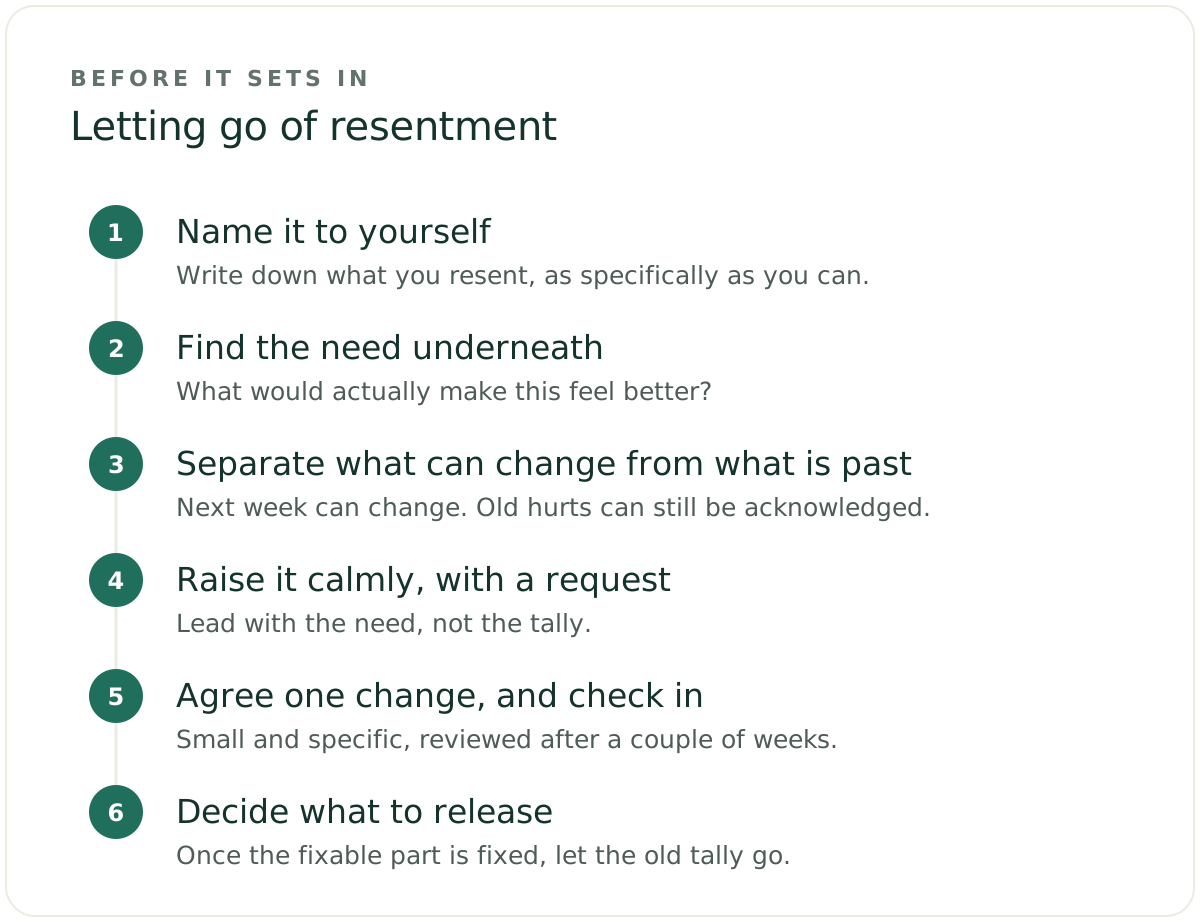
- Name it to yourself. Write down what you resent, as specifically as you can. Vague bitterness is hard to fix.
- Find the need underneath. Use the question above. What would actually make this feel better?
- Separate what can change from what is past. Next week’s chores can change. Something said three years ago cannot, though it can still be acknowledged.
- Raise it calmly, with a specific request. Pick a calm moment and lead with the need, not the tally: “I’ve been feeling resentful about how the housework is split, and I don’t want to. Can we sit down and divide it differently?”
- Agree one change, and check in. Something small and specific, reviewed after a couple of weeks, rebuilds trust faster than a big promise.
- Decide what to release. Once the fixable part is fixed, choose to let the old tally go. Our guide to how to forgive someone explains what forgiveness is, and what it is not.
An example
Priya has been quietly resentful for months. Every weeknight she cooks, cleans up and gets the kids to bed, while Tom, who works late, says he is too tired to help. By the time she raises it, it comes out as “You never do anything around here”, and Tom, who feels he works hard too, defends himself. Nothing changes.
Using the steps, Priya first writes down what she actually resents: not Tom, but feeling like the only adult on weeknights. The need underneath is shared responsibility, and some evenings off. She raises it on a Saturday morning: “I’ve been feeling resentful about weeknights, and I don’t want to feel that way about us. Could you take two nights a week, even if it’s later?” Tom, who had not realised how she felt, agrees to Tuesdays and Thursdays. Two weeks later they check in. It is not perfect, but the tally has stopped growing, and Priya finds it easier to let the old frustration go.
If resentment has been building for a long time, you may notice it leaking out as sarcasm and sighs rather than words, a pattern our guide to passive-aggressive behaviour explains.
When your partner resents you
Hearing that someone resents you is hard, and the instinct is to defend yourself. Try to listen first. Ask what it has been like for them, acknowledge the parts that are fair, and ask what would help. You do not have to agree with every part of their account to recognise that they have been carrying something. Something as simple as “I didn’t realise it felt like that. Tell me more” gives them room to say the rest, and shows you are on the same side. Then, together, agree one practical thing that will change. One honest conversation can release a surprising amount. Our guide to resolving personal conflict covers the wider principles.
When letting go is not the answer
Sometimes resentment is a reasonable response to something that should not continue. If your partner controls your money, contacts or decisions, puts you down, threatens you, or makes you afraid, the goal is not to let it go. It is to get support. Contact 1800RESPECT on 1800 737 732 for confidential support, or 000 in an emergency.
Where FairTalk fits in
Resentment grows in the conversations that never happen. FairTalk gives those conversations a fair setting, so the issue can be raised before it hardens. You talk the issue through together while FairTalk listens without taking sides, and either of you can pause if it gets heated. Afterwards, you both get a fair picture of each other’s perspective and a clear pathway forward you have shaped together, along with guidance on the communication skills each of you could build.
If you are not ready to raise it yet, the solo session feature lets you work through your own side first, so you can find the need underneath your resentment before you talk. FairTalk is for adults, it is not therapy, and it is not suitable where there is abuse, coercion or a power imbalance.
Frequently asked questions
What causes resentment in a relationship?
Resentment usually comes from feeling repeatedly treated unfairly, unheard or taken for granted, without the issue being resolved. Common causes are an unequal share of housework or responsibility, expectations that were never said, saying yes when you meant no, a hurt that was never repaired, and compromise that only goes one way.
Can a relationship survive resentment?
Yes, in most cases, as long as the resentment is brought into the open. Resentment points to an unmet need, and once that need is named and something specific changes, it usually eases. It is harder when resentment has been building for years or one person refuses to engage, and a couples counsellor can help then.
How do I stop resenting my partner?
Name what you resent, find the need underneath it, and raise it calmly with a specific request rather than a list of grievances. Agree one small change and check in after a couple of weeks. Once the fixable part is dealt with, make a deliberate choice to let the old tally go.
Is resentment the same as anger?
No. Anger is usually an immediate reaction that passes. Resentment is anger that has not been resolved and keeps being felt again over time, often building with each new incident. That is why resentful arguments tend to be about much more than the issue in front of you.
What should I do if my partner resents me?
Listen before you defend yourself. Ask what it has been like for them, acknowledge the parts that are fair, and ask what would help. Recognising that they have been carrying something, even if you see parts of it differently, often eases resentment more than any argument about the facts.